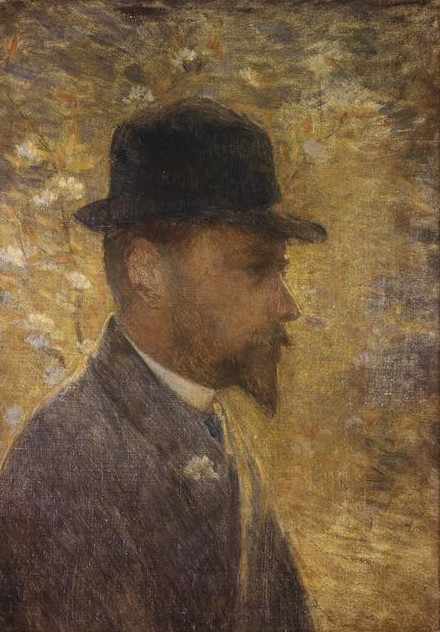
Why Henri Le Sidaner matters
Henri Le Sidaner is a bridge figure between Impressionism and the more hushed, symbol-laden painting that followed it, best known for twilight gardens and empty moonlit streets rendered in soft, broken color. He built an internationally exhibited career that ran from the Paris Salons of the 1880s to the presidency of the Academie des Beaux-Arts, and his market today mixes broad, steady liquidity with a small number of seven-figure results for his best Venice and garden subjects.
- Born
- 1862-08-07, Port-Louis, Mauritius
- Nationality
- French
- Media
- Painting, Printmaking
- Movement
- Post-Impressionism, Intimism
- Education
- Ecole nationale superieure des Beaux-Arts, Paris, under Alexandre Cabanel, circa 1882 to 1885 (no degree conferred); earlier atelier study in Dunkirk under Alexandre Desmit and Alphonse Chigot
- Signature motifs
- Twilight and nocturnal garden scenes, Empty moonlit streets and squares, Gerberoy garden views
By the numbers
- EUR 1,695,320Auction highLa Serenade, Venise, Christie's Paris, 20 October 2022; a higher, unconfirmed result near USD 2.1M is referenced by some market databases
- 1862BornPort-Louis, Mauritius
- 1939DiedParis or Versailles, France, age 76 (sources vary)
- President, 1937Academie des Beaux-ArtsElected member 1930
Selected works
Click any work to view it full screen.
Biography
Henri le Sidaner was born on 7 August 1862 in Port-Louis, Mauritius, to a French family that returned to France in 1872, settling in Dunkirk, where he attended the Lycee Notre Dame des Dunes and took early art lessons in the atelier of Alexandre Desmit and later Alphonse Chigot. Around 1882 he moved to Paris and entered the Ecole nationale superieure des Beaux-Arts under Alexandre Cabanel, but he found the academic studio confining and left within a few years, settling instead in the artists' colony at Etaples in 1885.
He debuted at the Salon des Artistes Francais in 1887 and won a bronze medal there in 1891. His first one-man show, held in 1897, brought wide critical notice and led to further solo exhibitions in London and Brussels. He settled at Gerberoy, a small village in Picardy, where he developed the terraced garden that became a recurring subject in his late paintings. France recognized him as Chevalier of the Legion d'honneur in 1908 and Officier in 1913. His international standing grew through the 1910s and 1920s: an entire room was devoted to his work at the 1914 Venice Biennale, he served on and exhibited with the Carnegie Institute in Pittsburgh across 1910, 1912, 1921, and 1925, winning the First Carnegie Prize in 1925 for Window on the Bay, and his work traveled through the United States in a 1929 exhibition. He was elected to the Academie des Beaux-Arts in 1930 and became its president in 1937.
Henri le Sidaner died in 1939, reportedly of a heart attack. Sources disagree on both the exact day, 14 or 16 July, and the city, Paris or Versailles are both given, and his grave is recorded at the cimetiere Saint-Louis in Gerberoy.
Critical reception
Le Sidaner was read in his own time as a painter of atmosphere rather than incident. Paul Signac's characterization of the work, preserved in Yann Farinaux-Le Sidaner's 1989 catalogue raisonne, describes an artist "influenced by a taste for tender, soft and silent atmospheres" who went so far "as to eliminate figures, as if he feared that the slightest human form might disturb their muffled silence." An unnamed critic reviewing the 1906 Salon, quoted in Christie's own lot essay for La Serenade, Venise, wrote that Le Sidaner "shows the true Venice, the familiar Venice, Venice true to life and lost in a dream." Later commentators, including at Hirschl & Adler and the Museo Thyssen, have grouped him among the Intimists and noted the frequent comparison of his paintings to the mood of Debussy's music, a comparison tied to his emphasis on twilight, mist, and quiet over narrative content.
Market
Le Sidaner's best-documented auction result is La Serenade, Venise, a large Venetian canvas sold for EUR 1,695,320 at Christie's Paris on 20 October 2022, a price in the range of USD 1.66 million at contemporary exchange rates. Market databases such as MutualArt also reference a Le Sidaner painting realizing up to USD 2.1 million, but the title, house, and sale date behind that figure could not be independently confirmed, so it is not treated here as the confirmed record. His market is otherwise broad rather than deep: Artprice records roughly 1,793 auction appearances for the artist, and results below the top tier are common. A more recent Christie's London sale on 6 March 2026, of the smaller, later canvas Le Boulevard du Roi (1930), realized GBP 254,000 (about USD 339,400), illustrating the wide spread between his best Venice and garden subjects and his more modest later work.
Top auction results
| Work | Price | Sale |
|---|---|---|
| La Serenade, Venise | USD 1,660,000 (EUR 1,695,320) | Christie's, Paris, 2022-10-20 |
| Le Boulevard du Roi (1930) (1930) | USD 339,400 (GBP 254,000) | Christie's, London, 2026-03-06 |
Selected exhibitions
| Years | Exhibition | Venues |
|---|---|---|
| 1897 | First one-man exhibition | Galerie Georges Petit / Galerie Mancini, Paris |
| 1914 | 57th Venice Biennale precursor edition | Venice Biennale (entire room devoted to his work) |
| 1921 | Exhibition | Carnegie Institute, Pittsburgh |
| 1924 | Exhibition | Musee des Beaux-Arts de Rouen |
| 1925 | Carnegie International (first prize, Window on the Bay) | Carnegie Institute, Pittsburgh |
| 1929 | Traveling exhibition | United States (multiple venues) |
| 1933 to 1939 | Private exhibitions | Galerie Charpentier, Paris |
| 1948 | Retrospective (posthumous) | Musee Galliera, Paris |
Museum collections
- Musee d'Orsay, Paris
- National Gallery of Art, Washington, D.C.
- Tate, London
- Art Institute of Chicago
- Carnegie Museum of Art, Pittsburgh
- Musee de la Chartreuse, Douai
Awards and honors
- Bronze medal, Salon des Artistes Francais (1891)
- Bronze medal, Exposition Universelle, Paris (1900)
- Chevalier, Legion d'honneur (1908)
- Officier, Legion d'honneur (1913)
- First Carnegie Prize, Carnegie Institute, Pittsburgh (1925)
- Elected member, Academie des Beaux-Arts (1930)
- President, Academie des Beaux-Arts (1937)
Authentication and provenance
No catalogue raisonne.
No catalogue raisonne could be independently confirmed. A 1989 volume by Yann Farinaux-Le Sidaner, Le Sidaner, L'Oeuvre Peint et Grave (Editions Andre Sauret), is cited by some dealers as documenting the painted and graphic work, but this has not been independently verified. No certificate-of-authenticity program has been identified. Works are generally authenticated through provenance and consistency with known exhibition and sale history.
Primary reference: https://www.sothebys.com/en/artists/henri-le-sidaner
What collectors should know
A 1989 volume by Yann Farinaux-Le Sidaner, cited by some dealers as a catalogue raisonne of the painted and graphic work, could not be independently confirmed in this review; provenance and consistency with known exhibition and sale history remain the strongest support for a work's status. No current exclusive gallery or estate representation has been identified; secondary-market activity runs through the major auction houses and specialist dealers such as Hirschl & Adler Galleries and Mark Murray Fine Paintings rather than a single representing gallery. Because the market is broad but uneven, with roughly 1,793 recorded auction appearances against a single fully documented seven-figure result, collectors should weigh subject matter, size, and period carefully: Venice and Gerberoy garden scenes from his mature period have driven the top prices, while smaller or later works trade well below that level.
Further reading and resources
Data current as of 2026-07-09.

