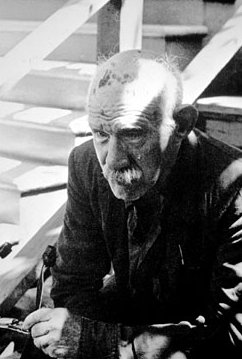
Why Henry Darger matters
Henry Darger is the artist most often cited as the definitive case of outsider art reaching the museum canon. A reclusive Chicago janitor and hospital worker with no formal art training, he spent more than six decades secretly producing an epic illustrated novel and hundreds of large-scale drawings and watercolors that were discovered only after his apartment was cleared in 1972, shortly before his death. For a collector, Darger is a study in posthumous market formation: a single, tightly held estate, a body of work concentrated overwhelmingly in museum collections, and a public auction record built from a very small number of sales.
- Born
- 1892-04-12, Chicago, USA
- Nationality
- American
- Media
- Drawing, Watercolor, Mixed-media collage
- Movement
- Outsider art
- Education
- No secondary, university, or art-school education is documented. Elementary schooling only, at Catholic and public grade schools in Chicago (including Skinner Elementary) and, from 1904, compulsory schooling within the Illinois Asylum for Feeble-Minded Children in Lincoln, Illinois.
- Signature motifs
- Vivian Girls narrative, Traced and collaged figures, Panoramic battle scenes
- Representation
- Andrew Edlin Gallery, New York (estate representation)
By the numbers
- EUR 601,500 (approx. USD 745,000)Auction highChristie's Paris, 2014; exact catalogue title unconfirmed in public sale records
- Largest public repositoryMuseum standingAmerican Folk Art Museum, New York
- Andrew Edlin GalleryRepresented byEstate representation (New York)
- Outsider artClassificationSelf-taught; work discovered in his apartment in 1972
Selected works
Click any work to view it full screen.
Biography
Henry Joseph Darger Jr. was born on April 12, 1892, at 350 W. 24th Street in Chicago. His father taught him to read as a child, and he was reportedly advanced directly from first grade to third grade because of his reading ability. He attended Catholic grade schools and later, while living at the Mission of Our Lady of Mercy, public elementary school, including Skinner Elementary in Chicago. In November 1904, following a clinical examination, he was institutionalized at the Illinois Asylum for Feeble-Minded Children in Lincoln, Illinois, where he was made to attend the asylum's school program. He ran away from the asylum at about age 17 and returned to Chicago, where he spent most of his working life as a janitor, dishwasher, and hospital worker, retiring in 1963.
Alone in his small apartment, Darger produced The Story of the Vivian Girls, in what is known as the Realms of the Unreal, of the Glandeco-Angelininian War Storm, Caused by the Child Slave Rebellion, an illustrated novel of more than 15,000 single-spaced typewritten pages accompanied by over 300 large-scale drawings and watercolors, plus journals, an autobiography, and bundled scrapbooks. His landlords, Nathan and Kiyoko Lerner, discovered this body of work in 1972 while clearing his apartment shortly before his death. Darger died on April 13, 1973, one day after his 81st birthday, at a nursing home in Chicago, and was buried in a pauper's grave at All Saints Cemetery in Des Plaines, Illinois.
Critical reception
The American Folk Art Museum describes itself as home to the single largest public repository of Darger's work, and it has staged repeated exhibitions dedicated to him, including in 1997, 2010, and 2017 to 2018. Intuit Art Museum in Chicago maintains a permanent reconstruction of his living and working space and organized a retrospective in 2003. His work has also been shown at the Hara Museum of Contemporary Art in Tokyo (2007) and at the Musee d'Art Moderne de la Ville de Paris (2015), and it was included in Klaus Biesenbach's Disasters of War exhibition at MoMA PS1 in 2000, a pairing with Goya that placed Darger inside a contemporary-art conversation rather than a folk-art one alone. Across museum and market writing, the consistent framing is that Darger's obsessive, self-taught practice, built from traced and collaged found imagery reworked into a vast invented war narrative, now sits among the central reference points for twentieth-century outsider art.
Market
Following Nathan Lerner's death, his widow Kiyoko Lerner managed the estate, and Andrew Edlin Gallery in New York is recognized as the primary gallery handling Darger's work on the market. The all-time public auction record is EUR 601,500 (approximately USD 745,000) for a large illustration from the Vivian Girls cycle, sold at Christie's Paris in 2014; the exact sale date and catalogue title of the work are not confirmed in the public summaries available. Reporting has cited private-sale prices as high as USD 800,000, but these are private transactions rather than auction results and do not supersede the 2014 public record. Public auction supply is thin because the great majority of Darger's major works remain either in museum collections or with the estate.
Top auction results
| Work | Price | Sale |
|---|---|---|
| Untitled illustration, Vivian Girls cycle (exact catalogue title unconfirmed) (2014) | USD 745,107 (EUR 601,500) | Christie's, Paris |
Selected exhibitions
| Years | Exhibition | Venues |
|---|---|---|
| 1996 to 1997 | The Unreality of Being | University of Iowa Museum of Art, Iowa City; Museum of American Folk Art, New York |
| 1997 | Henry Darger | American Folk Art Museum, New York |
| 2000 | Disasters of War | MoMA PS1, New York (curated by Klaus Biesenbach) |
| 2003 | Henry Darger retrospective | Intuit: The Center for Intuitive and Outsider Art, Chicago |
| 2007 | Henry Darger | Hara Museum of Contemporary Art, Tokyo |
| 2010 | Henry Darger retrospective | American Folk Art Museum, New York |
| 2015 | Henry Darger (1892 to 1973) | Musee d'Art Moderne de la Ville de Paris, Paris |
| 2017 to 2018 | Up Close: Henry Darger | American Folk Art Museum, New York |
Museum collections
- Museum of Modern Art, New York
- American Folk Art Museum, New York
- Collection de l'Art Brut, Lausanne
- Art Institute of Chicago
- Museum of Contemporary Art Chicago
- Milwaukee Art Museum
- New Orleans Museum of Art
- Smithsonian American Art Museum, Washington, D.C.
- Walker Art Center, Minneapolis
- Whitney Museum of American Art, New York
- Intuit Art Museum, Chicago
Authentication and provenance
No catalogue raisonne.
No published catalogue raisonne exists for Darger. Provenance and attribution rest on the estate, managed by Kiyoko Lerner and represented in the market by Andrew Edlin Gallery, together with the archives held by the American Folk Art Museum and Intuit Art Museum, which include his room, working materials, and papers.
Primary reference: https://www.edlingallery.com/artists/henry-darger
What collectors should know
There is no catalogue raisonne for Darger, and attribution and provenance depend on the estate's records, Andrew Edlin Gallery, and the archival holdings of the American Folk Art Museum and Intuit Art Museum. The public auction record is thin, a single well-documented high sale from 2014 in Paris, so any comparison of prices across works should account for how few transactions exist. Darger's childhood institutionalization at an asylum for children then classified as "feeble-minded" is a documented part of the public record and is presented here factually rather than as narrative color; it does not carry any diagnosis established by a reliable source.
Further reading and resources
Data current as of 2026-07-10.

