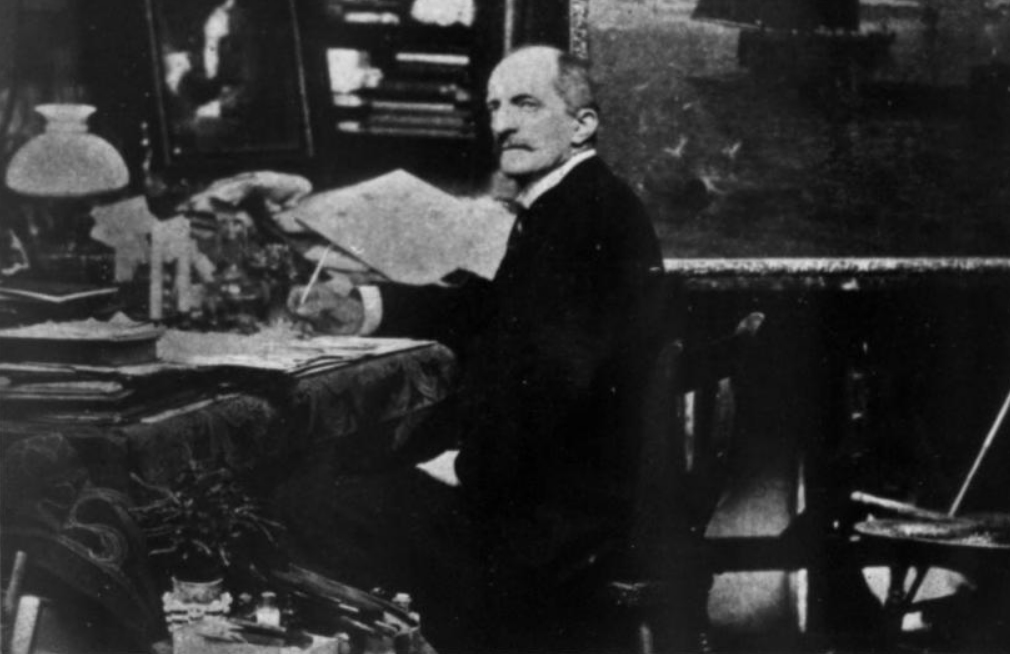
Why Horace van Ruith matters
Horace van Ruith is a minor but recurring name in the market for nineteenth-century Orientalist and Anglo-Indian painting. Trained in Germany and active for a time in Bombay, he built a body of portraits and Indian scenes that, more than a century after his death, has drawn renewed collector attention, anchored by a fully documented watercolour sale in the mid five figures and an unverified aggregator report of a much higher price for at least one painting.
- Nationality
- British
- Media
- Painting, Watercolour
- Movement
- Orientalism, Academic art
- Education
- Studied at art schools in Stuttgart and Munich, Germany; no degree, diploma, or exact enrollment years documented
- Signature motifs
- Orientalist scenes of Bombay, Portraiture
By the numbers
- USD 27,600Auction high (confirmed)Untitled watercolour, Saffronart, 6 April 2022; a higher, unverified figure of about USD 384,500 for a painting is reported by aggregator MutualArt without a confirmed work, house, or date
- c. 1879 to 1886Active in IndiaStudio in Bombay, later returned to London
- 4 institutionsPublic collectionsBritish Library, V&A, Royal College of Music, Asian Art Museum
- No confirmed gallery or estate representationRepresented by
Biography
Horace van Ruith was born in 1839, though one source gives 1840, and his birthplace is disputed: one source cites Saint Petersburg, Russia, another cites Capri, Italy, and neither claim is independently corroborated. He trained at art schools in Stuttgart and Munich in southern Germany, though no source specifies a degree or exact years of study. He is reported to have moved to Italy around 1870, before later relocating to Bombay, India, by the late 1870s, where accounts place him as active roughly from 1879 to 1886.
He became known for portraits, landscapes, and, above all, Orientalist scenes of daily Indian life, signing some works "Bombay." He exhibited at the Colonial and Indian Exhibition in London in 1886. Around that time he moved to London, where he remained until his death in 1923; only the year of death, not the exact date, is documented in available sources. Reference sites describe an oeuvre of several hundred paintings, watercolors, drawings, and illustrations across his career, though this figure comes from a single source and has not been independently corroborated.
Critical reception
No verbatim, attributable critical assessment of van Ruith from a named critic in a major outlet has been located. Art UK notes that only a small number of his works are held in public collections, with most of his output remaining in private hands, and independent researchers describe him as an artist who fell into relative obscurity after his death before drawing renewed attention through recent auction activity. This picture is descriptive rather than critical, and should be treated as a modest, still-developing market rediscovery rather than an established scholarly reassessment.
Watch
Market
Van Ruith's best fully documented auction result is an untitled watercolour sold at Saffronart on 6 April 2022 for USD 27,600 (INR 2,070,000). Separately, the aggregator MutualArt reports a realized price as high as USD 384,500 for a painting by the artist, but no source in the available record specifies the underlying work, auction house, or sale date for that figure, so it should be treated as an unverified upper bound rather than a confirmed record. Outside these figures, his market is modest and thin: aggregated auction data put realized prices for his paintings generally well under six figures, and prices for his works on paper have topped out closer to the USD 25,000 to 30,000 range. Auction-tracking sites record roughly sixty lots by him over time, most well below even the confirmed watercolour result, so any single high result should be read as an outlier rather than a market baseline.
Top auction results
| Work | Price | Sale |
|---|---|---|
| Untitled (watercolour) (2022) | USD 27,600 (INR 2,070,000) | Saffronart, 2022-04-06 |
Selected exhibitions
| Years | Exhibition | Venues |
|---|---|---|
| 1886 | Colonial and Indian Exhibition | London, UK |
Museum collections
- British Library, London
- Victoria and Albert Museum, London
- Royal College of Music, London
- Asian Art Museum, San Francisco
Authentication and provenance
No catalogue raisonne.
No catalogue raisonne has been identified for Horace van Ruith and no gallery or estate currently manages his authentication. Works are assessed case by case through auction house cataloguing, exhibition history, and museum provenance records.
Primary reference: https://artuk.org/discover/artists/van-ruith-horace-18391923
What collectors should know
Van Ruith is not currently represented by any identified commercial gallery or estate, and no catalogue raisonne exists, so attribution and dating rest on auction house cataloguing, exhibition records, and the handful of museum-held works (British Library, Victoria and Albert Museum, Royal College of Music, and the Asian Art Museum in San Francisco) rather than on a centralized scholarly authority. Basic biographical facts, his exact birthplace, precise nationality, and even his birth year in one source, carry some disagreement across otherwise reliable references, so collectors should treat secondary biographical claims with care and lean on primary auction and museum documentation. Given a thin trading history, any single high result, whether the confirmed 2022 Saffronart sale or the higher, unverified figures reported by market aggregators, should be weighed against the broader run of lower-value sales rather than treated as representative of typical demand.
Further reading and resources
Data current as of 2026-07-11.

