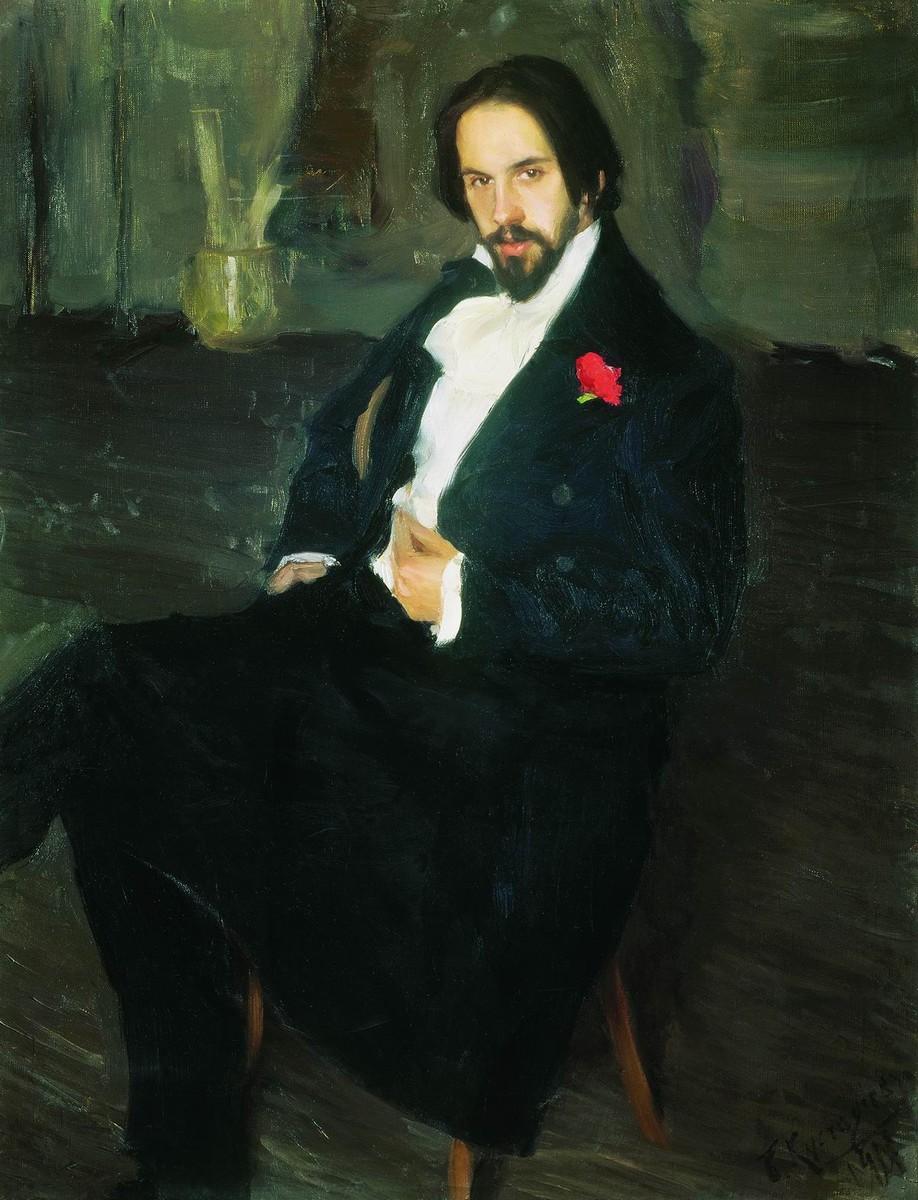
Why Ivan Bilibin matters
Ivan Bilibin is the artist most closely associated with the visual language of Russian fairy tales: firebirds, tsarevnas, and richly bordered folk ornament rendered with the flat decorative line of the lubok print. As a founding-era contributor to the Mir Iskusstva (World of Art) circle, he helped define Russian Art Nouveau book illustration and stage design at the turn of the twentieth century. For collectors, he represents a historical, thin-supply niche of the Russian art market, one whose value rests on scholarly reputation and provenance rather than a contemporary gallery infrastructure.
- Born
- 1876-08-16, Tarkhovka, near Saint Petersburg, Russian Empire
- Nationality
- Russian
- Media
- Book illustration, Watercolor, Stage and costume design
- Movement
- Mir Iskusstva (World of Art), Russian folk art revival
- Education
- First Saint Petersburg Classical Gymnasium, graduated 1896 with a silver medal; law degree, Imperial University of Saint Petersburg, 1900; studied painting under Ilya Repin at Princess Maria Tenisheva's school and the Higher Art School of the Imperial Academy of Arts, Saint Petersburg, 1898 to 1904; also studied briefly at Anton Azbe's art school, Munich, 1898.
- Signature motifs
- Russian fairy tale illustration, Lubok-inspired ornamental line work, "Folkloric imagery (firebird, Baba Yaga)"
By the numbers
- GBP 20,480Auction highThe Fox Hunter, Bonhams, London, November 2023; best documented result, exact sale day unconfirmed
- Deceased, 1942StatusDied during the Siege of Leningrad
- Member from 1900Mir IskusstvaContributor to the group from 1899
- Secondary auction market onlyPrimary marketNo gallery or estate representation confirmed
Selected works
Click any work to view it full screen.
Biography
Ivan Yakovlevich Bilibin was born on 16 August 1876 (4 August, Old Style) near Saint Petersburg. He completed secondary school at the First Saint Petersburg Classical Gymnasium in 1896, graduating with a silver medal, then earned a law degree from the Imperial University of Saint Petersburg in 1900. Alongside his legal studies he trained as an artist, attending the drawing school of the Imperial Society for the Encouragement of the Arts from 1895, studying briefly at Anton Azbe's art school in Munich in 1898, and working under Ilya Repin, first at Princess Maria Tenisheva's school and then at the Higher Art School of the Imperial Academy of Arts, through 1904.
Bilibin became known from 1899 for illustrated editions of Russian fairy tales, work that established his ornamental, folklore-driven style. He joined the Mir Iskusstva group in 1900, aligning him with the era's leading figures in Russian design and stage art, and he went on to work as a theatrical and costume designer as well as an illustrator. In 1937 he became a member of the Artists' Union of the USSR.
Bilibin remained in Leningrad through the German siege of the city in the Second World War. According to Russian cultural and archival sources, he refused evacuation and died of exhaustion on 7 February 1942 in a hospital at the Academy of Arts. A small number of sources cite 8 February 1942 as an alternate date, but the great majority of reference sources, including Russian state cultural institutions, converge on 7 February 1942.
Critical reception
Bilibin is consistently described in reference and museum literature as one of the defining illustrators and stage designers of Russian Art Nouveau, and as a central figure of the Mir Iskusstva circle alongside contemporaries who reshaped Russian book and theater design at the turn of the twentieth century. His fairy tale illustrations, drawing on the lubok print tradition and Slavic folklore, are treated as a foundational visual vocabulary that later Russian and Soviet illustrators worked within or against. No verbatim critical quotation from a named critic in a major outlet could be confirmed for this profile, so none is reproduced here.
Market
The best-documented auction result found for Bilibin is The Fox Hunter, which sold for GBP 20,480 at Bonhams, London, in November 2023; the exact day of sale is not available in the source reviewed for this profile. A higher figure of SEK 4,000,000 for a work titled Crimean Night, View of Oreanda and Aiu-Dagh appears in at least one dealer listing, but that sale could not be independently verified as a completed auction transaction, with no confirmed auction house or date attached to it, so it is not treated as the headline record here. His work otherwise surfaces through Russian-art specialist sales at major auction houses, including Sotheby's and Bonhams. No gallery or estate is documented as currently representing him, which is typical for an artist of his period; his market operates entirely on the secondary, auction side.
Top auction results
| Work | Price | Sale |
|---|---|---|
| The Fox Hunter (2023) | GBP 20,480 | Bonhams, London, 2023-11 |
Selected exhibitions
| Years | Exhibition | Venues |
|---|---|---|
| 1899 to 1904 | Mir Iskusstva group exhibitions | Saint Petersburg |
Authentication and provenance
No catalogue raisonne.
No published catalogue raisonne has been identified for Bilibin. Because many of his best-known book illustrations were mass-reproduced during his lifetime, works are typically authenticated through provenance research and the specialist Russian art departments of major auction houses rather than a certificate program.
Primary reference: https://en.wikipedia.org/wiki/Ivan_Bilibin
What collectors should know
There is no catalogue raisonne for Bilibin, and no confirmed gallery or estate representation, so authentication depends on provenance and the expertise of specialist Russian art departments at auction houses. Buyers should also take care with attribution: his son, Alexander Ivanovich Bilibin (1903 to 1972), was also a working artist, and reference catalogues list the elder Bilibin under both "Ivan Bilibin" and the fuller patronymic form "Ivan Yakovlevich Bilibin." Because many of his fairy tale images were mass-produced as book plates and later reproductions, collectors should distinguish original watercolors, drawings, and decorative-arts commissions from later prints. General reference literature associates his work with major Russian museum holdings, though this profile was not able to independently verify specific institutional accession records.
Further reading and resources
Data current as of 2026-07-16.

