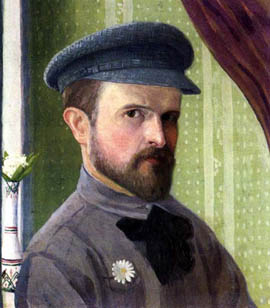
Why Ivan Kliun matters
Ivan Kliun was part of the small founding circle around Kazimir Malevich that pushed Russian painting into pure geometric abstraction, and his work remains one of the clearest records of how Suprematism was built, tested, and argued over in Moscow in the 1910s and 1920s. For collectors, he matters as a name held by major museums and as a market defined by scarcity and historical weight rather than by trading volume.
- Born
- 1873-09-01, Bolshiye Gorki, Vladimir Province, Russia
- Nationality
- Russian
- Media
- Painting, Sculpture, Graphic art
- Movement
- Russian avant-garde, Suprematism
- Education
- Studied in the 1890s at the Society for the Encouragement of the Fine Arts, Warsaw, and in Kiev; moved to Moscow in 1898 and trained in the studios of Fyodor Rerberg, 1902 to 1907, and Ilya Mashkov. No formal academic degree is documented in the available sources.
- Signature motifs
- Suprematist geometric abstraction, Still life
By the numbers
- GBP 220,000Auction highSpherical Suprematism, Sotheby's, London, 1983
- 1873 to 1943LifespanBorn Bolshiye Gorki, Russia; died Moscow, USSR
- MoMA; Thyssen-Bornemisza; State Tretyakov GalleryMuseum collections
- Tramway V (1915); 0.10, The Last Futurist Exhibition (1915 to 1916)Key group exhibitions
Biography
Ivan Kliun was born Ivan Vasilievich Klyunkov on 20 August 1873 (1 September, New Style) in the village of Bolshiye Gorki, Vladimir Province, Russia. He received his initial artistic training in the 1890s, including study at the Society for the Encouragement of the Fine Arts in Warsaw while working as a bookkeeper, and also studied in Kiev. In 1898 he moved to Moscow, where he studied in the studios of Fyodor Rerberg (1902 to 1907) and Ilya Mashkov and attended Anatoly Bolshakov's art school. It was through Rerberg's studio that he met Kazimir Malevich, beginning a working relationship that would shape the rest of his career.
Kliun's paintings were shown in the major Russian Futurist exhibitions of the mid-1910s, including Tramway V in 1915 and 0.10, The Last Futurist Exhibition of Paintings in Petrograd in 1915 to 1916, the exhibition at which Malevich first showed Suprematist canvases. Kliun developed his own geometric, color-based Suprematist vocabulary alongside Malevich before later turning to research on color theory. From 1918 to 1921 he taught color technique at the Higher State Art-Technical Studios (VKhUTEMAS), and from 1920 he was a member of the Institute of Artistic Culture (Inkhuk) in Moscow, later becoming a corresponding member of the State Academy of Art Sciences (GAHN). In 1927 he was appointed director of the central exhibitions office of the Department of Visual Arts of the People's Commissariat for Enlightenment (IZO-Narkompros), an official post within the Soviet cultural administration. As state pressure on abstraction increased, his later work moved toward figuration and still life. He died in Moscow on 13 December 1943, at the age of 70.
Critical reception
Kliun is treated by major museums and scholarship as a central, if historically underappreciated, figure of the Russian avant-garde, valued both for his own Suprematist paintings and for his role beside Malevich in defining non-objective art. The Museum of Modern Art has included him in thematic surveys such as Inventing Abstraction, 1910 to 1925 and The Russian Avant-Garde Book, 1910 to 1934, situating him within the first generation of abstraction rather than as a follower. A 2025 retrospective at the Moscow Museum of Modern Art, Ivan Kliun: Colour Forms, The Artist's Lab, was built around tracing his full arc "from geometric abstraction to realism," underlining that his later, more representational work is now taken as seriously as his Suprematist period. His association with the Costakis collection has also reinforced his market and institutional standing, since many of his most important surviving paintings passed through that collection into public hands.
Market
Kliun's market is thin and dominated by a small number of important historical works rather than steady turnover. The best-documented record price is GBP 220,000, paid at Sotheby's in London in 1983 for Spherical Suprematism, a painting with provenance through the George Costakis collection, the most significant private holding of Russian avant-garde art formed in Soviet Moscow. The same painting was later offered again with a much higher estimate, in the range of GBP 2,500,000 to 3,500,000, though public sources available do not confirm that it sold at that level. Artprice records roughly 422 lots by Kliun across his auction history, but the bulk of these trade far below the 1983 result, typically in the low five figures. Because full modern auction databases are only partially accessible, it is possible a higher price exists in proprietary records, but none is confirmed in the public sources reviewed.
Top auction results
| Work | Price | Sale |
|---|---|---|
| Spherical Suprematism | GBP 220,000 | Sotheby's, London, 1983 |
Selected exhibitions
| Years | Exhibition | Venues |
|---|---|---|
| 1915 | Tramway V | Petrograd (Russian Futurist exhibition) |
| 1915 to 1916 | 0.10: The Last Futurist Exhibition of Paintings | Petrograd |
| 2000 | Making Choices / The Modern Still Life | Museum of Modern Art, New York |
| 2002 | The Russian Avant-Garde Book, 1910 to 1934 | Museum of Modern Art, New York |
| 2012 to 2013 | Inventing Abstraction, 1910 to 1925 | Museum of Modern Art, New York |
| 2025 | Ivan Kliun. Colour Forms. The Artist's Lab | Moscow Museum of Modern Art (MMOMA) |
Museum collections
- Museum of Modern Art, New York
- Museo Nacional Thyssen-Bornemisza, Madrid
- State Tretyakov Gallery, Moscow
- State Museum of Contemporary Art, Thessaloniki (Costakis Collection)
Authentication and provenance
No catalogue raisonne.
No catalogue raisonne has been published for Ivan Kliun. Provenance for his most important works, including Spherical Suprematism, traces through the George Costakis collection of Russian avant-garde art, and collectors should rely on documented exhibition and collection history rather than a single authenticating body.
Primary reference: https://www.britannica.com/biography/Ivan-Vasilyevich-Klyun
What collectors should know
There is no published catalogue raisonne for Ivan Kliun, and current public sources do not identify a gallery or estate that formally represents his work today, so provenance research and documented exhibition history carry unusually heavy weight in authentication. His auction market is thin: a single 1983 result at Sotheby's London remains the best-documented benchmark, and the vast majority of recorded sales are modest by comparison, which means any single result should be read in the context of the specific work and its documented history rather than as a market trend. Given the small number of high-value transactions and the partial accessibility of modern price databases, collectors should treat any claimed record above the 1983 Sotheby's result with caution until it can be independently confirmed.
Further reading and resources
Data current as of 2026-07-09.

