Why Jack Levine matters
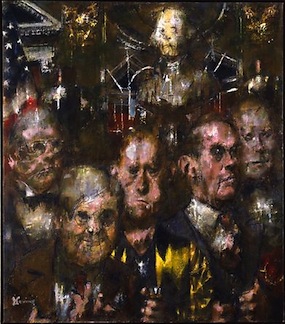
Jack Levine was one of the leading American Social Realist painters of the twentieth century, a satirist whose densely worked, expressionistic canvases took aim at political bosses, plutocrats, police, and society figures from the Depression era through the postwar decades. For a collector, he represents deep museum validation, with works in the Museum of Modern Art, the Metropolitan Museum, the Whitney, the National Gallery of Art, and the Phillips Collection, paired with a secondary market that is sparsely documented at auction. That combination rewards provenance-led collecting through the estate rather than price-chasing on thin comparables.
- Born
- 1915-01-03, Boston (South End), Massachusetts, USA
- Nationality
- American
- Media
- Painting, Printmaking
- Movement
- Social Realism, Boston Expressionism
- Education
- No formal degree confirmed. Studied under Harold K. Zimmerman at the Jewish Welfare Center, Roxbury, Massachusetts, 1924 to 1931, and with Denman Ross at Harvard University, 1929 to 1933.
- Signature motifs
- Satirical political and society scenes, Biblical and history subjects rendered in an expressionistic style
- Representation
- ACA Galleries, representing the estate
By the numbers
- 1945Guggenheim FellowshipJohn Simon Guggenheim Memorial Fellowship
- Full Academician, 1982National Academy of DesignElected 1979, full Academician 1982
- USD 10,080Documented auction saleKing David, Sotheby's New York, March 2022; the best-documented public result found, not confirmed as an all-time high given fragmentary public auction records
- ACA GalleriesRepresented byRepresents the artist's estate
Biography
Jack Levine was born January 3, 1915, in the South End of Boston, Massachusetts. His first formal training came as a teenager under the painter and teacher Harold K. Zimmerman at the Jewish Welfare Center in Roxbury, Massachusetts, from 1924 to 1931. Alongside fellow Boston painter Hyman Bloom, he also studied with Denman Ross at Harvard University from 1929 to 1933, work that placed him at the center of what critics later called Boston Expressionism.
Levine rose to national attention in the late 1930s as a Social Realist painter working under the WPA Federal Art Project, producing crowded, caricature-inflected scenes of political and institutional corruption. His painting The Feast of Pure Reason, acquired by the Museum of Modern Art, helped establish him alongside Ben Shahn as one of the foremost exponents of the social realist school that dominated American painting of the period. He went on to win a John Simon Guggenheim Memorial Fellowship in 1945 and a Fulbright grant to study in Italy in 1950, and was elected a Fellow of the American Academy of Arts and Sciences in 1955, a member of the American Academy of Arts and Letters in 1973, and an Academician of the National Academy of Design in 1982, having been elected an associate in 1979.
He died in New York City on November 8, 2010, at the age of 95.
Critical reception
Levine was recognized early as a central figure of American Social Realism. Grace Glueck's 2010 assessment for the New York Times situated him, alongside Ben Shahn, among the foremost exponents of the social realist school that dominated American painting in the late 1930s. His standing was reinforced by a 1978 retrospective at the Jewish Museum in New York that traveled to four additional American museums, and by later scholarly reassessment of his Boston roots, including the Danforth Art Museum's 2010 exhibition The Feast of Pure Reason: Expressionism in Boston, which placed him within the broader Boston Expressionist circle alongside Hyman Bloom.
Market
Levine's market is defined by institutional depth rather than a well-documented auction record. The best-documented public sales are King David, which sold for USD 10,080 at Sotheby's New York in March 2022, and The Offering, which sold for USD 7,680 at Bonhams Los Angeles (online) in August 2023; exact sale days are not available in public auction aggregators. Because public price databases for Levine are fragmentary and inconsistent between sources, these figures should be read as the best documented results rather than a confirmed all-time record, and collectors should weigh any single auction data point against the far more consistent signal of his museum holdings and estate representation through ACA Galleries.
Top auction results
| Work | Price | Sale |
|---|---|---|
| King David (2022) | USD 10,080 (USD 10,080) | Sotheby's, New York, 2022-03 |
| The Offering (2023) | USD 7,680 (USD 7,680) | Bonhams, Los Angeles (online), 2023-08 |
Selected exhibitions
| Years | Exhibition | Venues |
|---|---|---|
| 1978 | Jack Levine retrospective | The Jewish Museum, New York (traveled to four additional American museums) |
| 2010 | The Feast of Pure Reason: Expressionism in Boston | Danforth Art Museum, Framingham, Massachusetts |
Museum collections
- Museum of Modern Art, New York
- The Metropolitan Museum of Art, New York
- Whitney Museum of American Art, New York
- The Phillips Collection, Washington, D.C.
- Art Institute of Chicago
- Smithsonian American Art Museum, Washington, D.C.
- National Gallery of Art, Washington, D.C.
Awards and honors
- John Simon Guggenheim Memorial Fellowship (1945)
- Fulbright grant to study in Italy (1950)
- Fellow, American Academy of Arts and Sciences (1955)
- Elected, American Academy of Arts and Letters (1973)
- Full Academician, National Academy of Design (elected 1979) (1982)
Authentication and provenance
No catalogue raisonne.
No published catalogue raisonne has been identified in available sources. Works are generally verified through ACA Galleries, which represents the estate, and through documented museum and exhibition provenance.
Primary reference: https://acagalleries.com/artists/jack-levine/
What collectors should know
No published catalogue raisonne for Levine has been identified in available sources, so provenance verification runs through ACA Galleries, which represents the estate, and through documented museum and exhibition history. His auction footprint is thin and unevenly documented, meaning individual sale prices should not be extrapolated into a broader trend. The strongest, most durable signal in his market is the institutional one: sustained holdings at MoMA, the Met, the Whitney, the National Gallery of Art, and other major museums.
Further reading and resources
Data current as of 2026-07-13.

