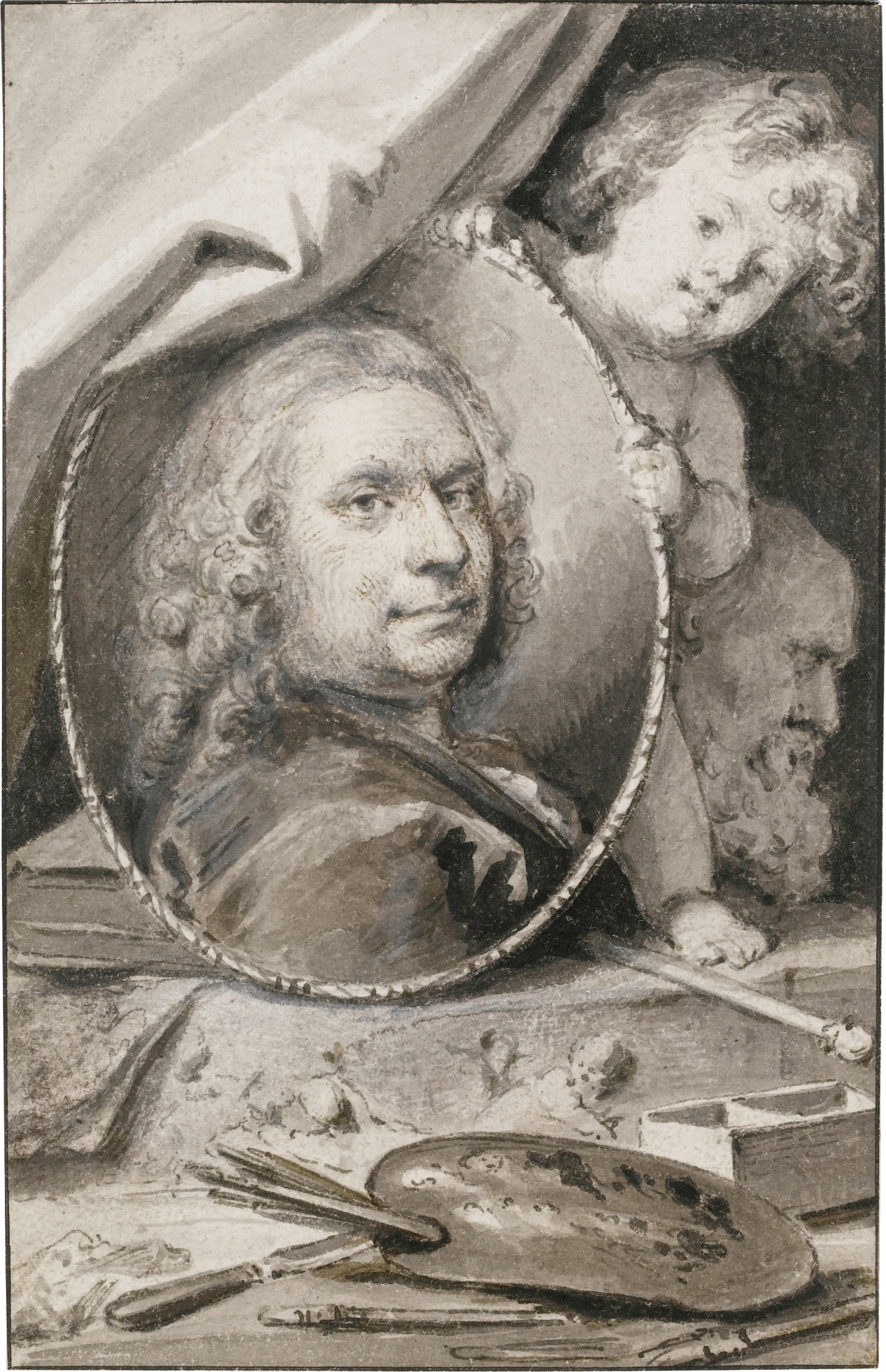
Why Jacob de Wit matters
Jacob de Wit was the leading decorative painter of eighteenth century Amsterdam, the artist who carried Dutch history painting into the ornamental schemes of civic and private interiors. He is best remembered for his distinctive form of grisaille, known in Dutch as witjes, in which flat painted panels convincingly imitate carved stone relief sculpture. His ceilings and wall decorations for the Amsterdam Royal Palace, private canal houses, and clandestine Catholic churches remain in place today, and his paintings and drawings are held by museums across the Netherlands, Germany, France, the United Kingdom, and the United States. For collectors, he represents a category distinct from easel painting: a decorative Old Master whose surviving output is split between site-specific interiors that never come to market and a smaller, thinly traded body of transportable paintings and drawings.
- Born
- 1695-12-19, Amsterdam, Netherlands
- Nationality
- Dutch
- Media
- Painting, Drawing
- Movement
- Dutch Golden Age, Dutch Rococo
- Education
- Apprenticed to Albert van Spiers in Amsterdam from about age 9 to 13; studied at the Royal Academy of Antwerp, 1711 to 1713; admitted to the Guild of St Luke, Antwerp, 1714.
- Signature motifs
- Grisaille witjes imitating carved relief, Trompe l'oeil ceiling and wall decoration, Allegorical and biblical narrative painting
By the numbers
- 1695 to 1754LivedBaptized 19 December 1695, Amsterdam; died 12 November 1754, Amsterdam, age 58
- WitjesSignature inventionGrisaille paintings imitating carved stone relief sculpture
- Royal Palace, AmsterdamMajor commissionCouncil Chamber ceiling and wall decoration, 1737
- Thin and fragmentedAuction marketNo single all-time record is confirmed across public sources as of 2026-07-18
Selected works
Click any work to view it full screen.
Biography
Jacob de Wit was baptized on 19 December 1695 in Amsterdam, in a clandestine Catholic church known as t Vrede Duifje on the Kerkstraat. He began his art training at about age nine as an apprentice to the painter Albert van Spiers in Amsterdam, remaining with him until around age thirteen. With financial support from an uncle, he then continued his studies in Antwerp, attending the Royal Academy there from 1711 to 1713 and becoming a member of the Guild of St Luke in 1714.
Returning to Amsterdam, de Wit built a career decorating the homes of the city's merchant elite and its Catholic churches, which, though officially proscribed, commissioned religious paintings for private worship. He became known above all for witjes, grisaille panels that used trompe l'oeil shading to mimic carved marble or stone relief, a technique he adapted for ceilings, chimneypieces, and door panels throughout Amsterdam's canal houses. His most celebrated work is the decorative program for the Council Chamber of the Amsterdam Royal Palace, completed in 1737 and including the large canvas Moses Electing the Council of Seventy Elders alongside painted trompe l'oeil statuary, a scheme still preserved in situ. He died in Amsterdam on 12 November 1754, at age fifty eight.
He should not be confused with two other historical figures of similar name: the seventeenth century Dutch statesman Jacob de Witt, or the Haarlem painter Jacob Willemsz. de Wet, who worked roughly a generation earlier and in a different city.
Critical reception
No exact, attributable critic quotations about Jacob de Wit could be verified for this profile. Art historical sources consistently place him at the center of Dutch decorative painting's turn toward a lighter, more theatrical Rococo idiom in the first half of the eighteenth century, crediting him in particular with the witjes technique and with sustaining large scale narrative and allegorical painting inside a genre, domestic and ecclesiastical decoration, that had mostly moved away from grand history painting after the Golden Age. His Royal Palace Council Chamber commission is treated by Dutch museums and heritage bodies as the summit of his career.
Market
Jacob de Wit's market is that of a decorative Old Master rather than an easel painter with a continuous exhibition history. Because much of his most significant work is a fixed part of historic interiors, such as the Amsterdam Royal Palace and various canal houses, it never reaches auction, and the transportable paintings and drawings that do come to market appear only intermittently, spread across a number of European and international auction houses.
No single all-time auction record for the artist is confirmed across the public sources reviewed as of 2026-07-18. Lempertz's artist index lists its highest price for de Wit as EUR 39,680 including premium, for the paired allegories Allegorie der Malerei und Bildhauerei and Allegorie der Musik und Schauspielkunst, though the exact sale date is not confirmed in the accessible record. Dorotheum's own listings are inconsistent, showing a realized price of EUR 14,622 in one source and a range of EUR 688 to EUR 2,750 in another, a discrepancy that public listings alone do not resolve. A Bonhams lot has appeared with an estimate rather than a confirmed hammer price. Collectors should treat any cited "record" for this artist as provisional until a specific work, price, house, and date can be verified together.
Top auction results
| Work | Price | Sale |
|---|---|---|
| Allegorie der Malerei und Bildhauerei / Allegorie der Musik und Schauspielkunst (paired allegories) | EUR 39,680 (including premium) | Lempertz, Cologne, Germany |
Selected exhibitions
| Years | Exhibition | Venues |
|---|---|---|
| 1737 | Council Chamber decorative scheme, including Moses Electing the Council of Seventy Elders | Royal Palace, Amsterdam |
| 1726 | Adoration of the Shepherds; Holy Family and Trinity | Museum Ons' Lieve Heer op Solder, Amsterdam |
| 1738 | Allegory of Government: Wisdom Defeating Discord | The Metropolitan Museum of Art, New York |
| 1742 to 1743 | Allegory of the Arts; Flora and Zephyr | The Metropolitan Museum of Art, New York |
| 1751 to 1752 | Allegory of the Four Seasons | Staatliche Museen Kassel |
| 1733 | Jupiter (in the guise of Diana) and Callisto, drawing | Cleveland Museum of Art |
| 1749 | Les Vestales | Musée Ingres-Bourdelle, Montauban |
| 1741 | Allegory of Trade, supraporte design for Keizersgracht 274 | Amsterdam |
Museum collections
- Royal Palace, Amsterdam (Koninklijk Paleis Amsterdam)
- Museum Ons' Lieve Heer op Solder, Amsterdam
- Amsterdam Museum
- Museum Willet-Holthuysen, Amsterdam
- Rijksmuseum, Amsterdam
- Museum Boijmans Van Beuningen, Rotterdam
- Staatliche Museen Kassel
- Städel Museum, Frankfurt am Main
- The Metropolitan Museum of Art, New York
- Cleveland Museum of Art
- Musée Ingres-Bourdelle, Montauban
Authentication and provenance
No catalogue raisonne.
No catalogue raisonne of Jacob de Wit's work has been confirmed. Attributions are supported by RKD (Netherlands Institute for Art History) records, museum curatorial documentation, and auction house cataloguing of this Dutch Old Master's paintings and drawings.
Primary reference: https://www.britannica.com/biography/Jacob-de-Wit-painter
What collectors should know
There is no confirmed catalogue raisonne for Jacob de Wit, and no commercial gallery or estate currently represents him; attribution and provenance research rely on RKD records, museum curatorial files, and auction house cataloguing. His auction footprint is thin and inconsistently documented, so any single price point, including the highest figures found in this research, should be verified against the specific work, sale date, and auction house before being treated as a benchmark. Because so much of his major output is embedded in historic interiors rather than freely traded, provenance tied to a documented commission, such as a named canal house or church, tends to matter more for this artist than for painters with a conventional studio-to-market history.
Further reading and resources
Data current as of 2026-07-18.

