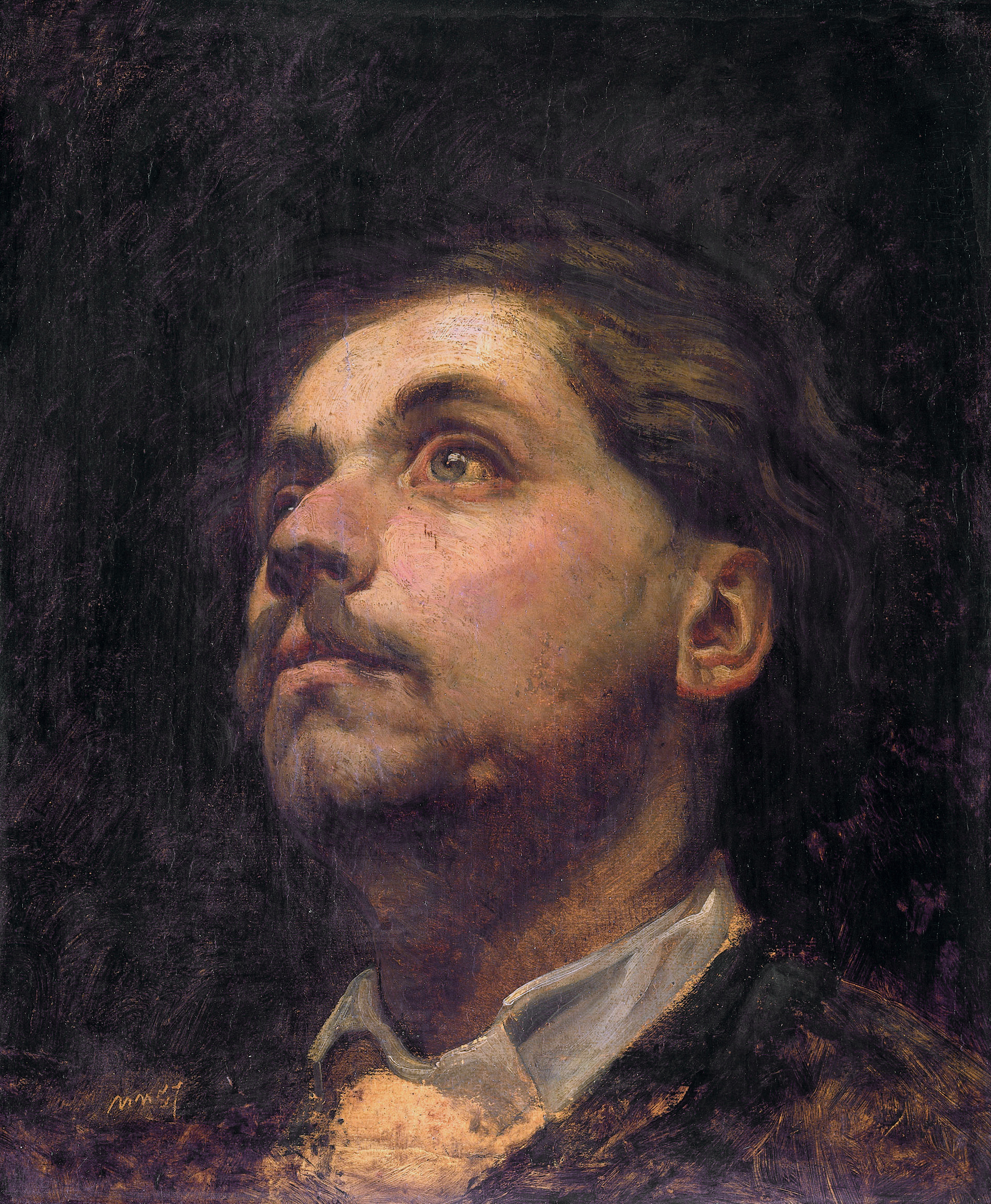
Why Jacob Maris matters
Jacob Maris was the eldest of the three painting Maris brothers and one of the founding figures of the Hague School, the group of Dutch landscape and genre painters who, in the last third of the nineteenth century, revived the atmospheric, tonal tradition of the Dutch Golden Age and carried it toward a more modern, impressionistic handling of light. His paintings of skies, beaches, canals, and windmills entered major museum collections across Europe and North America during and after his lifetime, and his standing as one of the most influential Dutch landscape painters of his era remains a matter of art-historical consensus rather than debate. For collectors, he represents a historically significant but thinly traded corner of the nineteenth-century Dutch market.
- Born
- 1837-08-25, The Hague, Netherlands
- Nationality
- Dutch
- Media
- Painting, Etching, Lithography
- Movement
- Hague School
- Education
- The Hague Academy (Haagsche Teekenacademie), 1850 to 1853, under J.A.B. Stroebel and Hubertus van Hove; Antwerp Academy (Koninklijke Academie voor Schone Kunsten), circa 1854 to 1856, under Nicaise de Keyser; further study in the studio of Ernest Hebert, Paris, 1865 to 1871
- Signature motifs
- Dutch skies and atmospheric light, Beach, canal, and windmill landscapes
By the numbers
- USD 35,000Auction highOn the Amstel, Sotheby's New York, January 2017 (best documented result in available auction databases)
- 1837 to 1899LifespanBorn The Hague, died Karlsbad (now Karlovy Vary)
- Hague SchoolMovementWith brothers Matthijs and Willem Maris
- Commander, Order of the Netherlands LionHonorYear of conferment not documented in available sources
Selected works
Click any work to view it full screen.
Biography
Jacob Hendricus Maris was born on 25 August 1837 in The Hague, the son of printer Mattheus Maris and Hendrika Bloemert, and the eldest brother of painters Matthijs Maris and Willem Maris. Around 1849 he entered the studio of Hague genre painter J.A.B. Stroebel, and from 1850 to 1853 he studied at the Hague Academy of Art (Haagsche Teekenacademie) while continuing to work under Stroebel. In 1853 he became an apprentice to Hubertus van Hove, and the following year he followed van Hove to Antwerp, where he attended evening classes at the Antwerp Academy under the history painter Nicaise de Keyser, roughly from 1854 to 1856, before returning to The Hague in 1857.
In 1861 Maris traveled through Germany, Switzerland, and France with his brother Matthijs. On returning home he took further lessons at the Hague Academy, studying Italian genre subjects under J. Ph. Koelman and drawing from life at Pulchri Studio. From 1865 to 1871 he lived and worked in Paris, largely in the studio of Ernest Hebert, painting Italian folk subjects and landscapes; he returned to the Netherlands around the time of the Franco-Prussian War and settled permanently in The Hague, where he increasingly turned to the beach, dune, and canal landscapes for which he is best known.
Maris was active in the artistic life of his time: in 1889 he served on the jury of an exhibition of fine arts in Amsterdam that awarded James McNeill Whistler a gold medal, and in 1898 he was among the artists invited to exhibit with the newly formed International Society of Sculptors, Painters and Gravers, of which Whistler was president. He was made a Commander of the Order of the Netherlands Lion, though the exact year of that honor is not documented in the sources reviewed for this profile. Jacob Maris died on 7 August 1899 in Karlsbad, then in Bohemia, Austria-Hungary and now Karlovy Vary in the Czech Republic, at the age of sixty-one. He was buried at the General Cemetery in The Hague.
Critical reception
Historians and museums consistently place Jacob Maris among the most important Dutch landscape painters of the last quarter of the nineteenth century, and as one of the artists, alongside his brothers Matthijs and Willem, who defined the Hague School's revival of seventeenth-century Dutch tonal painting under the influence of the Barbizon School. Contemporary criticism, including commentary attributed to the writer Philippe Zilcken, praised his rendering of the hazy, silver-grey light and remote horizons characteristic of the Dutch coast and sky, though the original publication and year of that commentary could not be confirmed in the sources reviewed here. Museum programming, including a Kunstmuseum Den Haag exhibition devoted to the Maris brothers and the Hague School, reflects the broader critical view that the school's atmospheric approach shaped the generation of Dutch painters that followed.
Market
Jacob Maris has no current gallery representation or managed estate; as a painter who died in 1899, his work is traded entirely on the secondary market, through auction houses and dealers specializing in nineteenth-century Dutch and Hague School painting, such as Simonis and Buunk in the Netherlands. During his lifetime his work was widely distributed abroad through the Hague branch of the dealer Goupil and Cie, which placed paintings in collections in Britain, France, Canada, and the United States.
The best-documented public auction result for Maris is On the Amstel, which sold at Sotheby's New York in January 2017 for USD 35,000, the highest figure identified in the public auction-price databases reviewed for this profile; the exact day of sale is not specified in the source consulted. Most other tracked results sit well below that figure, often in the thousands to low tens of thousands of dollars or euros, and the number of high-value public sales is small. Because public auction-price aggregators do not offer complete coverage of every sale worldwide, this figure should be read as the best available public indicator rather than a confirmed absolute record.
Top auction results
| Work | Price | Sale |
|---|---|---|
| On the Amstel (2017) | USD 35,000 (USD 35,000) | Sotheby's, New York, 2017-01 |
Selected exhibitions
| Years | Exhibition | Venues |
|---|---|---|
| 1890 | Second exhibition of the Societe des Peintres-Graveurs Francais | Paris (6 to 26 March 1890) |
| 1898 | Founding exhibition, International Society of Sculptors, Painters and Gravers | London (society formed with James McNeill Whistler as president) |
| 1870s to 1890s | Regular exhibitor at major British and Dutch venues | Royal Academy, Grosvenor Gallery, New Gallery, Fine Art Society, and Goupil Gallery, London; Glasgow Institute of the Fine Arts; Royal Scottish Academy, Edinburgh; Royal Society of Artists, Birmingham; Manchester City Art Gallery |
Museum collections
- Rijksmuseum, Amsterdam
- Van Gogh Museum, Amsterdam
- Kunstmuseum Den Haag, The Hague
- Museum Boijmans Van Beuningen, Rotterdam
- The National Gallery, London
- Metropolitan Museum of Art, New York
- National Gallery of Art, Washington, D.C.
- Musee d'Orsay, Paris
Awards and honors
- Commander, Order of the Netherlands Lion (exact year of conferment not documented)
Authentication and provenance
No catalogue raisonne.
No catalogue raisonne has been published for Jacob Maris. Attribution and authentication rely on connoisseurship, museum and dealer provenance records, and specialists in Hague School painting such as Simonis and Buunk.
Primary reference: https://www.britannica.com/biography/Jacob-Maris
What collectors should know
Jacob Maris has no catalogue raisonne and no current gallery or estate representation; verification depends on museum and dealer provenance records and on specialists in Hague School painting. His auction market is thin, with a documented high of USD 35,000 and most other results well below that level, so individual sale prices should be read as data points from a limited and imperfectly documented market rather than as a stable pricing curve. His durability as a name rests less on auction turnover than on the breadth of his presence in major museum collections across the Netherlands, the United Kingdom, continental Europe, and North America, which reflects sustained institutional and scholarly regard for his role in the Hague School.
Further reading and resources
Data current as of 2026-07-16.

