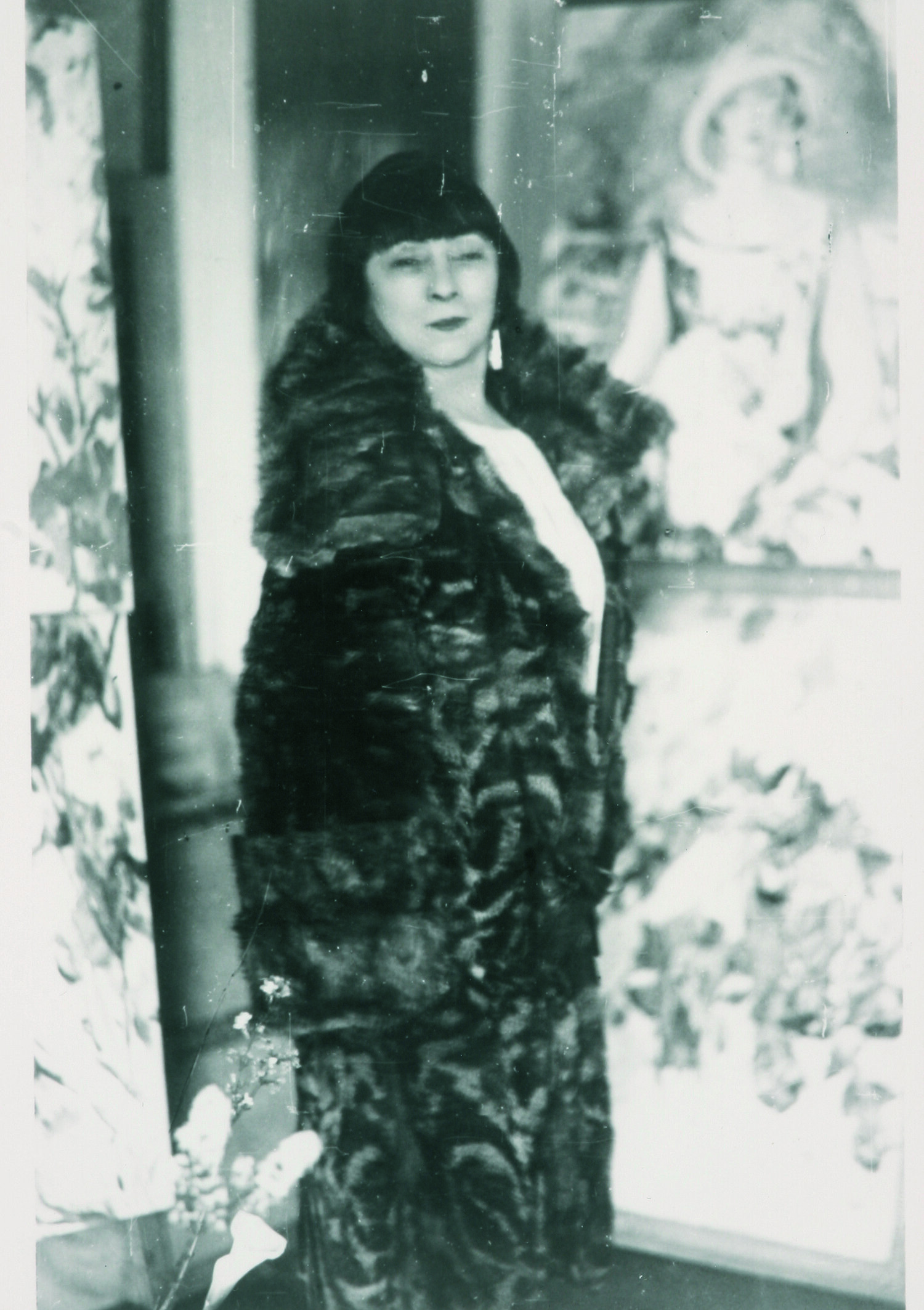
Why Jacqueline Marval matters
Jacqueline Marval was a French painter closely tied to the Fauvist circle in Paris in the years before the First World War, praised in her own time by Guillaume Apollinaire and given a rare public commission at the Théâtre des Champs-Élysées, yet largely absent from museum retrospectives and the auction market for most of the century after her death. For a collector, she is a case study in a rediscovery market: real institutional credibility and growing curatorial attention, paired with a thin, poorly documented auction history that makes any single price point hard to generalize from.
- Born
- 1866-10-19, Quaix-en-Chartreuse, Isère, France
- Nationality
- French
- Media
- Painting, Lithography, Sculpture
- Movement
- Fauvism
- Education
- No formal art-school degree documented. Trained as a schoolteacher, completing that training around 1884, and was largely self-taught as a painter after moving into artistic circles in Paris.
- Signature motifs
- Fauvist color and pattern, Nudes and odalisques
- Representation
- Comité Jacqueline Marval, Paris (estate custodian; no current commercial gallery representation confirmed)
By the numbers
- EUR 160,000Auction highOil on canvas, Sotheby's Paris, 2011; exact title and sale date not publicly documented
- Armory Show, 1913US debutNew York, Chicago, Boston
- Théâtre des Champs-Élysées, 1913Public commissionFoyer de la Danse decoration, Paris (reported)
- Comité Jacqueline Marval, ParisEstate custodianNo current commercial gallery representation confirmed
Selected works
Click any work to view it full screen.
Biography
Jacqueline Marval was the professional name of Marie-Joséphine Vallet, born 19 October 1866 in Quaix-en-Chartreuse, near Grenoble, France, the second of eight children in a family of schoolteachers. She trained to become a teacher herself, completing that training around 1884, and worked for a time as a substitute teacher before turning to painting. She had no formal art-school education; she was largely self-taught, and gained access to Paris's artistic circles chiefly through her companion Jules Flandrin, through whom she met Henri Matisse, Albert Marquet, and Georges Rouault. She settled in Paris, in Montparnasse, around 1895, and took the name Marval by combining the first letters of her first name, Marie, and her surname, Vallet.
She began exhibiting at the Salon des Indépendants in 1901, and her 1903 painting Les Odalisques drew notice from Apollinaire and Francis Picabia; Les Cigales followed at the Salon des Indépendants in 1906. In 1913 she was reportedly selected to help decorate the Foyer de la Danse at the newly built Théâtre des Champs-Élysées, and that same year her work appeared in the Armory Show in New York, Chicago, and Boston, marking her first exhibition in the United States. She went on to show in San Francisco in 1915, Saint Louis in 1916, at the Metropolitan Museum of Art's Modern French Art exhibition in New York in 1919 and 1920, and repeatedly in Pittsburgh through the late 1920s.
Marval died on 28 May 1932 in Paris, at the Hôpital Bichat. English-language and Spanish-language reference sources attribute her death to cancer, though a full clinical record has not been located. Some later writers have described her final years as marked by poverty, though that characterization comes from secondary retrospective accounts rather than contemporaneous documentation. After her death, exhibitions of her work were sparse for decades; the first museum retrospective did not take place until 1987, at the Musée Hébert in Grenoble.
Critical reception
One of the most remarkable artists of our time.
Marval earned early and specific praise from Guillaume Apollinaire, who is reported to have called her, in 1912, "one of the most remarkable artists of our time." Contemporaries in the Fauvist circle, including Matisse, Marquet, and Flandrin, were reported to have awaited each new painting of hers with curiosity. Her reported selection to help decorate the Théâtre des Champs-Élysées in 1913 and her inclusion in the Armory Show the same year placed her among the recognized modern painters of her generation; she was elected to the Société nationale des Beaux-Arts in 1922, though no Salon medals or state prizes are documented. After decades of relative institutional silence, interest has revived: the Comité Jacqueline Marval, custodian of the largest surviving body of her work, has partnered on shows including a 2024 retrospective at the Millesgården Museum in Stockholm and her inclusion in the traveling exhibition on the dealer Berthe Weill, shown at NYU's Grey Art Museum, the Musée des Beaux-Arts de Montréal, and the Musée de l'Orangerie in Paris through early 2026.
Market
Marval's auction market is thin and unevenly documented. The highest price identified for a work by the artist is EUR 160,000, for an oil on canvas sold at Sotheby's Paris in 2011; specialist French valuation sources describe this as her record, but no publicly accessible catalogue entry confirms the work's exact title or calendar sale date. Typical results for her paintings run well below that figure, with smaller works reported in the low thousands of euros and larger formats occasionally reaching into the tens of thousands. No sale above the 2011 benchmark has been identified through mid-2026.
Top auction results
| Work | Price | Sale |
|---|---|---|
| Oil on canvas (title not documented in available public sources) (2011) | EUR 160,000 | Sotheby's, Paris |
Selected exhibitions
| Years | Exhibition | Venues |
|---|---|---|
| 1901 to 1906 | Salon des Indépendants | Paris (recurring exhibitor; Les Odalisques shown 1903, Les Cigales shown 1906) |
| 1913 | Foyer de la Danse decoration | Théâtre des Champs-Élysées, Paris |
| 1913 | International Exhibition of Modern Art (Armory Show) | 69th Regiment Armory, New York, traveled to Chicago and Boston |
| 1919 to 1920 | Modern French Art | Metropolitan Museum of Art, New York |
| 1925 to 1930 | Recurring exhibitions of modern French art | Pittsburgh (1925, 1926, 1929, 1930) |
| 1987 | Retrospective | Musée Hébert, Grenoble |
| 2024 | Jacqueline Marval: Fauvism, Feminism, Flamboyance | Millesgården Museum, Stockholm |
| 2024 to 2026 | Berthe Weill, Art Dealer of the Parisian Avant-Garde | Grey Art Museum, NYU, New York; Musée des Beaux-Arts de Montréal; Musée de l'Orangerie, Paris |
Museum collections
- Musée d'arts de Nantes
- Musée de Grenoble
- Musée des Beaux-Arts de Chambéry
- Musée Paul-Dini, Villefranche-sur-Saône
- Musée Mainssieux, Voiron
- Musée Léon-Dierx, Saint-Denis, Réunion
- Milwaukee Art Museum
Awards and honors
- Elected to the Société nationale des Beaux-Arts (1922)
Authentication and provenance
No catalogue raisonne.
No published catalogue raisonne has been located. Works are generally authenticated through the Comité Jacqueline Marval in Paris, which holds the largest known collection of her work and works with lending museums; this is a private custodial arrangement, not a certification program.
Primary reference: https://www.jacqueline-marval.com/biography
What collectors should know
There is no published catalogue raisonne for Marval, and authentication generally runs through the Comité Jacqueline Marval in Paris rather than through any independent certifying body. Her public auction record is sparse: the one benchmark price identified, EUR 160,000 at Sotheby's Paris in 2011, lacks a confirmed title or exact date in public sources, and most documented sales are far smaller. Given the small number of public transactions, collectors should weigh provenance and Comité-linked documentation heavily and treat any single auction result as a data point rather than a trend line.
Further reading and resources
Data current as of 2026-07-18.

