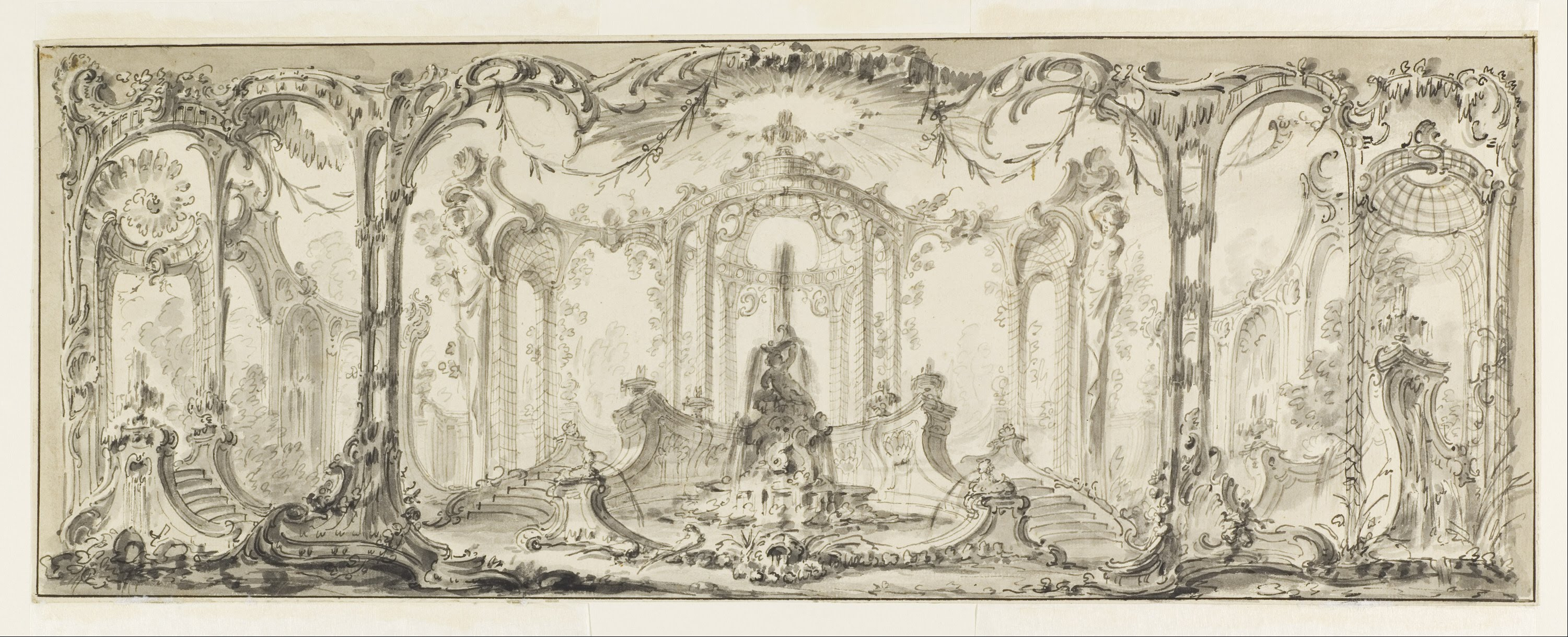
Why Jacques de Lajoue matters
Jacques de Lajoue is a significant early exponent of French Rococo architectural fantasy, an artist whose painted capriccios and engraved ornament designs helped circulate the decorative language of the style among eighteenth century designers and craftsmen. He matters to collectors less as an active auction name and more as a documented presence in the permanent collections of the Louvre, the Musee de Picardie in Amiens, and the Musee des Beaux-Arts in Angers, making him a reference point for anyone building a Rococo or French Old Master collection.
- Nationality
- French
- Media
- Painting, Drawing
- Movement
- Rococo
- Education
- No school or named master documented. Received (agree, then recu) into the Academie Royale de Peinture et de Sculpture as an architectural painter, 1721.
- Signature motifs
- Architectural capriccio, Rococo cartouche and ornament design
By the numbers
- EUR 50,000Best documented auction resultL'Optique et l'Astronomie (pair), Sotheby's Paris, 19 June 2006. Market databases reference possible more recent record sales (2022 to 2026) but prices could not be confirmed.
- Received 1721Academie RoyaleAdmitted as an architectural painter
- 1737 to 1753Salon activityExhibited at the Academy's Salons
- None publishedCatalogue raisonne
Selected works
Click any work to view it full screen.
Biography
Jacques de Lajoue was born in Paris, in either 1686 or 1687 (sources differ), the son of the architect and master mason Jacques de La Joue and Marguerite Cannaban. No school or named teacher is documented for his early training. The most detailed modern study of his career, art historian Katie Scott's 2010 article on his work, states plainly that "the name of his master is unknown" and that "details concerning his years of formation are entirely lacking."
His professional record begins in 1721, when he presented two landscape perspective paintings to the Academie Royale de Peinture et de Sculpture and was received as an architectural painter, reportedly on 26 April 1721. He went on to exhibit at the Academy's exhibitions and Salons into the 1750s, with recorded activity through 1753. A 1732 perspective view of the Bibliotheque Sainte-Geneviève brought him particular acclaim. He produced a series of allegories of the Arts and Sciences, including a pair depicting Optics and Astronomy, for the cabinet of Michel Ferdinand d'Albert d'Ailly, duc de Chaulnes, and in 1740 published the engraved series Paysages et Perspectives, alongside books of cartouche and ornament designs that circulated his architectural fantasies widely among Rococo designers and craftsmen. He married Mariane Derlin, and their son Jacques Gabriel (1730 to 1810) is recorded in a Louvre family portrait attributed to the artist.
Jacques de Lajoue died in Paris in 1761. Several secondary biographical sources, though not a primary archival record, give the specific date as 12 April 1761.
Critical reception
Modern scholarship treats Jacques de Lajoue as a significant early exponent of Rococo architectural fantasy and interior ornament design, distinguished from his contemporaries by his engraved output, which allowed his inventions in cartouches, garden pavilions, and imagined perspectives to spread beyond individual paintings. Katie Scott's 2010 academic study of his work situates him within debates over how Rococo screens and staging devices operate visually, treating him as a serious subject of art historical analysis rather than a minor decorator. No verbatim critical quotation from a named critic in a major outlet could be confirmed for this profile, so none is reproduced here.
Market
Jacques de Lajoue's market is thin and infrequent, consistent with an eighteenth century painter whose surviving output is largely absorbed into museum collections. The most fully documented auction result located for this profile is a pair of paintings, L'Optique et l'Astronomie, which sold for EUR 50,000 at Sotheby's Paris on 19 June 2006. Market databases reference apparent record sales in more recent years, including 2022 to 2026, but the prices, works, and exact sale dates for those transactions could not be confirmed from available sources, so no current all-time high can be stated with confidence. Works by the artist, when they appear at auction, tend to be handled by old-master departments at major houses rather than by any dedicated gallery or estate, since none currently represents him.
Top auction results
| Work | Price | Sale |
|---|---|---|
| L'Optique et l'Astronomie (pair) (2006) | EUR 50,000 | Sotheby's, Paris, 2006-06-19 |
Selected exhibitions
| Years | Exhibition | Venues |
|---|---|---|
| 1721 | Academie Royale reception | Academie Royale de Peinture et de Sculpture, Paris |
| 1737 to 1753 | Salon exhibitions | Academie Royale de Peinture et de Sculpture, Paris |
Museum collections
- Musee du Louvre, Paris
- Musee de Picardie, Amiens
- Musee des Beaux-Arts, Angers
Awards and honors
- Received (agree, then recu) into the Academie Royale de Peinture et de Sculpture as an architectural painter (1721)
Authentication and provenance
No catalogue raisonne.
No catalogue raisonne has been published for Jacques de Lajoue. Attributions rest on comparison with securely documented paintings and drawings, the engraved series Paysages et Perspectives (1740), and curatorial review by institutions such as the Louvre and old-master specialists at major auction houses.
Primary reference: https://en.wikipedia.org/wiki/Jacques_de_Lajoue
What collectors should know
There is no catalogue raisonne for Jacques de Lajoue, and no gallery or estate currently represents his work, so provenance research and comparison with securely attributed museum holdings, including the Louvre, the Musee de Picardie, and the Musee des Beaux-Arts d'Angers, are the main tools for confirming authenticity. His birth year is recorded inconsistently as 1686 or 1687 across otherwise reliable sources, a reminder of how incomplete the archival record remains for artists of this period. Because so few works come to market, and the best documented priced sale on record dates to 2006, with more recent activity referenced but unpriced in market databases, any collector considering a purchase should treat auction comparables with caution and lean on institutional and scholarly documentation instead.
Further reading and resources
Data current as of 2026-07-18.

