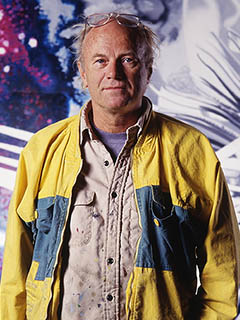
Why James Rosenquist matters
James Rosenquist was one of the founding painters of American Pop art, the artist who brought the scale and technique of the commercial billboard into the museum. His training as a Times Square sign painter shaped a signature method: fragmented, larger-than-life images of consumer goods, faces, and machinery, cut together the way an editor cuts film. His 1964 to 1965 mural F-111 is one of the touchstone works of postwar American painting and anchors the Museum of Modern Art's collection. For a collector, Rosenquist represents a case where museum-grade historical importance has not always translated into deep auction liquidity, making provenance and estate verification especially important.
- Born
- 1933-11-29, Grand Forks, North Dakota, USA
- Nationality
- American
- Media
- Painting, Printmaking
- Movement
- Pop Art
- Education
- University of Minnesota, 1952 to 1954; Art Students League of New York, scholarship 1955, approximately one year
- Signature motifs
- Billboard-scale fragmented imagery, Collage compositions merging consumer advertising and everyday objects
- Representation
- "Thaddaeus Ropac (James Rosenquist Estate)", "Acquavella Galleries"
By the numbers
- USD 3.3MAuction highBe Beautiful (1964), Sotheby's New York, 2014
- F-111 (1964 to 1965)MoMA collection workPermanent collection, Museum of Modern Art, New York
- 2003 to 2004Guggenheim retrospectiveTraveled to Houston, New York, Bilbao, and Wolfsburg
- Thaddaeus Ropac (Estate); Acquavella GalleriesRepresented by
Biography
James Albert Rosenquist was born on November 29, 1933, in Grand Forks, North Dakota. As a teenager he won a scholarship to the Minneapolis School of Art, then studied art at the University of Minnesota from 1952 to 1954. A 1955 scholarship brought him to the Art Students League of New York, where he studied for about a year.
To support himself in New York, Rosenquist worked through the late 1950s and early 1960s as a commercial billboard painter in Times Square, an experience that gave him both his working method, painting at enormous scale from small studies, and his visual vocabulary of advertising imagery. He had his first solo gallery exhibition at Richard Bellamy's Green Gallery in 1962, and by 1963 he was included in two career-defining group exhibitions, Six Painters and the Object at the Solomon R. Guggenheim Museum and Dorothy Miller's Americans 1963 at the Museum of Modern Art, alongside Andy Warhol, Roy Lichtenstein, Jasper Johns, Jim Dine, and Robert Rauschenberg. His mural-scale F-111 (1964 to 1965), a room-sized meditation on the Vietnam War, American consumer culture, and Cold War anxiety, had its first solo museum showing at the Jewish Museum in New York and later entered the permanent collection of the Museum of Modern Art.
Rosenquist remained a central figure in American art for the rest of his career. In 1978 he was appointed to a six-year term on the National Council on the Arts. He was the subject of numerous retrospectives, including a 1991 survey at the State Tretyakov Gallery in Moscow and a major touring retrospective organized by the Guggenheim Museum in 2003 to 2004 that traveled to Houston, New York, Bilbao, and Wolfsburg. He received the Golden Plate Award from the American Academy of Achievement in 1988, was inducted into the Florida Artists Hall of Fame in 2001, and received the Fundacion Cristobal Gabarron international award for art in 2002.
Rosenquist died at his home in New York City on March 31, 2017, at the age of 83, after a long illness, according to The New York Times. His estate is now represented by Thaddaeus Ropac, and his work continues to be exhibited internationally, including Waiting for an Idea at Off Paradise in New York in 2026.
Critical reception
Rosenquist is consistently placed, alongside Andy Warhol, Roy Lichtenstein, and Jasper Johns, among the founding painters of American Pop art, distinguished from his peers by his background in commercial sign painting and by the mural scale of his major works. Curators and museums have repeatedly returned to F-111 as the work that most fully demonstrates his method: fragmenting unrelated commercial and political imagery into a single continuous composition that reads as both formal abstraction and social commentary on Cold War America. His inclusion in the Guggenheim's 1963 Six Painters and the Object and MoMA's Americans 1963, followed by numerous retrospectives over his career, reflects sustained institutional consensus that his billboard-derived technique carried real historical weight rather than novelty. No verbatim critical assessment from a named critic in a major outlet could be confirmed for this profile, so none is quoted here.
Market
Rosenquist's auction record stands at USD 3.3 million, set by the 1964 painting Be Beautiful at Sotheby's New York on May 14, 2014. The previous record, USD 2.09 million for F-111 (1964) at Sotheby's New York on November 11, 1986, still ranks among his top results, and in November 2023 the 1979 painting Dog Descending a Staircase sold for USD 736,600 at Christie's New York, above its estimate. Print and multiple editions trade well below his painting market, though exact recent figures could not be confirmed for this profile.
His market volume is modest relative to his museum standing. Overall sale counts remain comparatively thin, so any single result should be read in the context of the specific work rather than as a broad market trend.
Top auction results
| Work | Price | Sale |
|---|---|---|
| Be Beautiful (1964) | USD 3,300,000 (USD 3,300,000) | Sotheby's, New York, 2014-05-14 |
Selected exhibitions
| Years | Exhibition | Venues |
|---|---|---|
| 2026 | Waiting for an Idea | Off Paradise, New York |
| 2003 to 2004 | James Rosenquist retrospective | Solomon R. Guggenheim Museum, New York; Museum of Fine Arts, Houston; Guggenheim Bilbao; Kunstmuseum Wolfsburg |
| 1991 | Retrospective | State Tretyakov Gallery, Moscow |
| 1963 | Americans 1963 | Museum of Modern Art, New York |
| 1963 | Six Painters and the Object | Solomon R. Guggenheim Museum, New York |
| 1962 | First solo exhibition | Green Gallery, New York |
Museum collections
- Museum of Modern Art, New York
- Metropolitan Museum of Art, New York
- Whitney Museum of American Art, New York
- Solomon R. Guggenheim Museum, New York
- Tate, London
- Centre Pompidou, Paris
- Museum of Contemporary Art, Los Angeles
Awards and honors
- Appointed to the National Council on the Arts, six-year term (1978)
- Art in America Young Talent Painter (1963)
- Golden Plate Award, American Academy of Achievement (1988)
- Florida Artists Hall of Fame (2001)
- Fundacion Cristobal Gabarron International Award for Art (2002)
Authentication and provenance
No catalogue raisonne.
No published catalogue raisonne has been confirmed for this artist. Works are overseen for exhibition history and verification by the James Rosenquist Estate, represented by Thaddaeus Ropac, and by Acquavella Galleries.
Primary reference: https://ropac.net/artists/76-james-rosenquist-estate/
What collectors should know
There is no published catalogue raisonne for Rosenquist, so provenance research and verification through the artist's estate, now represented by Thaddaeus Ropac, and through galleries such as Acquavella carry extra weight. His auction market is thin relative to his museum profile: a small number of major paintings, led by the 2014 sale of Be Beautiful at USD 3.3 million, sets the top of the market, while prints and multiples trade at a fraction of those prices. Collectors should treat any single auction result as specific to that work and moment rather than as evidence of a broad price trend, and should expect that major paintings will surface at auction infrequently.
Further reading and resources
Data current as of 2026-07-09.

