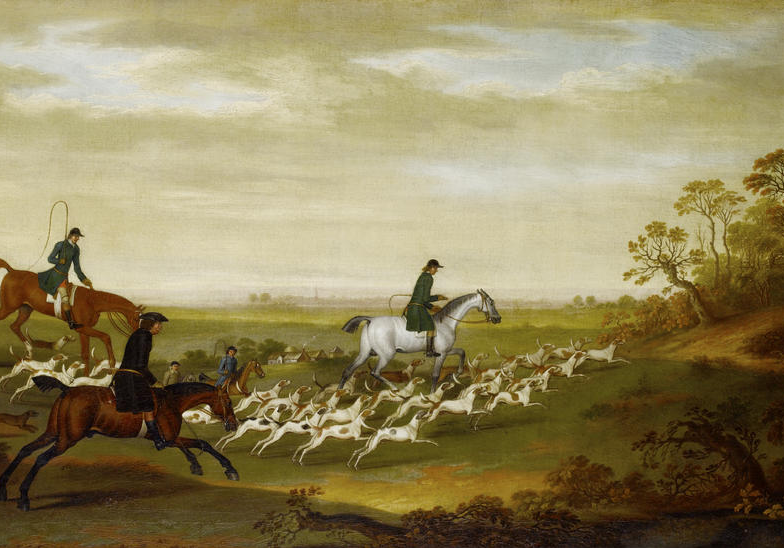
Why James Seymour matters
James Seymour, active from about 1720 to 1752, is generally credited as one of the first English painters to specialize almost exclusively in sporting and equestrian subjects, working a full generation before George Stubbs codified the genre. His racehorses, hunters, and hunting scenes helped establish a visual vocabulary for British sporting art that later painters built on, and his work is held today in institutions including Tate and the Yale Center for British Art. For collectors, he matters less as an active auction name and more as a foundational, museum-anchored figure in the early history of British animal and sporting painting.
- Nationality
- English
- Media
- Painting
- Movement
- Sporting art, Georgian-era British painting
- Education
- St Martin's Lane Academy, London, attended 1720, under Louis Cheron and John Vanderbank; otherwise self-taught, studying pictures in his father's collection
- Signature motifs
- Racehorses, Hunting scenes, Equestrian portraiture
By the numbers
- c. 1720 to 1752ActiveFrom St Martin's Lane Academy to his death
- Sporting and equestrian paintingSpecializationAmong the first English painters devoted almost exclusively to the genre
- GBP 22,680Best-documented auction resultThe Match, Two Racehorses on the Downs, Sotheby's London, April 2022; not confirmed as an all-time record
- 30 June 1752DeathSouthwark, London
Selected works
Click any work to view it full screen.
Biography
James Seymour was born around 1702, probably in London, the son of James Seymour Sr., a banker, goldsmith, and dealer in diamonds and pictures. His father's trade in art gave the younger Seymour early access to paintings and prints, and standard references describe him as essentially self-taught. In 1720 he attended the newly opened art academy in St Martin's Lane, London, founded by Louis Cheron and John Vanderbank, paying an additional subscription that October.
Seymour built his career painting racehorses, hunters, and hunting scenes for aristocratic patrons, including the 6th Duke of Somerset, whose collection held a number of his canvases. He moved in racing and gambling circles throughout his life, and that involvement eventually cost him: he ran through his income on the turf and fell into debt. He died on 30 June 1752 at lodgings on Blackman Street in Southwark, London, unmarried and, according to later accounts, surrounded by unfinished paintings.
Critical reception
Seymour's contemporaries recognized his specialty early. A contemporary obituary, cited by Tate, described him as particularly eminent in horse painting. He is now generally treated as an important transitional figure between the earlier tradition of gentleman sporting portraiture and the more anatomically ambitious painting that George Stubbs brought to the field a generation later.
Market
Seymour's market is thin and difficult to characterize with confidence. Available research located a single well-documented recent sale: a work titled The Match, Two Racehorses on the Downs sold at Sotheby's in London in April 2022 for GBP 22,680, against an estimate of GBP 20,000 to 30,000. That is the highest price identified in this research, but comprehensive auction-database coverage was not available, so it should be treated as the best-documented result rather than a confirmed all-time record. His paintings appear periodically at London sales of English sporting and Old Master pictures, most often through specialist departments at Sotheby's, Christie's, and Bonhams, and are handled on the dealer market by specialists such as Lane Fine Art and Richard Green, both of whom maintain published research on the artist.
Top auction results
| Work | Price | Sale |
|---|---|---|
| The Match, Two Racehorses on the Downs (2022) | GBP 22,680 | Sotheby's, London, 2022-04 |
Selected exhibitions
| Years | Exhibition | Venues |
|---|---|---|
| 1700s | Paintings held in the collection of the 6th Duke of Somerset | Private collection (exact venue and dates not documented) |
| Ongoing | Permanent collection holdings | Tate, London |
Museum collections
- Tate, London
- Yale Center for British Art, New Haven
- Virginia Museum of Fine Arts, Richmond
Authentication and provenance
No catalogue raisonne.
No catalogue raisonne of Seymour's work has been identified. Attribution relies on connoisseurship, documented provenance, and the published research of specialist dealers rather than on a certifying scholarly catalogue.
Primary reference: https://www.tate.org.uk/art/artists/james-seymour-488
What collectors should know
No catalogue raisonne of Seymour's work has been identified, and attribution rests on connoisseurship, documented provenance, and the published research of specialist dealers rather than on a certifying scholarly catalogue. His auction market is thin: this research located only one clearly documented recent sale, which makes any single result a fragile guide to value and argues for caution before treating any price as representative. Collectors should also take care with the name itself, since it is shared by other people, including a twentieth-century Hollywood screenwriter and various living artists and designers, none of whom should be confused with the eighteenth-century sporting painter described here.
Further reading and resources
Data current as of 2026-07-16.

