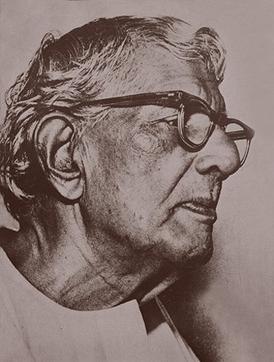
Why Jamini Roy matters
Jamini Roy is one of the pivotal figures of modern Indian art, an academically trained painter who deliberately turned away from Western realism to build a visual language out of Bengal's own folk and devotional traditions, above all the Kalighat pat paintings sold near Calcutta's temples. For a collector, he represents a case where cultural and institutional significance is unusually settled: his paintings are held by national and international museums, his work has been legally classed by the Indian government as a national art treasure, and yet his market runs through a scattered set of galleries and auction houses rather than a single estate or dealer of record.
- Born
- 1887-04-11, Beliatore, Bankura district, Bengal, British India
- Nationality
- Indian
- Media
- Painting, Tempera on cloth
- Movement
- Indian modernism, Folk art revivalism
- Education
- Government School of Art, Calcutta, Diploma in Fine Arts, 1903 to 1908
- Signature motifs
- Kalighat-derived folk figures, Flat frontal compositions
- Representation
- "Grosvenor Gallery, London", "DAG, New Delhi and Mumbai"
By the numbers
- INR 4.32 croreAuction highUntitled (tempera on cloth), Saffronart, 13 October 2021
- 1954Padma BhushanIndia's third-highest civilian award
- 1976National Art Treasure statusWorks restricted from export under India's Antiquities and Art Treasures Act
- No single exclusive dealer; active galleries include Grosvenor Gallery and DAGRepresented by
Biography
Jamini Roy was born on 11 April 1887 in Beliatore, in the Bankura district of Bengal, then part of British India. He enrolled at the Government School of Art in Calcutta in 1903, studying under Abanindranath Tagore, and earned a Diploma in Fine Arts there in 1908. His early career followed the academic path of the school, producing portraits and landscapes in a Western realist idiom.
Over the 1920s Roy broke from that training, developing a flattened, boldly outlined style drawn from Kalighat pat paintings and Bengali folk and religious imagery, and he began working in tempera on cloth, paper, and other everyday materials rather than oil on canvas. His paintings were shown publicly for the first time on British India Street in Calcutta in 1938, following an earlier 1929 exhibition sponsored by Mukul Dey that was inaugurated by Sir Alfred Watson, editor of The Statesman. His work traveled internationally during his lifetime, including exhibitions in London in 1946 and New York in 1953.
Roy received India's Padma Bhushan in 1954 and was made a Fellow of the Lalit Kala Akademi, the national art academy, in the mid-1950s. He died at his residence in South Calcutta on 24 April 1972, at the age of eighty-five, after being diagnosed with uraemia and lapsing into a coma from which he did not recover, as reported by a contemporaneous Hindustan Times account and repeated in later Indian press summaries of his career. Encyclopedic sources including Britannica and Wikipedia likewise place his death in Calcutta, now Kolkata, on that date. In 1976, four years after his death, the Indian government declared his works national art treasures under the Antiquities and Art Treasures Act, restricting their export from the country.
Critical reception
From the start of his mature style, critics read Roy's turn to folk idiom as a deliberate act of cultural recovery rather than a stylistic novelty. At the inauguration of his 1929 Calcutta exhibition, Sir Alfred Watson, editor of The Statesman, praised Roy's effort to build a national art rooted in native tradition rather than in academic conventions imported from abroad. That framing, of Roy constructing a national visual language out of indigenous materials and imagery rather than imported academic technique, has largely held up in later scholarship and museum programming, and it underlies the government's later decision to protect his paintings as national treasures.
Market
Roy's recorded auction high is an untitled large tempera-on-cloth painting that sold for INR 4.32 crore in an online sale conducted by Saffronart on 13 October 2021, reported at the time as his most expensive work to date. Subsequent results have varied widely below that figure, including an untitled work that made roughly INR 16.3 lakh at AstaGuru in Mumbai in 2022 and further lots reported in 2026, illustrating how much individual results can differ depending on the specific work and moment of sale. No catalogue raisonne has been identified, and no single gallery or estate acts as his exclusive representative; instead, his secondary market runs through a set of established dealers, including Grosvenor Gallery in London and DAG in India, alongside periodic appearances at major international auction houses. The 1976 national art treasure designation also affects supply outside India, since many works cannot legally leave the country.
Top auction results
| Work | Price | Sale |
|---|---|---|
| Untitled (large tempera on cloth) | INR 4.32 crore (approximately Rs 43,200,000) | Saffronart, Online sale (Saffronart, India), 2021-10-13 |
Selected exhibitions
| Years | Exhibition | Venues |
|---|---|---|
| 1929 | Early exhibition sponsored by Mukul Dey | Calcutta, India (inaugurated by Sir Alfred Watson, editor of The Statesman) |
| 1938 | First public exhibition of his paintings | British India Street, Calcutta, India |
| 1946 | London exhibition | London, UK (venue not specified in available sources) |
| 1953 | New York exhibition | New York, USA (venue not specified in available sources) |
| 1956 | Exhibition at the National Gallery of Art | National Gallery of Art, Washington, D.C., USA |
| 2012 | Jamini Roy (1887 to 1972): Journey to the Roots | National Gallery of Modern Art, New Delhi, India |
| 2018 | Conserving Treasures: Jamini Roy and Modern Indian Art | Harn Museum of Art, University of Florida, Gainesville, USA |
| 2025 | Jamini Roy, Monochrome | Grosvenor Gallery, London, UK |
Museum collections
- National Gallery of Modern Art, New Delhi
- Harn Museum of Art, University of Florida
Awards and honors
- Viceroy's Gold Medal, All-India Exhibition (1934)
- Padma Bhushan, Government of India (1954)
- Fellow, Lalit Kala Akademi (second Fellow conferred by the academy) (1956)
- Works declared national art treasures, Antiquities and Art Treasures Act, part of the government's 'Nine Masters' designation (1976)
Authentication and provenance
No catalogue raisonne.
No catalogue raisonne has been located and no single estate representative confirms attributions. Works are authenticated through provenance research and the network of established dealers who handle the market, including Grosvenor Gallery, DAG, and Aicon Gallery. A 1976 government declaration classed his paintings as national art treasures under India's Antiquities and Art Treasures Act, which restricts export of many works and shapes how provenance is documented.
Primary reference: https://www.britannica.com/biography/Jamini-Roy
What collectors should know
Roy's market is thin and uneven relative to his institutional stature, so a single auction result should be read carefully rather than treated as a stable trend line. There is no catalogue raisonne and no single authenticating estate, which puts extra weight on provenance and on the track record of the specific dealer or house involved; Grosvenor Gallery, DAG, and Aicon Gallery are among the more established names currently handling his work. Collectors buying or researching Roy should also account for India's 1976 national art treasure designation, which restricts the export of many of his paintings and shapes where, and how, works legitimately come to market outside the country.
Further reading and resources
Data current as of 2026-07-16.

