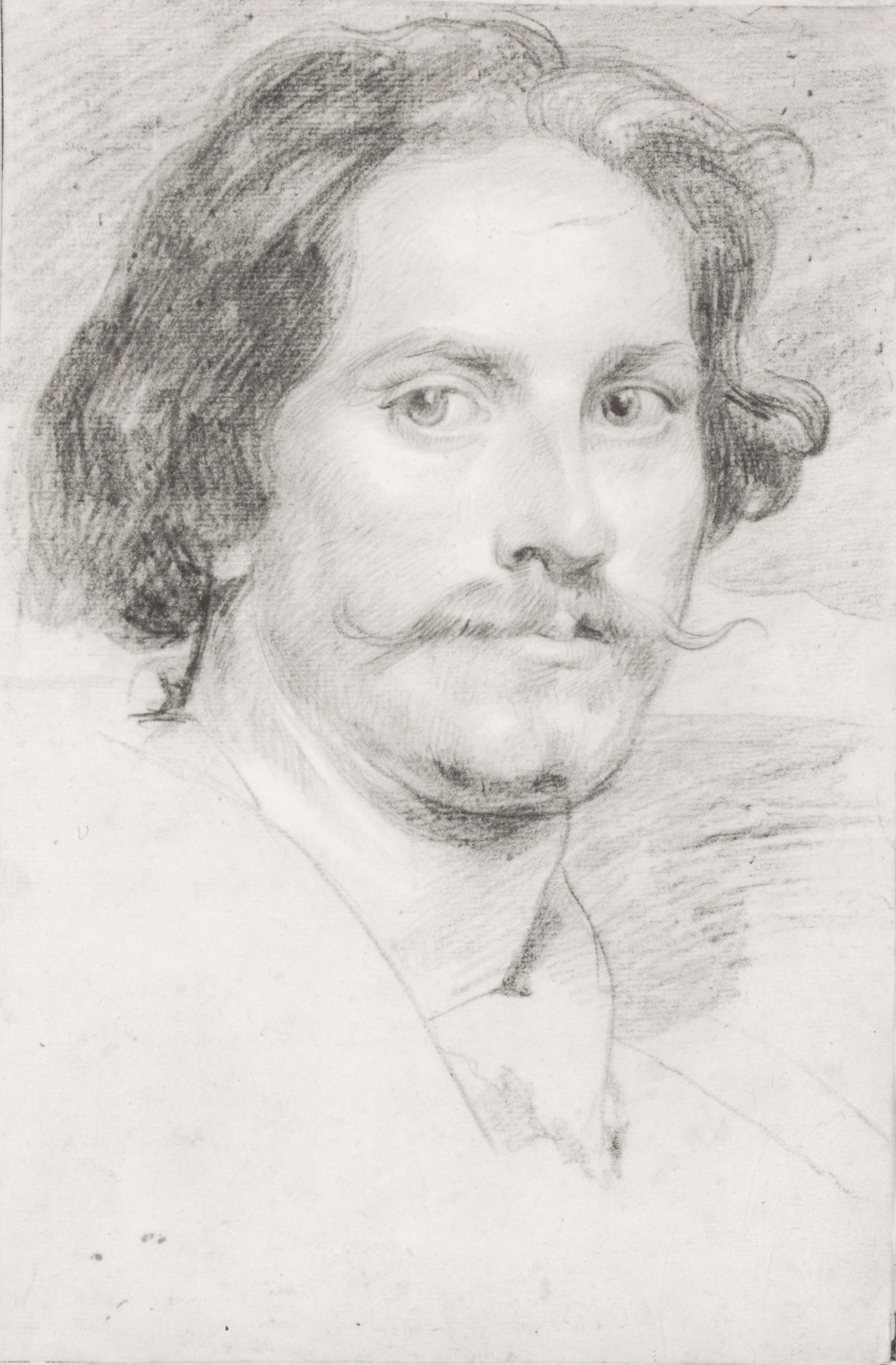
Why Jan Boeckhorst matters
Jan Boeckhorst, also documented as Johann Bockhorst, was a German-born painter who became one of the most trusted collaborators inside the great Antwerp workshops of the early to mid seventeenth century, working alongside Peter Paul Rubens, Anthony van Dyck, and Jacob Jordaens. He is a useful case for collectors of Flemish Baroque painting precisely because his career sits inside that network rather than apart from it: his work appears in major museum collections from Antwerp to Los Angeles, yet attribution and authentication still depend heavily on connoisseurship and archival research rather than a settled market apparatus.
- Nationality
- German
- Media
- Painting, Drawing, Tapestry design
- Movement
- Flemish Baroque
- Education
- Gymnasium Paulinum, Munster, to 1620; canon at St. Clemens, Wissel, from 1621; artistic training in Antwerp from c. 1626, chiefly in the workshop of Jacob Jordaens; master, Antwerp Guild of Saint Luke, 1633 to 1634
- Signature motifs
- Mythological and religious history painting, Apollo tapestry cartoons, Rubens-workshop collaborations
By the numbers
- GBP 93,750Auction high (documented)Apollo on his Sun Chariot, Bonhams London, 7 December 2016, auction 24055 lot 48
- Master, Antwerp Guild of St. LukeGuild status1633 to 1634
- Multiple public collectionsMuseum collectionsIncluding KMSKA Antwerp, Rubenshuis, Stadel Museum, LACMA, Getty, Kunsthistorisches Museum Vienna; full institutional count not independently verified
- c. 1626 to 1668Active periodAntwerp
Selected works
Click any work to view it full screen.
Biography
Boeckhorst was born around 1604 in Munster, Westphalia, though at least one institutional source leaves open the possibility that he was born in nearby Rees. He received a humanist education at the Gymnasium Paulinum in Munster until 1620, then in 1621, at age seventeen, became a canon at the collegiate church of St. Clemens in Wissel, near Kalkar. He was never ordained a priest, and by around 1626, at the unusually late age of about twenty-two, he set that path aside to study painting in Antwerp.
There is no firm documentary proof of direct study under Rubens. The early biographer Cornelis de Bie, writing in 1661, states that he apprenticed under Jacob Jordaens, and modern scholars favor Jordaens as the more likely teacher, since Rubens was largely away in Spain and England in the late 1620s. By 1633 or 1634 Boeckhorst had become a master in the Antwerp Guild of Saint Luke, confirming his standing as an independent painter. He is recorded as making two study trips to Italy to look closely at Titian and Tintoretto, returning to Antwerp by about 1640. He went on to paint large-scale history, religious, and mythological subjects, worked closely with Rubens's studio on collaborative commissions, and designed cartoons for an eight-part tapestry series on the myths of Apollo. He died in Antwerp on 21 April 1668 and was buried in the Saint James Church, known locally as the Sint-Jacobskerk.
Critical reception
Modern scholarship treats Boeckhorst less as a peripheral assistant and more as an independently significant painter who absorbed the Venetian color of Titian and Tintoretto during his Italian travels and folded it into the history-painting language of Rubens's Antwerp. He was known in his own time by the nickname "Lange Jan," or "Tall Jan." Because his hand overlaps closely with Rubens, Van Dyck, and Jordaens, attribution of individual paintings remains an active area of curatorial and archival research. No exact, verifiable, bylined critical quotation about Boeckhorst in a major outlet could be confirmed for this profile, so none is reproduced here.
Market
Boeckhorst's auction market is thin and unevenly documented compared with his Antwerp contemporaries. The most frequently cited high result is Apollo on his Sun Chariot, which sold for GBP 93,750 including premium at Bonhams London on 7 December 2016 (auction 24055, lot 48), the best-documented result found for the artist. A separate market-summary compiler reports an even higher figure, EUR 158,000, for an oil painting sold at Christie's London in 2012 as lot 46, and describes it there as his top recorded painting price. That figure comes from a secondary valuation aggregator rather than a primary Christie's catalogue entry, and the painting's title and exact sale date could not be confirmed. Collectors should treat the EUR 158,000 figure as an unverified, secondary-sourced claim, not as a confirmed record.
Top auction results
| Work | Price | Sale |
|---|---|---|
| Apollo on his Sun Chariot | GBP 93,750 | Bonhams, London, 2016-12-07 |
| Untitled oil on canvas (title not confirmed) (2012) | EUR 158,000 | Christie's, London |
Selected exhibitions
| Years | Exhibition | Venues |
|---|---|---|
| 2019 | Van Titiaan tot Rubens: Meesterwerken uit Antwerpen en andere Vlaamse collecties | Museum Boijmans Van Beuningen, Rotterdam |
| 2012 | De Heemskerck a Le Brun: les plus beaux dessins du musee du Mont-de-Piete de Bergues | Musee du Mont-de-Piete, Bergues |
| 2008 | Black is Beautiful: Rubens to Dumas | De Nieuwe Kerk, Amsterdam |
Museum collections
- Royal Museum of Fine Arts Antwerp (KMSKA)
- Rubenshuis, Antwerp
- Kunsthistorisches Museum, Vienna
- Städel Museum, Frankfurt am Main
- Los Angeles County Museum of Art
- J. Paul Getty Museum, Los Angeles
Authentication and provenance
No catalogue raisonne.
No catalogue raisonne has been confirmed for Jan Boeckhorst. A scholarly catalogue of his paintings and drawings by Ursula Harting, reviewed in the journal of the Historians of Netherlandish Art, documents much of the known oeuvre, but it has not been confirmed to meet the formal standard of a catalogue raisonne. Attribution continues at the museum and curatorial level, given how closely his hand can resemble that of Rubens, Van Dyck, and Jordaens.
Primary reference: https://en.wikipedia.org/wiki/Jan_Boeckhorst
What collectors should know
Boeckhorst's market is small, thinly traded, and short on primary-source pricing detail, which means any single auction result should be weighed carefully rather than treated as a stable benchmark. No catalogue raisonne has been confirmed; the closest scholarly equivalent is Ursula Harting's documented catalogue of his paintings and drawings, and verification of any individual work depends on museum curatorial opinion and provenance research rather than a certifying body. Because his hand overlaps closely with Rubens, Van Dyck, and Jordaens, collectors should expect attribution questions to be a normal, ongoing part of owning or evaluating his work. No current gallery or estate representation could be identified; his paintings and drawings circulate through auction houses and reside in public museum collections.
Further reading and resources
Data current as of 2026-07-18.

