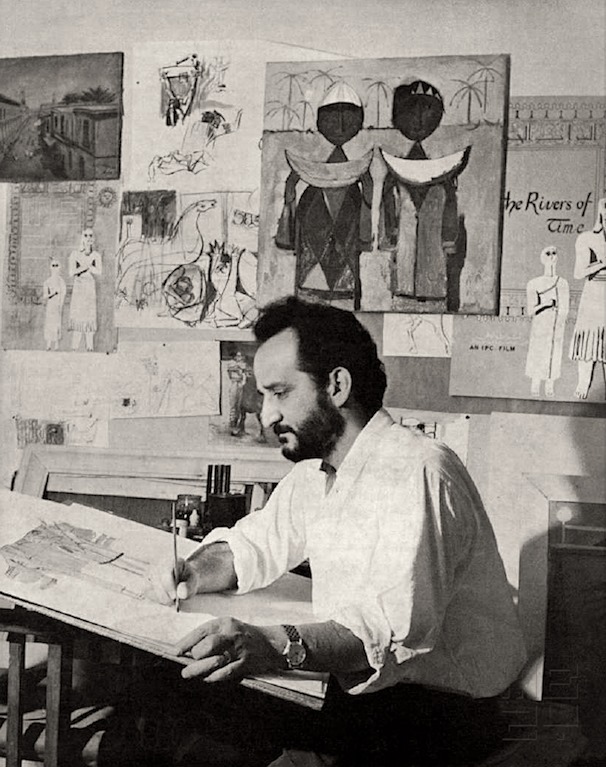
Why Jawad Selim matters
Jawad Selim, whose name is catalogued interchangeably as Jewad Selim and Jawad Salim, is widely credited as the founding figure of modern Iraqi art. Working as both painter and sculptor in Baghdad through the 1940s and 1950s, he led a generation that fused ancient Mesopotamian and Islamic visual heritage with the language of European modernism he absorbed in Paris, Rome, and London. He co-founded the Baghdad Group for Modern Art and designed the Freedom Monument that still stands in Baghdad's Tahrir Square. For collectors, he represents a foundational, historically important body of work that trades in a small, tightly specialized Middle Eastern art market rather than the broad secondary market of a living contemporary artist.
- Nationality
- Iraqi
- Media
- Painting, Sculpture
- Movement
- Iraqi Modernism, Baghdad Group for Modern Art
- Education
- Primary and secondary school, Baghdad, years unrecorded; Ecole des Beaux-Arts, Paris, 1938 to 1939, on an Iraqi government scholarship (interrupted by the outbreak of World War II); studied sculpture under Angelo Zanelli, Rome, 1939 to 1940; Slade School of Fine Art, London, 1946 to 1949. No completed degree is documented for any of these periods.
- Signature motifs
- Semi-abstract figuration merging Mesopotamian and European modernist forms, Monumental public sculpture
- Representation
- Meem Gallery, Dubai
By the numbers
- GBP 838,750Auction highGood and Evil, An Abstraction, Bonhams London, 17 November 2021, a world record for the artist
- Co-founder, Baghdad Group for Modern ArtFounding roleBaghdad, 1951
- International competition prizeTate Gallery honorPrize in an international sculpture competition, exhibited at the Tate Gallery, London; exact competition name and year not confirmed in available sources
- Tahrir Square, BaghdadFreedom MonumentDesigned 1959 to 1961; installation completed after his death
Selected works
Click any work to view it full screen.
Biography
Jawad Selim was born in Ankara, then part of the Ottoman Empire, in a year most auction house and specialist collection sources give as 1919, though some academic and reference sources instead cite 1920 or 1921; no exact birth date has been documented in available sources. He came from an artistic family: his father, Mohammed Hajji Selim, was himself a pioneering modern Iraqi painter, and several of his siblings, including his sister Naziha Selim, also became artists. He completed primary and secondary school in Baghdad before winning a silver prize in sculpture at the city's first art exhibition in 1931, at about age eleven, which helped set him on course for study abroad.
On an Iraqi government scholarship, Selim studied painting and sculpture at the Ecole des Beaux-Arts in Paris beginning in 1938, then relocated to Rome to study in the atelier of the sculptor Angelo Zanelli in 1939. Both periods of study were cut short by the outbreak of the Second World War, forcing his return to Baghdad. In 1946 he traveled to London and studied sculpture at the Slade School of Fine Art through 1949, where he came under the influence of Henry Moore and other Western modernists; it was in London that he met the English artist Lorna Beryl Selim, whom he married and who later moved with him to Baghdad.
Returning to Iraq in 1949, Selim became head of the Sculpture Department at the Institute of Fine Arts in Baghdad. In 1951 he co-founded the Baghdad Group for Modern Art with fellow Iraqi artists, a collective built around the idea of grounding a modern visual language in Iraq's own artistic and archaeological heritage rather than simply importing European styles. His international profile grew through the 1950s: he received a prize in an international sculpture competition exhibited at London's Tate Gallery, though the exact competition name and year are not confirmed in available sources, and in 1954 a touring exhibition organized by the American Friends of the Middle East carried his work to Portland, New York, Philadelphia, Pittsburgh, and Chicago.
From 1959 he worked on his best known public commission, the Freedom Monument (Nasb al-Hurriya), a long bronze relief for Baghdad's Tahrir Square commemorating the 1958 revolution. Selim died in Baghdad on 23 January 1961, apparently of a heart attack, before the monument was fully installed; one French-language source gives 22 January instead. His widow, Lorna Selim, oversaw the completion and installation of the monument, which remains a landmark of modern Iraqi public art.
Critical reception
Institutional and market sources consistently describe Selim in foundational terms. Bonhams calls him "the founding father of modern Iraqi art," while Wikipedia describes him as "one of Iraq's greatest 20th century sculptors." The recurring critical thread is his role as a bridge figure, translating Mesopotamian and Islamic visual heritage into a modern, semi-abstract idiom, a project that reached its fullest public expression in the Freedom Monument and that continues to anchor recent scholarly and museum reassessments of the Baghdad Group for Modern Art.
Market
Selim's market is small, specialized, and concentrated in Middle Eastern art sales at Bonhams and Christie's. His all-time auction record is Good and Evil, An Abstraction, which sold for GBP 838,750 including premium at Bonhams London on 17 November 2021, a result the house described as a new world record for the artist. That sale succeeded earlier records, including a reported USD 876,730 result for The Watermelon Seller at a Christie's London sale (exact date unconfirmed in available sources) and a USD 336,000 result at a Bonhams Dubai sale in March 2008, showing a market that has moved upward in step-changes tied to a small number of major lots rather than steady turnover. Meem Gallery in Dubai has represented and exhibited his work in the commercial gallery market. There is no published catalogue raisonne, so provenance research and the documentation held by institutions such as the Dalloul Art Foundation carry particular weight in verifying individual works.
Top auction results
| Work | Price | Sale |
|---|---|---|
| Good and Evil, An Abstraction | GBP 838,750 | Bonhams, London, 2021-11-17 |
Selected exhibitions
| Years | Exhibition | Venues |
|---|---|---|
| 1953 | Iraqi Art Exhibition in India | New Delhi, Calcutta, Hyderabad |
| 1954 | Jewad Selim, touring exhibition | American Friends of the Middle East tour: Portland, New York, Philadelphia, Pittsburgh, Chicago |
| 1956 | Baghdad Exhibition of Paintings and Sculptures | Al-Mansur Club, Baghdad |
| 1957 | Exhibition of Contemporary Art in Iraq | UNESCO House, Beirut |
| 1961 | Freedom Monument (Nasb al-Hurriya) | Tahrir Square, Baghdad |
| 1968 | Jewad Selim, solo exhibition | National Museum of Modern Art, Baghdad |
| 2025 to 2026 | All Manner of Experiments: Legacies of the Baghdad Modern Art Group | NYU Abu Dhabi Art Gallery |
Museum collections
- Mathaf: Arab Museum of Modern Art, Doha
- National Museum of Modern Art, Baghdad
- Jordan National Gallery of Fine Arts, Amman
Awards and honors
- Silver prize in sculpture, First Baghdad Art Exhibition (1931)
- Prize in an international sculpture competition, exhibited at the Tate Gallery, London (exact competition name and year not confirmed in sources)
Authentication and provenance
No catalogue raisonne.
No published catalogue raisonne exists for the artist. Works are chiefly authenticated and tracked through the specialist departments of major auction houses (Bonhams, Christie's) and through the archival and provenance research of the Dalloul Art Foundation and the Ibrahimi Collection.
Primary reference: https://bonhams.shorthandstories.com/artist-101-jewad-selim/
What collectors should know
Selim's market sits well outside the mainstream of Western postwar and contemporary auction activity: results are infrequent, concentrated at Bonhams and Christie's Middle Eastern art sales in London and Dubai, and driven by a small number of high-value lots rather than broad, continuous trading. There is no catalogue raisonne, so collectors should expect authentication and provenance work to rest on auction house specialist review and on documentation held by institutions such as the Dalloul Art Foundation. Even basic biographical data, including his exact birth year, is unsettled across otherwise reliable sources, a reminder that pre-1960s Iraqi modernist record-keeping is thinner than for better-documented Western contemporaries; none of this affects the strength of his institutional standing, which rests on museum holdings and his founding role in the Baghdad Group for Modern Art rather than on market volume.
Further reading and resources
Data current as of 2026-07-13.

