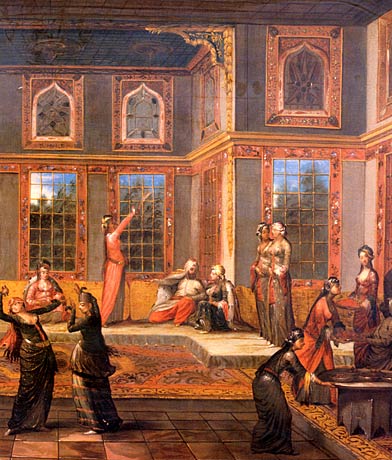
Why Jean-Baptiste Vanmour matters
Jean-Baptiste Vanmour is the closest thing the early eighteenth century has to a photojournalist of the Ottoman court. Working in Constantinople for nearly four decades, he produced the most sustained and detailed visual record of Tulip Era life, from sultans and grand viziers to ambassadors, dervishes, and street scenes, that survives from any European painter of the period. For collectors, he matters less as a market name than as a documentary source: his paintings anchor the core Ottoman-subject holdings of the Rijksmuseum, and his market today is a thin, museum-adjacent Old Master category rather than a liquid trading name.
- Born
- 1671-01-09, Valenciennes, France
- Nationality
- Flemish-French
- Media
- Painting
- Movement
- Old Master, Ottoman court painting
- Education
- Documented only as training in the atelier of Jacques-Albert Gerin in Valenciennes. No formal academy and no precise years of study are recorded in standard references.
- Signature motifs
- Ottoman court and diplomatic scenes, Tulip Era genre painting, Portraits of sultans and ambassadors
By the numbers
- EUR 85,400Auction high (documented)'Osman Marriage,' Lempertz, Cologne. Exact sale date not published in the accessible auction record.
- 1699 to 1737Active in Constantinople
- Peintre Ordinaire du Roy en LevantRoyal titleConferred by Louis XV, 1725
- Rijksmuseum, AmsterdamCore collectionVanmour series, reunited 1903
Selected works
Click any work to view it full screen.
Biography
Jean-Baptiste Vanmour was born on 9 January 1671 in Valenciennes, in what was then a contested border region between France and the Spanish Netherlands. Little is documented about his early training beyond a consistent reference across standard biographical sources to study in the atelier of the painter Jacques-Albert Gerin, also cited as an early teacher of Antoine Watteau. No formal academy enrollment or precise years of study are recorded.
Around 1699, Vanmour traveled to Constantinople in the retinue of Charles de Ferriol, the newly appointed French ambassador to the Ottoman Porte, and came under his patronage. He appears to have remained in the city for the rest of his life, building a practice around portraits of sultans and court officials, records of ambassadorial receptions and processions, and genre scenes of everyday Ottoman life, including markets, festivals, and religious practice. In 1725 he was granted the title Peintre Ordinaire du Roy en Levant by Louis XV, formally recognizing his role as the French crown's painter in the Levant.
Vanmour's most consequential patron was Cornelis Calkoen, the Dutch ambassador to Constantinople from 1725 to 1743, who commissioned an extensive series of paintings documenting his embassy and Ottoman court life. That group later passed into the Amsterdam city collection and was reunited at the Rijksmuseum in 1903, where it remains the core public holding of his work. Vanmour died in Constantinople, in the Galata district, on 22 January 1737. His burial site is not firmly documented; Wikidata records only a general burial location of Istanbul, with no further corroboration found in current research.
Critical reception
Vanmour is treated in the scholarly and museum literature primarily as a documentary source rather than as a subject of stylistic debate. Institutions including the Rijksmuseum present his Ottoman-court paintings as records of Tulip Era diplomacy and daily life, valuable for costume, ceremony, and social detail as much as for painterly technique. No verbatim critical assessment from a named critic in a major contemporary outlet could be confirmed in current research, so none is quoted here; the consistent institutional framing, across museum and auction-house materials alike, is of Vanmour as the principal European eyewitness painter of the Ottoman court in his period.
Market
Vanmour's auction market is small and infrequent, consistent with an artist whose work is concentrated in museum collections rather than private hands. The highest documented result identified in current research is EUR 85,400 for a work titled Osman Marriage, sold through Lempertz in Cologne; the Lempertz artist index confirms the price but does not publish the exact sale date, so that detail is treated as unresolved rather than assumed. A separate, well-documented sale is the painting Arrival of the English Ambassador Sir Robert Sutton, Constantinople, attributed to Vanmour, which sold at Heritage Auctions for USD 75,000; the exact sale date and city could not be confirmed in current research. Other results, including lots at Dorotheum and Sotheby's, have realized more modest sums or estimate-only outcomes, reinforcing that this is a specialist Old Master category with limited comparable data rather than a name with a well-established price curve.
Top auction results
| Work | Price | Sale |
|---|---|---|
| Osman Marriage | EUR 85,400 | Lempertz, Cologne, Germany |
| Arrival of the English Ambassador Sir Robert Sutton, Constantinople (attributed to Jean-Baptiste Vanmour) | USD 75,000 (USD 75,000) | Heritage Auctions |
Selected exhibitions
| Years | Exhibition | Venues |
|---|---|---|
| 2003 | Lale Devri Istanbul'una Iki Ozgun Bakis: Van Mour ve Levni | Topkapi Palace Museum, Istanbul |
Museum collections
- Rijksmuseum, Amsterdam
- Wellcome Collection, London
Awards and honors
- Peintre Ordinaire du Roy en Levant, royal title conferred by Louis XV (1725)
Authentication and provenance
No catalogue raisonne.
No catalogue raisonne has been identified for Vanmour. Attribution and authentication rest on museum scholarship, principally the Rijksmuseum's Vanmour series (assembled from ambassador Cornelis Calkoen's collection and reunited in 1903), together with standard auction-house cataloguing practice for Old Masters.
Primary reference: https://en.wikipedia.org/wiki/Jean_Baptiste_Vanmour
What collectors should know
Vanmour is a specialist Old Master category, not a liquid contemporary market. There is no catalogue raisonne, so attribution weight falls on documented provenance, comparison to the secure Rijksmuseum group, and standard auction-house cataloguing, including "attributed to" and workshop designations that materially affect price. Auction data is sparse, with only a handful of clearly documented results, so any single sale should be read as one data point in a thin market rather than as a stable benchmark. Collectors should also expect variant spellings of the artist's name, including Jean Baptiste Vanmour and Jean-Baptiste van Mour, across catalogues and databases; these refer to the same painter, not to different artists.
Further reading and resources
Data current as of 2026-07-13.

