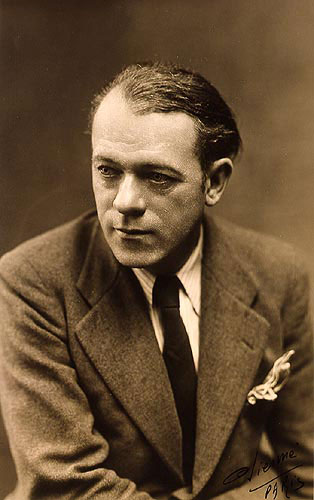
Why Jean Dufy matters
Jean Dufy spent much of his career, and much of his critical reception, in the shadow of his older brother Raoul, one of the twentieth century's best known Fauvist colorists. But Jean built a distinct, decades-long practice of his own: color-saturated scenes of Paris, its orchestras, racecourses, and regattas, alongside decorative arts work that earned him a gold medal at the 1925 Exposition Internationale des Arts Decoratifs. For collectors, he represents an accessible entry point into the Ecole de Paris generation, a painter with genuine museum presence, priced well below his brother's market.
- Born
- 1888-03-12, Le Havre, France
- Nationality
- French
- Media
- Painting, Watercolor, Decorative arts
- Movement
- Art Deco, École de Paris
- Education
- General schooling in Le Havre, including a certificat d'études primaires elementaire (1901); sources disagree on his art training, with several galleries and auction houses citing enrollment at the Ecole des Beaux-Arts du Havre alongside Raoul Dufy, Othon Friesz, and Georges Braque, while at least one market source describes him as self-taught.
- Signature motifs
- Parisian street and river scenes, Orchestras and musicians, Circuses and racecourses, Regattas and harbor scenes
- Representation
- Findlay Galleries, Rehs Galleries
By the numbers
- EUR 274,000Auction highVoiliers dans le port du Havre (1907), sold 2023; auction house and exact date not documented in available sources. No single, fully verified all time record could be confirmed.
- Gold Medal1925 awardExposition Internationale des Arts Decoratifs, porcelain service Chateaux de France
- Findlay Galleries; Rehs GalleriesMarketHistoric dealers handling secondary market sales; artist is deceased with no exclusive representation
Biography
Jean Dufy was born on 12 March 1888 in Le Havre, France, eleven years after his brother Raoul. He attended public schools in Le Havre, earning a certificat d'etudes primaires elementaire on 9 July 1901, before financial constraints ended his general schooling and he began paid work around age sixteen. Secondary sources disagree on his art training: several galleries and auction houses, including Christie's, Findlay Galleries, and Saddle River Gallery, state he trained at the Ecole des Beaux-Arts du Havre, the school that also trained Raoul, Othon Friesz, and Georges Braque, while at least one market source describes him as having no formal training. He later moved to Paris, where Raoul became his principal artistic mentor.
In Paris, Jean developed a signature repertoire of subjects: Parisian streets and quays, orchestras and musicians, circuses, racecourses, and regattas, rendered in bright, fluid color close in spirit to his brother's Fauvism but with its own decorative rhythm. He also worked in the applied arts, designing a porcelain dinner service, Chateaux de France, for a porcelain manufacturer; the service won a gold medal at the 1925 Exposition Internationale des Arts Decoratifs et Industriels Modernes in Paris. He exhibited regularly at the Salon d'Automne through the 1920s and early 1930s and showed with dealers in Paris (Galerie Bing & Cie) and New York (Balzac Galleries, Perls Galleries). At his brother's request, he contributed research and preparatory sketches to Raoul's monumental mural La Fee Electricite for the Pavilion of Electricity at the 1937 Exposition Internationale de Paris.
He continued to paint and exhibit after World War II, showing in New York, Philadelphia, Boston, Chicago, and Montreal into the 1950s. His wife died earlier in 1964, and Jean Dufy died on 12 May 1964, at age 76, in La Boissiere, a hamlet of Boussay in the Indre-et-Loire department of France; sources vary on whether his death followed hers by roughly two weeks or two months, and this profile does not assert a specific interval.
Critical reception
Jean Dufy's critical reception has long been shaped by comparison to his brother Raoul; gallery and auction house biographies, including those from Christie's, Rehs Galleries, and Findlay Galleries, consistently frame his career in relation to Raoul's, noting their shared training circle in Le Havre and Jean's later apprenticeship under his brother's influence in Paris. Within that frame, dealers and museums have praised his color sense and his eye for the theater of Parisian public life, orchestras, racecourses, circuses, and river scenes rendered with a decorative, musical rhythm. His inclusion in the collections of the Centre Pompidou, the Museum of Modern Art, the Art Institute of Chicago, and the Albertina confirms institutional recognition even where independent critical writing on him specifically remains thin.
Market
Multiple individual sales place Jean Dufy's market in the low six figures, but no single, fully documented all time auction record could be confirmed for this profile. The oil Voiliers dans le port du Havre (1907) sold for EUR 274,000 in 2023, the highest price tied to a named, dated work found in research, though the auction house and exact calendar date were not identified in available sources. Heritage Auctions' artist index separately lists a USD 103,125 sale on 3 December 2021 as its highest Jean Dufy result, though the title of that work is not given. A New York sale of Place de la Concorde has also been reported at USD 121,150, again without a confirmed auction house or date. Market summaries suggest oils on canvas have reached figures as high as roughly EUR 420,000, but no source ties that figure to a specific, verifiable sale, so it is not treated as a confirmed record here. Across these results, his prices sit well beneath his brother Raoul's market, consistent with his standing as a strong secondary figure of the Ecole de Paris rather than a headline name.
Top auction results
| Work | Price | Sale |
|---|---|---|
| Voiliers dans le port du Havre (1907) | EUR 274,000 | Not documented in available sources, Not documented in available sources, 2023 |
| Not documented in available sources | USD 103,125 | Heritage Auctions, 2021-12-03 |
Selected exhibitions
| Years | Exhibition | Venues |
|---|---|---|
| 1920 to 1932 | Salon d'Automne | Grand Palais des Champs-Elysees, Paris (shown 1920, 1923, 1924, 1927, 1932) |
| 1925 | Exposition Internationale des Arts Decoratifs et Industriels Modernes | Paris (gold medal, porcelain category) |
| 1929 | Solo exhibition | Galerie Bing & Cie, Paris |
| 1930 | Solo exhibition | Balzac Galleries, New York |
| 1937 | La Fee Electricite (Pavilion of Electricity) | Exposition Internationale de Paris |
| 1938 | Solo exhibition | Perls Galleries, New York |
| 1946 to 1950s | Postwar exhibitions | New York, Philadelphia, Boston, Chicago, and Montreal |
Museum collections
- Centre Pompidou (Musee National d'Art Moderne), Paris
- Museum of Modern Art, New York
- Art Institute of Chicago
- Albertina Museum, Vienna
- Los Angeles County Museum of Art
- Detroit Institute of Arts
Awards and honors
- Gold Medal, Exposition Internationale des Arts Decoratifs et Industriels Modernes, Paris (porcelain service Chateaux de France, produced for a porcelain manufacturer) (1925)
Authentication and provenance
No catalogue raisonne.
No catalogue raisonne could be confirmed in available research. Provenance verification for secondary market works currently relies on established dealers, such as Findlay Galleries and Rehs Galleries, and on auction house expertise.
Primary reference: https://www.artnet.com/artists/jean-dufy/
What collectors should know
Jean Dufy died in 1964 and has no current gallery representation in the sense used for living artists. Findlay Galleries and Rehs Galleries are established dealers who continue to handle secondary market sales and publish biographical research on him. No catalogue raisonne could be confirmed in available research, which places extra weight on provenance and on dealer or auction house expertise when authenticating a work. Medium matters a great deal to value: oils on canvas command far more than gouaches and works on paper. Because no single, fully documented all time record price could be confirmed, and because different market summaries cite different top figures, collectors should treat any quoted "record price" for this artist with caution and verify recent comparable sales directly with an auction house before relying on it.
Further reading and resources
Data current as of 2026-07-15.

