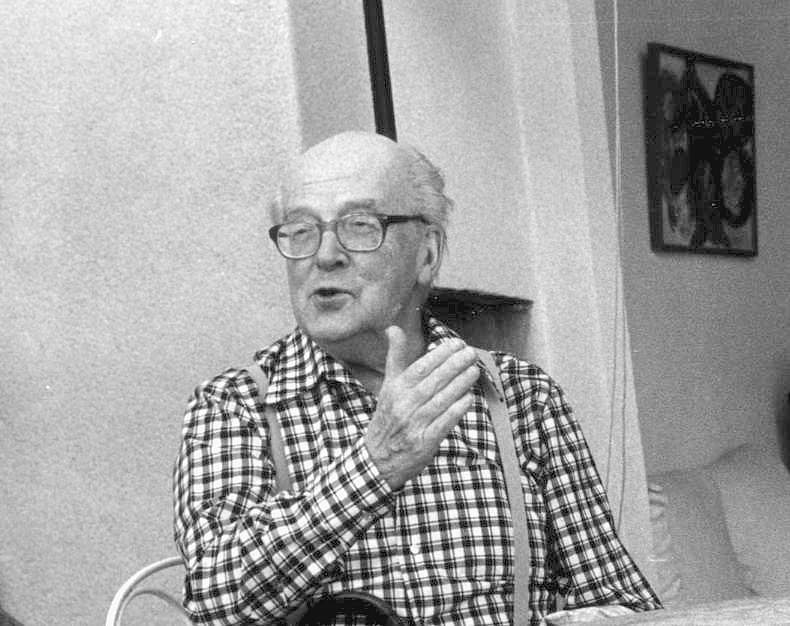
Why Jean Le Moal matters
Jean Le Moal was one of the founding members of the Salon de Mai and a leading figure of the postwar generation of French non-figurative painters loosely grouped as the New School of Paris, alongside close contemporaries such as Alfred Manessier, Roger Bissière, Jean Bertholle, and Gustave Singier. His paintings sit in the collections of the Centre Pompidou and the Tate, and he undertook major public commissions in stained glass and mural decoration for French religious and civic buildings. For collectors, he represents an established but modestly scaled corner of the postwar French abstraction market: strong institutional validation, a documented public record, and a secondary market that remains thin and mostly French.
- Born
- 1909-10-30, Authon-du-Perche, France
- Nationality
- French
- Media
- Painting, Printmaking, Stained glass
- Movement
- Lyrical Abstraction, École de Paris
- Education
- École des Beaux-Arts de Lyon, from 1926; École nationale supérieure des arts décoratifs, Paris, from 1929; Académie Ranson, Paris, under Roger Bissière, 1935 to 1938
- Signature motifs
- Non-figurative composition, Stained-glass and mural commissions
- Representation
- Galerie Laurentin
By the numbers
- 1909 to 2007LifespanBorn Authon-du-Perche, died Chilly-Mazarin, France
- approx. EUR 65,550Auction high (documented)Mer et brisants, Perrin-Royere-Lajeunesse, Versailles, 1990; single-source figure, exact date undocumented
- Founding memberSalon de MaiParis, post-war exhibiting society
- Galerie LaurentinRepresented by
Biography
Jean Le Moal was born on 30 October 1909 in Authon-du-Perche, France. He moved to Lyon in 1926 and entered the École des Beaux-Arts. In 1929 he relocated to Paris and enrolled at the École nationale supérieure des arts décoratifs. In the early 1930s he frequented private academies in Montparnasse and Montmartre, and in 1935 he joined the fresco workshop that Roger Bissière had opened at the Académie Ranson in Paris, where he remained to about 1938.
Through the Académie Ranson circle, Le Moal formed lasting ties with Manessier, Bertholle, and Singier, artists with whom he would repeatedly exhibit after the war, notably in the 1946 group show Trois Peintres at Galerie Drouin in Paris. He was one of the founding members of the Salon de Mai, the Paris exhibiting society that became a key venue for postwar abstraction, and by the early 1950s his work was showing across Europe and Latin America. He received the Prix de la Critique in 1953 and was later named Commandeur de l'Ordre des Arts et des Lettres in 1984. Beyond painting and printmaking, he worked in stage design, tapestry, and stained glass, contributing to public and religious commissions in stained glass and mural decoration. One source, not independently corroborated elsewhere in the record consulted here, states that he was married to the sculptor Juana Muller from 1944 until her death in 1952.
Museum retrospectives followed across Germany, Luxembourg, and France through the 1960s and 1970s, including shows in Lubeck, Wuppertal, Luxembourg, Metz, Caen, and Lille. He died on 16 March 2007 in Chilly-Mazarin, France. Le Monde's obituary, published that May, noted that news of his death had circulated only slowly, a detail consistent with the quieter, less market-driven profile that has defined his reputation relative to some of his Salon de Mai contemporaries. Posthumous retrospectives, including at the Maison des Arts de Châtillon in 2015 and the Musée des Beaux-Arts de Quimper in 2018, have continued to reassess his place in French non-figuration.
Critical reception
Institutional and curatorial writing consistently places Le Moal within Lyrical Abstraction and the broader non-figurative wing of the postwar École de Paris, describing surfaces built from linear arabesques interspersed with flecks and passages of color. The Musée de Valence's educational materials frame him as one of the principal representatives of French non-figuration in the second half of the twentieth century, a reading echoed by Art UK's cataloguing of his style. His critical standing rests less on a single signature breakthrough than on sustained institutional presence: founding membership in the Salon de Mai, the 1953 Prix de la Critique, a string of European museum retrospectives beginning in the 1960s, and major public commissions in stained glass and tapestry that placed his abstraction in civic and religious spaces rather than only on gallery walls. No verbatim, attributable critical quotation from a named critic in a major outlet could be confirmed from the sources reviewed for this profile.
Market
Le Moal's secondary market is modest in scale and thinly documented compared to peers such as Manessier or Bissière. French valuation guides place typical results for his paintings in a range of roughly EUR 15,000 to 65,000, depending on size, period, and subject. The highest figure found in available sources is a sale of Mer et brisants (1958 to 1959) reported at the equivalent of about EUR 65,550 at Perrin-Royere-Lajeunesse in Versailles in 1990; this figure comes from a single specialist source and the exact sale date is not documented, so it should be treated as an approximate high rather than a fully verified record. A more recent, better-documented result is L'orage (1958), which sold for EUR 57,000 in 2019. His market today is served primarily through Galerie Laurentin in Paris and Brussels, alongside occasional appearances at French regional auction houses.
Top auction results
| Work | Price | Sale |
|---|---|---|
| Mer et brisants (1958 to 1959) (1990) | EUR 65,550 (approx.) | Perrin-Royere-Lajeunesse, Versailles, France, 1990 |
Selected exhibitions
| Years | Exhibition | Venues |
|---|---|---|
| 1945 | La Jeune Peinture Française | Palais des Beaux-Arts, Brussels |
| 1946 | Trois Peintres (with Alfred Manessier and Gustave Singier) | Galerie Drouin, Paris |
| 1961 | Retrospective exhibitions | Museum Lubeck; Museum Wuppertal; Musée de la Ville de Luxembourg |
| 1963 | Retrospective | Musée de Metz, France |
| 1971 | Retrospective | Musée de Caen and Musée de Lille, France |
| 2015 | Retrospective | Maison des Arts de Châtillon, France |
| 2018 | Retrospective | Musée des Beaux-Arts de Quimper, France |
Museum collections
- Centre Pompidou (Musée National d'Art Moderne), Paris
- Tate, London
- Musée d'Art Moderne du Luxembourg
- Museum of Modern Art, Wellington, New Zealand
- Musée de Valence
- Musée des Beaux-Arts de Quimper
Awards and honors
- Prix de la Critique (1953)
- Commandeur de l'Ordre des Arts et des Lettres (1984)
Authentication and provenance
No catalogue raisonne.
No published catalogue raisonne has been confirmed for this artist. Works are generally authenticated through provenance, with several galleries, including Galerie Laurentin, currently active in his market.
Primary reference: https://www.galerie-laurentin.com/en/jean-lemoal
What collectors should know
No catalogue raisonne for Jean Le Moal has been confirmed, so provenance and gallery documentation, principally through Galerie Laurentin, carry extra weight in authentication. His institutional footprint is real and well distributed, with holdings at the Centre Pompidou, the Tate, and a number of French and international museums, but his auction market remains thin, largely confined to French salerooms, and inconsistently reported across price databases. Collectors should treat any single headline auction figure for this artist with some caution given the limited number of well-documented sales, and should note that his major public works, the stained glass and murals, are not part of the transactable market; paintings and prints on paper are the primary categories collectors are likely to encounter.
Further reading and resources
Data current as of 2026-07-18.

