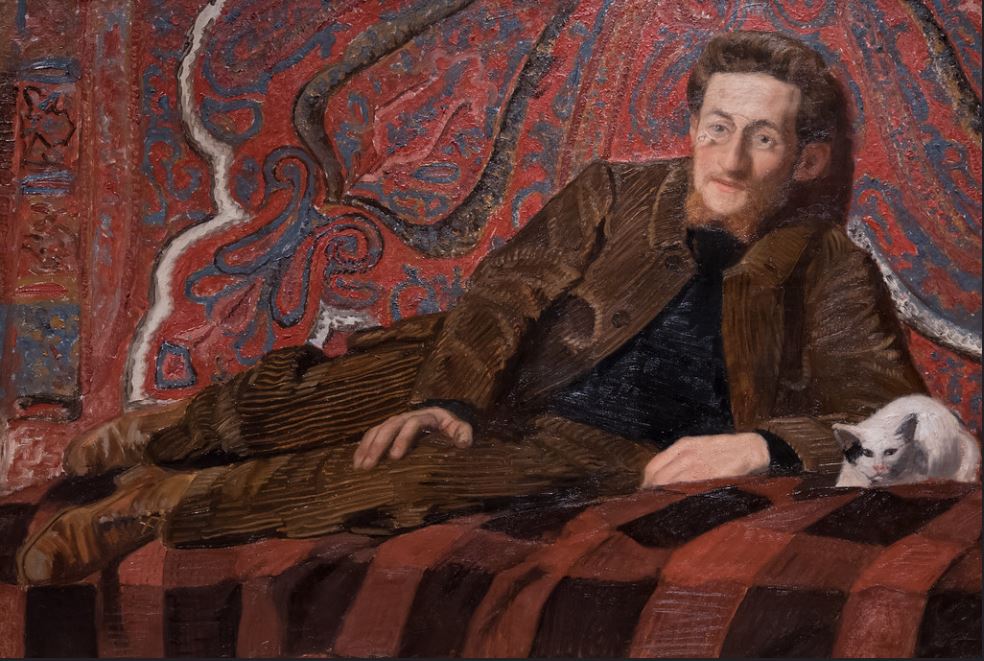
Why Jean Puy matters
Jean Puy stood in the room where Fauvism became a public scandal. At the 1905 Salon d'Automne in Paris, he exhibited alongside Henri Matisse, Andre Derain, and Henri Manguin in the show that critic Louis Vauxcelles branded with the term "Fauves." Puy is generally described as one of the movement's more moderate members, and his career is a useful case study in how an artist can be historically central to a landmark moment in modern art while remaining, a century later, a modest presence at auction. For collectors, he offers real museum-collection depth at a market scale far below his better-known Fauvist peers.
- Born
- 1876-11-08, Roanne, Loire, France
- Nationality
- French
- Media
- Painting
- Movement
- Fauvism
- Education
- Baccalaureat en lettres et philosophie; Ecole des Beaux-Arts de Lyon (architecture and painting, under Tony Tollet), 1895 to 1897; Academie Julian, Paris (painting, under Jean-Paul Laurens and Benjamin Constant), 1898; Academie Carriere, Paris (under Eugene Carriere), from 1899
- Signature motifs
- Fauvist landscapes, Nudes
- Representation
- No current gallery or estate representation documented; historically placed through dealer Ambroise Vollard
By the numbers
- GBP 73,250Highest documented auction priceNu au peignoir, June 2009; auction house and sale location not documented in sources reviewed
- 1905Salon d'Automne Fauves debutExhibited alongside Matisse, Derain, and Manguin in the Salon d'Automne's Fauve room
- 10+Museum collectionsCentre Pompidou, Musee d'Orsay, Hermitage Museum, Art Institute of Chicago, among others
- None documentedCurrent representationHistorically placed through dealer Ambroise Vollard
Selected works
Click any work to view it full screen.
Biography
Jean Puy was born on 8 November 1876 in Roanne, in the Loire department of France. He completed a classical secondary education, earning the baccalaureat in letters and philosophy, before enrolling at 19 in the Ecole des Beaux-Arts in Lyon, where he studied architecture, drawing, and painting under Tony Tollet from about 1895 to 1897.
In 1898, Puy moved to Paris to continue his training at the Academie Julian under Jean-Paul Laurens and Benjamin Constant. Finding the instruction there too conventional, he transferred around 1899 to the more progressive academy run by Eugene Carriere, where he met Henri Matisse, Andre Derain, and other artists who would soon be labeled Fauves. His paintings gained notice through the Salon des Independants and the Salon d'Automne in Paris between 1900 and 1905, and through shows at Berthe Weill's gallery, an early champion of the avant-garde. The 1905 Salon d'Automne, where his work appeared alongside the movement's core figures, marked his most significant moment in the historical record. He later worked under a long-term arrangement with the dealer Ambroise Vollard.
After the First World War, Puy's painting turned toward a more intimate, personally toned palette. Sources describe him exhibiting internationally over subsequent decades in cities including London, Turin, Dallas, New Delhi, Berlin, New York, San Francisco, Algiers, and Toronto, though exact dates and venues for these shows are not well documented. In 1939 he returned to Roanne, where he lived until his death on 6 March 1960, at the age of 84. His death is documented by municipal sources in Roanne, where a lycee was later named for him.
Critical reception
Puy's critical standing rests substantially on his place in the room that gave Fauvism its name: at the 1905 Salon d'Automne, Louis Vauxcelles saw his work alongside Matisse, Derain, and Manguin and coined the term "Fauves" for the group. Specific period reviews of Puy's individual contribution, and any later critical reassessment of his postwar work, were not confirmed in the sources reviewed for this profile. No formal prizes, medals, or state honors for Puy could be confirmed in available sources.
Market
Public auction data for Jean Puy is thin relative to his historical standing. The best-documented result identified in current research is Nu au peignoir, reported at GBP 73,250 (roughly EUR 85,956) in a June 2009 sale; the auction house and sale location were not specified in the source reviewed, and no more recent sale exceeding that figure has been confirmed. A 2014 sale of the painting Nu debout is reported at EUR 77,000, above its EUR 20,000 to 25,000 estimate, though full sale-house and location detail for that result was likewise not confirmed. Given the small number of documented sales, any single result should be read with caution rather than as a settled index of value.
Top auction results
| Work | Price | Sale |
|---|---|---|
| Nu au peignoir (2009) | GBP 73,250 (reported as approx. EUR 85,956) | Not documented in sources reviewed, Not documented in sources reviewed, 2009-06 |
Selected exhibitions
| Years | Exhibition | Venues |
|---|---|---|
| 1900 to 1905 | Salon des Independants and Salon d'Automne | Salon des Independants; Salon d'Automne, Paris |
| 1905 | Salon d'Automne (Fauves room) | Salon d'Automne, Paris |
| c. 1900 to 1905 | Gallery exhibitions | Galerie Berthe Weill, Paris |
| 20th century, undated | International touring exhibitions | London (with Albert Marquet), Turin, Dallas, New Delhi, Berlin, New York, San Francisco, Algiers, Toronto |
| undated | Jean Puy (1876 to 1960): Ambroise Vollard (1866 to 1939) | Musee de Pont-Aven / Musee Joseph Dechelette, Roanne |
Museum collections
- Centre Pompidou, Musee national d'art moderne, Paris
- Musee d'Orsay, Paris
- Musee du Petit Palais, Paris
- Musee des Beaux-Arts de Lyon
- Musee de Grenoble
- Musee Matisse, Le Cateau-Cambresis
- Musee Joseph Dechelette, Roanne
- Art Institute of Chicago
- Hermitage Museum, St. Petersburg
- Courtauld Institute of Art, London
Authentication and provenance
No catalogue raisonne.
No published catalogue raisonne has been identified in available sources. Works are generally authenticated through signature (typically 'J. Puy'), inscriptions, and dealer or family archive provenance; collectors should verify any attribution directly with the selling house.
Primary reference: https://en.wikipedia.org/wiki/Jean_Puy
What collectors should know
There is no confirmed catalogue raisonne for Jean Puy, and no current gallery or estate representation could be identified in available sources; his historical dealer relationship was with Ambroise Vollard. Authentication in practice relies on signature (typically "J. Puy," sometimes inscribed "JPUY"), stretcher inscriptions, and provenance research rather than a centralized reference catalogue, so collectors should confirm attribution directly with the auction house or a qualified specialist. His auction record itself carries a caveat: the highest documented price, from June 2009, is reported without a named auction house or sale city in the source reviewed, and the broader sales record is limited enough that pricing patterns should be treated as indicative rather than statistically reliable.
Further reading and resources
Data current as of 2026-07-18.

