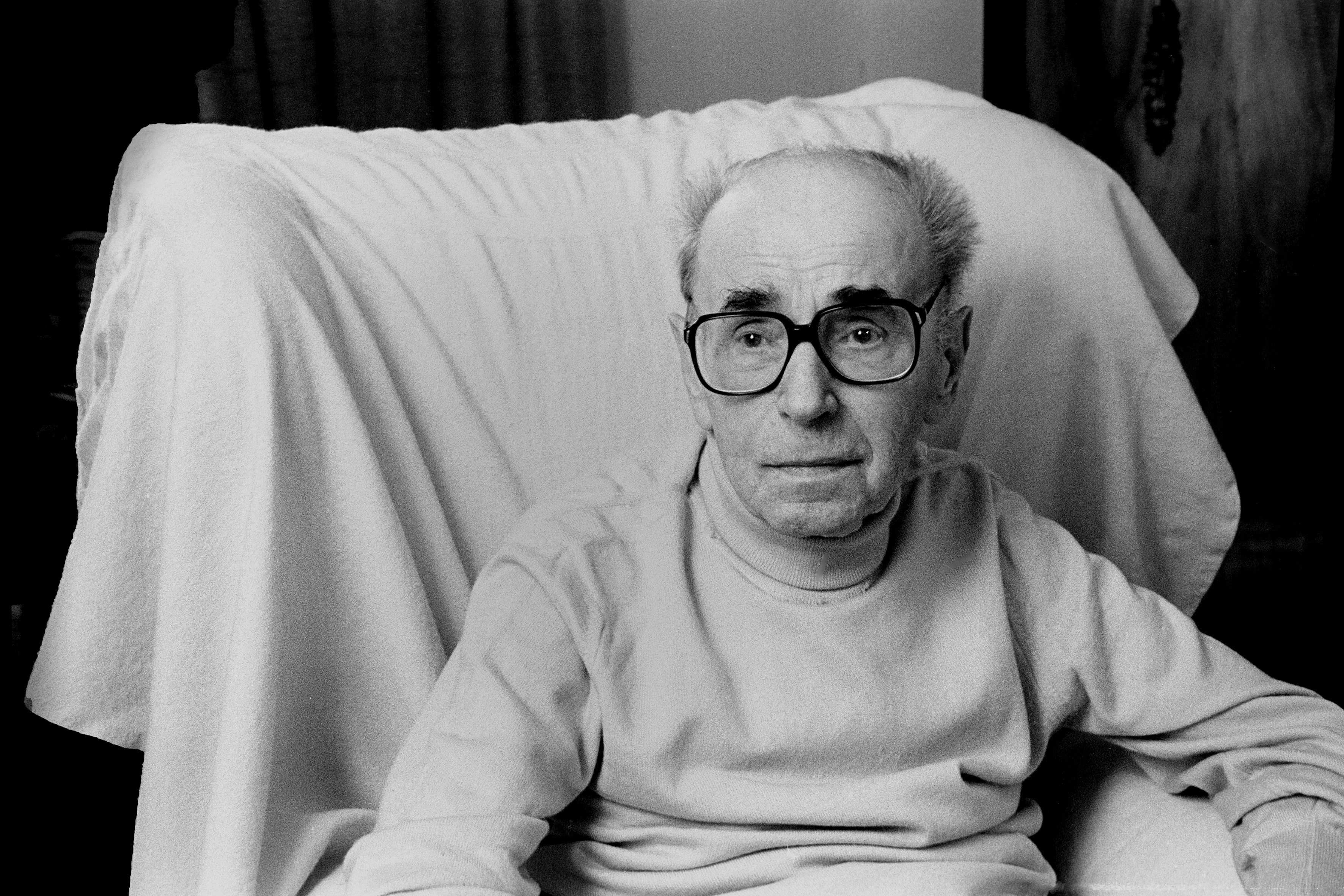
Why Jiri Kolar matters
Jiri Kolar was a central figure of twentieth century Czech culture, a poet who became one of the most inventive collage artists in postwar Europe. He is credited with originating collage techniques, chiasmage, rollage, and crumplage among them, that treated found printed material as both language and image. His work sits in major museum collections from Prague to New York and Paris, making him an important name for collectors of Eastern European postwar and conceptual art, even though his auction market remains thin relative to his institutional standing.
- Born
- 1914-09-24, Protivin, Bohemia, Austria-Hungary
- Nationality
- Czech
- Media
- Collage, Painting, Visual poetry
- Movement
- Czech avant-garde, Concrete and visual poetry
- Education
- No completed degree. Educated at a council school in Kladno, then apprenticed as a carpenter, sometimes described as a cabinetmaker, rather than through any art academy or university.
- Signature motifs
- Collage techniques he originated, including chiasmage, rollage, and crumplage, Visual and concrete poetry
- Representation
- Galerie Lelong & Co.
By the numbers
- EUR 14,400Auction highOhne Titel (Die kalte Platte), Lempertz, Cologne (exact sale date not publicly confirmed)
- 1914 to 2002Born to diedProtivin, Bohemia to Prague, Czech Republic
- Prize, Sao Paulo Biennial1969 honor
- Galerie Lelong & Co.Represented by
Selected works
Click any work to view it full screen.
Biography
Jiri Kolar was born on 24 September 1914 in Protivin, then part of Austria-Hungary and now in South Bohemia, Czech Republic. He had no formal art school training. Sources describe a council school education in Kladno followed by an apprenticeship as a carpenter, sometimes rendered as a cabinetmaker, rather than any university or fine arts academy training. In the years that followed he worked a series of manual and clerical jobs, including as a baker's assistant, a night watchman, and a waiter, while developing as a writer and, later, a visual artist.
Kolar first made his name as a poet and writer, exhibiting as early as 1937 at Galerie D37 in Prague and in 1938 at the Mozarteum in Salzburg. From the 1950s onward he turned increasingly toward visual collage, and sources describe him as a pioneering figure in the medium. He was also known as a patron of samizdat literature and of younger artists during the decades of Communist rule in Czechoslovakia. His international reputation grew through the 1960s and 1970s: he received a prize at the 10th Bienal de Sao Paulo in 1969, and his work was shown at Mánes and the National Gallery in Prague, at the Centre Pompidou in Paris, and in three separate exhibitions at the Solomon R. Guggenheim Museum in New York, in 1975, 1978, and 1985. He later received the Gottfried Herder Prize (1971) and the Order of Tomas Garrigue Masaryk, 2nd Class (1991), followed by the Jaroslav Seifert Prize (1992).
Jiri Kolar died on 11 August 2002 at his residence in Prague, at the age of 87. His death was reported in an obituary in The New York Times and is confirmed by major reference sources including Tate, Wikidata, and Czech and German encyclopedic entries. A small number of sources give his age at death as 88 or 89, a discrepancy attributable to inconsistent public reporting rather than to any dispute over his birth and death dates, which are consistently documented as 24 September 1914 to 11 August 2002.
Critical reception
Kolar is treated in art historical and museum literature as a pioneer who bridged poetry and visual art, using cut, folded, and layered printed matter to comment on language, image, and, implicitly, the political conditions of Communist Czechoslovakia. Museums including the Centre Pompidou, the Guggenheim, and the National Gallery Prague gave him sustained institutional attention across his career, and his collage inventions, chiasmage, rollage, and crumplage, are consistently cited as his central contribution to the medium. Recent institutional programming, including a 2026 exhibition at the National Gallery Prague tied to his Sao Paulo Biennial prize, indicates continued curatorial interest in his work.
Market
Kolar's auction market is modest and thinly traded compared with his museum profile. The highest price documented for his work is EUR 14,400, achieved by the collage Ohne Titel (Die kalte Platte) at Lempertz in Cologne (Auction 912, Lot 841); the exact sale date has not been publicly confirmed. Other documented results are lower: MutualArt records a sale of Pocta Albersovi (Omaggio ad Albers) for approximately USD 11,806 at an auction house in Italy, and Czech auction platforms show many works selling in the range of roughly 1,000 to 5,500 CZK, about EUR 40 to 220. No sale exceeding the Lempertz result has been identified in the sources reviewed.
Top auction results
| Work | Price | Sale |
|---|---|---|
| Ohne Titel (Die kalte Platte) | EUR 14,400 | Lempertz, Cologne |
Selected exhibitions
| Years | Exhibition | Venues |
|---|---|---|
| 2026 | Jiri Kolar X Bienal de Sao Paulo | National Gallery Prague |
| 2000 | Jiri Kolar | Narodni Galerie (National Gallery), Prague |
| 1993 | Jiri Kolar | Narodni Galerie (National Gallery), Prague |
| 1982 | Jiri Kolar | Centre Pompidou, Paris |
| 1975, 1978, and 1985 | Jiri Kolar | Solomon R. Guggenheim Museum, New York |
| 1969 | 10th Bienal de Sao Paulo | Sao Paulo Biennial (awarded the biennial prize) |
| 1962 | Jiri Kolar | Manes, Prague |
| 1937 | Jiri Kolar | Galerie D37, Prague |
Museum collections
- Metropolitan Museum of Art, New York
- National Gallery Prague
- Centre Pompidou, Paris
- Museum Ludwig, Cologne
- Museum Kampa, Prague
- Tate, London
Awards and honors
- Prize, 10th Bienal de Sao Paulo (1969)
- Gottfried Herder Prize (1971)
- Order of Tomas Garrigue Masaryk, 2nd Class (1991)
- Jaroslav Seifert Prize (1992)
Authentication and provenance
No catalogue raisonne.
No published catalogue raisonne has been confirmed for Kolar's work. Authentication and provenance questions are generally referred to the artist's estate and to the galleries and institutions, such as Galerie Lelong, that have handled his collage archive.
Primary reference: https://www.artsy.net/artist/jiri-kolar-1
What collectors should know
There is no confirmed catalogue raisonne for Kolar, so provenance research and authentication generally run through his estate and through the galleries, such as Galerie Lelong, that have represented his archive. His auction record is thin: relatively few works come to market, prices have stayed modest, and the Lempertz high (Auction 912) has not been surpassed in the years since, based on the sales data available. For a collector, Kolar's appeal rests on his historical and museum importance within Czech and European postwar art rather than on a track record of rising auction prices, and any acquisition should weigh that gap between institutional stature and market liquidity.
Further reading and resources
Data current as of 2026-07-18.

