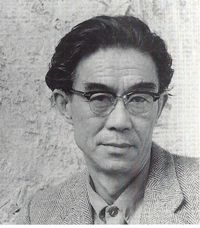
Why Jiro Yoshihara matters
Jiro Yoshihara is the founder and lifelong leader of the Gutai Art Association, the Japanese postwar collective that pushed abstraction toward performance, material experimentation, and a direct physical engagement with paint that anticipated much of what later came to be called process art internationally. For a collector, he matters as the origin point of an entire movement now central to the global story of postwar abstraction, and as an artist whose late Circle paintings remain his most recognizable and most sought works.
- Born
- 1905-01-01, Osaka, Japan
- Nationality
- Japanese
- Media
- Painting, Works on paper, Ceramics
- Movement
- Gutai, Postwar Japanese abstraction
- Education
- Kitano Secondary School, Osaka; business studies in the Kansai region (sources differ on whether the degree-granting school was Kwansei Gakuin University or Kansai University); no formal art degree, largely self-taught with informal guidance from Kamiyama Jiro and Tsuguharu Foujita.
- Signature motifs
- Circle motif, Gestural abstract impasto
- Representation
- "Fergus McCaffrey, Tokyo (has mounted major historical exhibitions of his work)"
By the numbers
- USD ~690KAuction highReported peak price for a painting (MutualArt, Artprice); exact lot, sale date, and house not publicly disclosed
- Gutai Art Association, 1954Founded
- Order of the Rising Sun, Gold Rays with Rosette, 1972Posthumous honor
- 2nd India Triennial, 1971Gold Medal
Biography
Jiro Yoshihara was born on 1 January 1905 in Osaka, Japan. He attended Kitano Secondary School in Osaka and went on to study business in the Kansai region; sources differ on whether the degree-granting institution was Kwansei Gakuin University or Kansai University, and no single account fully reconciles the two. He did not receive a formal art education. His skill in oil painting developed largely on his own from childhood, later supplemented by informal guidance from the painter Kamiyama Jiro and, briefly, from Tsuguharu Foujita. A planned period of study in Paris, encouraged by Foujita, was abandoned after his father objected, and Yoshihara instead joined the family business while continuing to paint and exhibit.
He showed abstract work with the Nika-kai group in the 1930s and built a reputation in the Kansai region over the following two decades. In 1954 he founded and became the guiding figure of the Gutai Art Association, a group of younger Japanese artists whom he encouraged toward radical, materially direct forms of abstraction and action-based work. Gutai gained international visibility through the Salon de Mai in Paris in 1952, a 1958 group exhibition at Martha Jackson Gallery in New York, and later inclusion in the 1965 traveling exhibition The New Japanese Painting and Sculpture, organized by the San Francisco Museum of Art and shown at the Museum of Modern Art in New York.
From the 1950s, Yoshihara's own painting moved from gestural, heavily worked abstract surfaces toward the stark, Zen-inflected circle compositions for which he is now best known, a body of work he pursued with increasing focus through the 1960s and into the early 1970s. He won the Gold Medal at the 2nd India Triennial in New Delhi in 1971. According to published biographical accounts, he died in Ashiya, Japan, on 10 February 1972, at age 67, reportedly following a subarachnoid hemorrhage. Gutai dissolved that same year, following his death.
Critical reception
Yoshihara is treated in art-historical and market literature primarily as an instigator rather than as a solitary studio painter, credited with creating the conditions, and writing the Gutai manifesto, that let a generation of younger Japanese artists pursue radical, materially direct abstraction. His leadership role rather than a large personal exhibition record is the more frequent subject of critical attention. His late Circle paintings are the works most often cited as the clearest statement of his mature aesthetic, and gallery and museum texts frequently reference his own description of the circle as a form that could fill any space without requiring further invention.
Market
Market databases (MutualArt, Artprice) report a peak auction price of approximately USD 690,095 for a painting, but the exact lot, sale date, and auction house behind that figure are not disclosed in the publicly accessible portions of those listings, so it should be read as an approximate high rather than a fully documented record. Other tracked results run from the tens of thousands to the low hundreds of thousands of dollars, most often for works sold in Japan and Hong Kong, including a reported GBP 193,000 result flagged by Barnebys that exceeded its high estimate. As with many historical Gutai-generation artists, supply at auction is uneven year to year, and full lot-level detail is not consistently available, so any single figure should be treated with caution rather than as a settled benchmark.
Top auction results
| Work | Price | Sale |
|---|---|---|
| Untitled painting (specific work not publicly identified in accessible sources) | USD 690,095 |
Selected exhibitions
| Years | Exhibition | Venues |
|---|---|---|
| 1934 | Nika-kai exhibition | Nika-kai, Japan |
| 1952 | Salon de Mai | Paris |
| 1958 | Gutai group exhibition | Martha Jackson Gallery, New York |
| 1965 | The New Japanese Painting and Sculpture | San Francisco Museum of Art, traveled to the Museum of Modern Art, New York |
| 1971 | 2nd India Triennial | New Delhi (Gold Medal awarded) |
| 1992 | Jiro Yoshihara | Ashiya City Museum of Art and History (retrospective) |
| 2019 | Jiro Yoshihara: The Persistence of Form | Fergus McCaffrey, Tokyo |
Awards and honors
- Osaka Prefectural Cultural Award (year not specified in available sources)
- Gold Medal, 2nd India Triennial (1971)
- Order of the Rising Sun, Gold Rays with Rosette (posthumous) (1972)
Authentication and provenance
No catalogue raisonne.
No published catalogue raisonne is confirmed as of this writing. Attribution and market handling appear to run through Gutai Art Association records, family and estate contacts, and specialist galleries such as Fergus McCaffrey, rather than through a documented, centralized authentication body.
Primary reference: https://www.artsy.net/artist/jiro-yoshihara
What collectors should know
There is no confirmed catalogue raisonne for Yoshihara, and no single, publicly documented gallery holds exclusive representation of his estate; Fergus McCaffrey in Tokyo has mounted the most substantial recent historical exhibition of his work, and pieces also surface through specialist Gutai-focused galleries and auction houses in Japan, Hong Kong, and the West. Collectors should treat provenance and direct consultation with Gutai-specialist dealers as essential, given the absence of a centralized authentication body. Because his most valuable works are concentrated in a small number of major circle paintings, and because auction supply is thin, geographically scattered, and not always fully documented at the lot level, any single result, including the reported approximate USD 690,095 peak price, should be read as a directional data point rather than as a stable index of his broader market.
Further reading and resources
Data current as of 2026-07-11.

