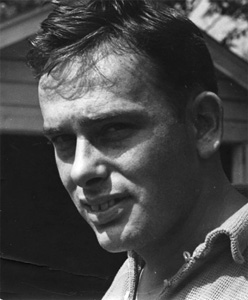
Why Joe Jones matters
Joe Jones was one of the most visible American Social Realist painters of the Depression era, a self-taught artist from a working-class St. Louis family whose murals and wheat field paintings gave visual form to New Deal era ideas about labor and the land. He remains historically significant for his Works Progress Administration commissions and for a body of work now held in several American museum collections, even though his auction market today is thin and only lightly documented compared with his institutional standing.
- Born
- 1909-04-07, St. Louis, Missouri, USA
- Nationality
- American
- Media
- Painting, Lithography, Mural
- Movement
- Social Realism, American Scene
- Education
- Self-taught. Completed only the eighth grade, 1923. Attended evening art classes at a St. Louis art school. No degree confirmed.
- Signature motifs
- Wheat fields and rural labor, New Deal post office murals
- Representation
- Hirschl & Adler Galleries (secondary market), D. Wigmore Fine Art (secondary market)
By the numbers
- 1937Guggenheim FellowshipAwarded for painting
- Held in major U.S. museum collectionsMuseum collectionsIncludes Whitney Museum of American Art, Smithsonian American Art Museum, Saint Louis Art Museum, National Gallery of Art
- 1933 to 1963Career spanDepression era Social Realist and WPA muralist
- No confirmed estate representationRepresented bySecondary market handled by Hirschl and Adler Galleries and D. Wigmore Fine Art
Selected works
Click any work to view it full screen.
Biography
Joe Jones was born Joseph John Jones on April 7, 1909, in St. Louis, Missouri, the son of a house painter. He had little formal schooling, completing only the eighth grade in 1923 before going to work with his father, and he later described himself simply as self-taught, supplementing his practice with evening art classes at a St. Louis art school.
Jones rose to national attention during the Great Depression as a painter of the American Scene, producing Social Realist images of labor, farms, and social conditions. He was associated with the John Reed Club and contributed to New Masses, and by the mid-1930s his work was appearing in major national exhibitions, including the Museum of Modern Art's Painting and Sculpture from 16 American Cities (1933 to 1934) and the Whitney Museum's biennial exhibitions of contemporary American painting. His first one-man show opened at the American Contemporary Art Gallery in New York in the spring of 1935. The Works Progress Administration commissioned him to paint post office murals in Missouri, Kansas, and Arkansas, and in 1937 he received a Guggenheim Foundation Fellowship. During the Second World War, he is reported to have designed war posters, in at least one account alongside Thomas Hart Benton, though the details are not fully documented. In his later years he settled in Morristown, New Jersey, turning increasingly to coastal landscapes of New Jersey and Bermuda alongside commercial illustration and mural work.
He died of a heart attack at his Morristown home on April 9, 1963, at age 54. His death was reported the next day by the New York Times, and is confirmed independently by the Missouri Encyclopedia and by museum and gallery biographies, all of which give the same date and place.
Critical reception
Jones's reputation over the following decades has rested chiefly on his identity as a Depression era Social Realist and WPA muralist, a working artist whose paintings of wheat fields, labor, and rural hardship were read at the time as records of American conditions rather than as formal abstraction. A 2017 retrospective, Restless Regionalist: The Art of Joe Jones, at the Albrecht-Kemper Museum of Art in St. Joseph, Missouri, with accompanying scholarship from the Birger Sandzen Memorial Gallery, renewed attention to an artist regional historians and press coverage have described as a forgotten or overlooked figure relative to his historical standing.
Market
Public auction data for Joe Jones is sparse and, as of this writing, could not be fully verified at the lot level. Aggregated market summaries from Artnet put his highest recorded auction figure at roughly USD 9,000, but that source does not disclose the specific work, sale date, or auction house behind the number, and no higher, fully documented result could be confirmed from primary auction sources. Retail gallery listings for his work run considerably higher, up to about USD 25,000, but retail asking prices are not auction comparables and should not be treated as such. No gallery or estate has been publicly confirmed as his official representative; Hirschl and Adler Galleries and D. Wigmore Fine Art, both in New York, are among the dealers currently listing biographical material and works for the artist.
Selected exhibitions
| Years | Exhibition | Venues |
|---|---|---|
| 1933 to 1934 | Painting and Sculpture from 16 American Cities | Museum of Modern Art, New York |
| 1934 | National Exhibition of Art by the Public Works of Art Project | Corcoran Gallery of Art, Washington, D.C. |
| 1934 | Whitney Biennial Exhibition of Contemporary American Painting | Whitney Museum of American Art, New York |
| 1935 | First one-man exhibition | American Contemporary Art Gallery, New York |
| 1936 | Paintings of Wheat Fields | Walker Gallery, New York |
| 1936 | Our American Farms | Whitney Museum of American Art, New York |
| 1937 | Exhibitions following Guggenheim Fellowship award | Carnegie Institute, Pittsburgh |
| 2017 | Restless Regionalist: The Art of Joe Jones | Albrecht-Kemper Museum of Art, St. Joseph, Missouri |
Museum collections
- Whitney Museum of American Art, New York
- Smithsonian American Art Museum, Washington, D.C.
- Saint Louis Art Museum, St. Louis
- National Gallery of Art, Washington, D.C.
Awards and honors
- Guggenheim Foundation Fellowship (1937)
Authentication and provenance
No catalogue raisonne.
No catalogue raisonne has been confirmed for this artist. No estate or foundation is publicly documented as of this writing. Hirschl and Adler Galleries and D. Wigmore Fine Art list and deal in his paintings and prints, and provenance is typically established through exhibition history and prior museum or gallery documentation.
Primary reference: https://americanart.si.edu/artist/joe-jones-2500
What collectors should know
Jones's work sits in a number of respected museum collections, including the Whitney Museum of American Art, the Smithsonian American Art Museum, and the Saint Louis Art Museum, which is a meaningful signal of historical importance. The auction record for his paintings and prints, however, is thin and inconsistently documented in public databases, so collectors should treat any single reported price with caution and verify specific lots directly with an auction house rather than relying on aggregated summary figures. With no catalogue raisonne and no confirmed estate representative, provenance research and direct exhibition history are the most reliable paths to authentication.
Further reading and resources
Data current as of 2026-07-18.

