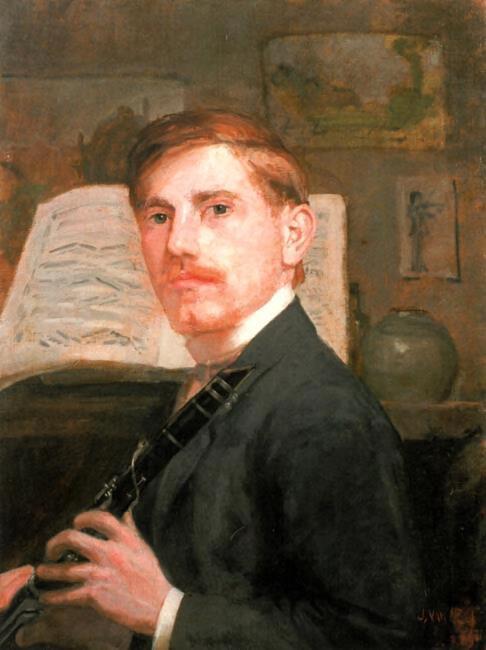
Why Johan van Hell matters
Johan van Hell was a Dutch painter, printmaker, and professional musician active in Amsterdam through the first half of the twentieth century. He is best known for socially engaged, flattened figurative scenes of street musicians, market vendors, and working people, for a bronze medal in the painting competition of the 1924 Paris Olympics, and for renewed institutional attention in recent decades, including a dedicated exhibition at Museum MORE in 2016 and 2017. For a collector, he is a niche but historically grounded name: institutional presence in the Netherlands is real, but the auction record is thin and no catalogue raisonne exists, so provenance and dealer documentation carry unusual weight.
- Born
- 1889-02-28, Amsterdam, Netherlands
- Nationality
- Dutch
- Media
- Painting, Watercolor, Printmaking, Lithography
- Movement
- Social Realism, Dutch interbellum figuration
- Education
- Quellinusschool, Amsterdam, diploma in decorative painting, 1906; Rijksnormaalschool voor Tekenleraren, Amsterdam, teaching certificate, 1909; Rijksakademie van Beeldende Kunsten, Amsterdam, drawing, painting, and model courses, 1909 to 1913, under Richard Roland Holst
- Signature motifs
- Street scenes and market life, Working-class musicians and vendors, Flattened, strongly outlined figures
- Representation
- Kunsthandel Simonis & Buunk, Ede (secondary market), Galerie Trompenburgh, 's-Graveland (secondary market)
By the numbers
- EUR 88,634Auction highWindow cleaner (1927), Adams Amsterdam Auctions, NRC Anniversary Sale, 14 March 2024
- Bronze medal, PaintingOlympic honor1924 Paris Olympic Art Competitions, for The Skaters (1919)
- Dutch specialist dealersMarket channelKunsthandel Simonis & Buunk; Galerie Trompenburgh
Selected works
Click any work to view it full screen.
Biography
Johan van Hell, born Johannes Gerardus Diederik van Hell, was born on 28 February 1889 in Amsterdam. He took his first painting lessons around 1903 from G.W. Knap, then trained formally at the Quellinusschool in Amsterdam, earning a diploma in decorative painting in 1906. He continued at the Rijksnormaalschool voor Tekenleraren, the state college for art teachers, completing his teaching qualification in 1909, and then studied drawing, painting, and figure work at the Rijksakademie van Beeldende Kunsten in Amsterdam from 1909 to 1913 under Richard Roland Holst. Alongside his visual art training, he studied clarinet and oboe, reportedly at Amsterdam's Volksmuziekschool and privately with the clarinetist Piet Swager, and went on to work as a professional musician as well as a drawing teacher.
He was active in socialist politics and culture, associated with the Sociaal-Democratische Arbeiderspartij (SDAP) and the Socialistische Kunstenaarskring, and his mature style, from the mid-1920s, moved toward a simplified figurative idiom with strong lines and bright colors, focused on everyday street scenes and the lives of working-class people. In 1939 his work was included in Onze Kunst van Heden (Our Art of Today), a major survey exhibition and sale at the Rijksmuseum in Amsterdam.
Johan van Hell died on 31 December 1952 in Amsterdam, from an acute kidney inflammation complicated by diabetes. His work later received renewed institutional attention, including a dedicated exhibition, Op klare toon, at Museum MORE in Gorssel in 2016 and 2017.
Critical reception
Van Hell's critical standing rests less on contemporaneous reviews, which are not documented in detail in available sources, than on his institutional placement. His inclusion in the 1939 Onze Kunst van Heden exhibition at the Rijksmuseum marked him as part of the recognized Dutch art establishment of his time. Renewed museum attention, including Museum MORE's Op klare toon (On Clear Tone) exhibition in 2016 and 2017, has presented him as a socially minded artist working across painting, printmaking, and music. Writers on his work consistently point to the same throughline: everyday, working-class subject matter rendered in an increasingly stylized, flatly colored, strongly contoured figurative language from the mid-1920s onward. No verbatim, attributed critical assessment from a named critic in a major outlet could be confirmed for this profile, so none is quoted here.
Market
Van Hell's market is small, specialized, and centered in the Netherlands. His documented auction high is EUR 88,634 for the painting Window cleaner (1927), sold at Adams Amsterdam Auctions' NRC Anniversary Sale on 14 March 2024, the standout result of that sale. Dutch dealers such as Kunsthandel Simonis & Buunk have also offered paintings, for example a work titled Drei grasende Pferde (Three Grazing Horses), at asking prices around EUR 49,000, though asking prices are not auction results. Taken together, the evidence points to a market with a confirmed auction ceiling just under EUR 90,000, with day-to-day activity handled by a small number of specialist Dutch galleries and auction houses rather than international salerooms.
Top auction results
| Work | Price | Sale |
|---|---|---|
| Window cleaner (Ramenwasser) (1927) | EUR 88,634 | Adams Amsterdam Auctions, Amsterdam, Netherlands, 2024-03-14 |
Selected exhibitions
| Years | Exhibition | Venues |
|---|---|---|
| 1924 | Art Competitions, Painting (Open) | 1924 Summer Olympics art competitions, Games of the VIII Olympiad, Paris; bronze medal for The Skaters |
| 1939 | Onze Kunst van Heden (Our Art of Today) | Rijksmuseum, Amsterdam |
| 2016 to 2017 | Johan van Hell. Op klare toon | Museum MORE, Gorssel |
Awards and honors
- Bronze medal, Painting (Open class), Art Competitions, 1924 Summer Olympics, Paris, for The Skaters (De Schaatsenrijders, 1919) (1924)
Authentication and provenance
No catalogue raisonne.
No catalogue raisonne has been published or confirmed for Johan van Hell, and there is no known certificate-of-authenticity program. Market verification runs through established Dutch dealers, principally Kunsthandel Simonis and Buunk and Galerie Trompenburgh, neither of which holds exclusive estate representation.
Primary reference: https://en.wikipedia.org/wiki/Johan_van_Hell
What collectors should know
There is no catalogue raisonne for Johan van Hell, and no formal certificate-of-authenticity program; verification in practice runs through established Dutch specialist dealers, principally Kunsthandel Simonis & Buunk and Galerie Trompenburgh, neither of which holds exclusive representation of the artist's estate. Auction supply is thin, and the only confirmed high-water mark is EUR 88,634 for Window cleaner (1927), so any single result should be read against that narrow base rather than as a stable trend line. Given the limited public sale history, collectors should weight documented provenance and established-dealer paper trails heavily when evaluating a specific work.
Further reading and resources
Data current as of 2026-07-18.

