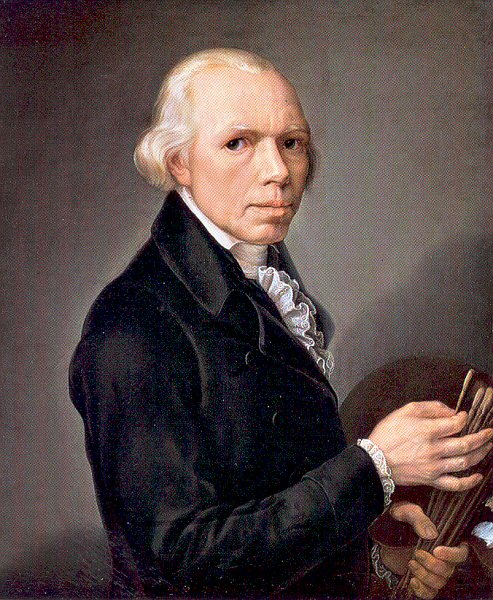
Why Johann Wenzel Peter matters
Johann Wenzel Peter was among the most sought-after animal painters working in Rome in the decades around 1800, prized by Prince Marcantonio Borghese and later by Pope Gregory XVI. His monumental menagerie paintings, most notably the Earthly Paradise now in the Vatican Museums, place him among the relatively small group of Old Master specialists whose work anchors two of Europe's most visited public collections, the Vatican and the Galleria Borghese. For today's collectors, he is a useful reminder that strong institutional and princely provenance does not always translate into a legible auction market, and that the two forms of value need to be assessed separately.
- Nationality
- Austrian
- Media
- Painting, Fresco
- Movement
- Neoclassicism, Animal painting
- Education
- Apprenticed as an engraver in his father's workshop in Karlsbad, then trained as a coin and medal engraver in Vienna. Sent to Rome in 1774 to study sculpture, turning to painting around 1781. Appointed professor of painting at the Accademia di San Luca, Rome, in 1812.
- Signature motifs
- Large-scale animal compositions, "Earthly Paradise" menagerie scenes
By the numbers
- Professor, Accademia di San LucaCareer postAppointed 1812, Rome
- Vatican Museums (Pinacoteca Vaticana)Primary collectionIncludes the Paradiso terrestre, among works purchased for the papal collections under Pope Gregory XVI
- Rome, 1774 to 1829Active period
- Secondary market onlyAuction marketNo confirmed all-time record price located in public sale records; known lots are estimates or circle- or attributed-to sales
Selected works
Click any work to view it full screen.
Biography
Johann Wenzel Peter was born in 1745 in Karlsbad, Bohemia, now Karlovy Vary in the Czech Republic. Sources disagree on the exact day, giving either 8 or 9 September 1745, so the day is left unresolved here rather than stated as certain. He first trained in his father's workshop as a gunsmith and engraver, then went on to work as a coin and medal engraver at the imperial court in Vienna.
Peter traveled to Rome in 1774 to study sculpture. Around 1781 he turned instead to painting, and went on to specialize in animal subjects. He remained in Rome for the rest of his life. Prince Marcantonio Borghese became one of his key patrons, commissioning a cycle of some 162 animal depictions in fresco for the Casino of the Villa Borghese, generally dated to 1776 to 1777. Later, Pope Gregory XVI purchased a group of Peter's paintings, including the Earthly Paradise, for the papal collections, works that now form the core of his presence in the Vatican Museums. In 1812 Peter was appointed professor of painting at the Accademia di San Luca in Rome. He died in Rome on 28 December 1829.
Critical reception
Contemporary and later commentary consistently frames Peter as a leading animal painter of Neoclassical Rome. The Italian auction house Wannenes, in its cataloguing of an attributed work, describes him as considered the most celebrated animal painter of his era, a characterization echoed across market and reference sources that treat him as the leading specialist of the genre working in Rome between the late eighteenth and early nineteenth centuries.
Market
Johann Wenzel Peter has no catalogue raisonne, and this profile cannot confirm a reliable all-time auction record with a specific work, price, house, and date. Public sources show only pre-sale estimates and a small number of realized results, several attached to works catalogued as attributed to or circle of the artist rather than fully autograph. Dorotheum in Vienna has offered his paintings with estimates in the range of roughly EUR 12,000 to 35,000. Sotheby's carried a work signed "Wenzel Peters" with an estimate of EUR 60,000 to 80,000, though no confirmed sale result for that lot is available. Koller Auktionen in Zurich sold a work catalogued as circle of Johann Wenzel Peter for CHF 6,250 including premium. Wannenes in Genoa has offered attributed works at lower estimates. Given this pattern, collectors should treat any single reported price as indicative at best rather than as an established market benchmark.
Selected exhibitions
| Years | Exhibition | Venues |
|---|---|---|
| 1776 to 1777 | Animal fresco cycle (162 animals) | Casino of the Villa Borghese, Rome, for Prince Marcantonio Borghese |
| 1812 | Professor of painting | Accademia di San Luca, Rome |
| n.d. (Pope Gregory XVI era) | Paradiso terrestre (Earthly Paradise) acquired for the papal collections | Sala del Concistoro, Vatican Museums, Rome |
| 2017 | 19th Century Paintings sale | Dorotheum, Vienna |
| 2018 | Old Master Paintings sale | Dorotheum, Vienna |
| 2018 | The Four Doves, after the mosaic from the Villa Hadriana, Tivoli (signed Wenzel Peters) | Sotheby's |
| n.d. | Umkreis (circle of) lot, sold CHF 6,250 | Koller Auktionen, Zurich |
| n.d. | Leone che azzanna un cane (attributed to) | Wannenes Art Auctions, Genoa |
Museum collections
- Vatican Museums (Pinacoteca Vaticana), Vatican City
- Galleria Borghese, Rome
Authentication and provenance
No catalogue raisonne.
No catalogue raisonne exists. Works are verified through provenance research and Old Master specialists at the auction houses that handle his paintings, since his early collections were dispersed and attributions in the trade range from fully autograph to attributed to or circle of.
Primary reference: https://www.biographien.ac.at/oebl/oebl_P/Peter_Johann-Wenzel_1745_1829.xml
What collectors should know
Peter's stature rests on institutional and princely provenance rather than on a well-documented auction history. The Vatican Museums and the Galleria Borghese hold his most important works, and that placement is the strongest evidence of his historical standing. There is no catalogue raisonne, no current gallery or estate representation, and the market operates entirely through Old Master specialists such as Dorotheum, Sotheby's, Koller, and Wannenes. Attribution is a live issue: many lots are catalogued as attributed to or circle of the artist rather than fully autograph. Even his exact birth date is disputed in the scholarly record, a reminder that documentation for an artist of this period can remain incomplete. Collectors should weight museum and provenance evidence heavily and treat any quoted auction figure with caution absent a verified hammer price.
Further reading and resources
Data current as of 2026-07-16.

