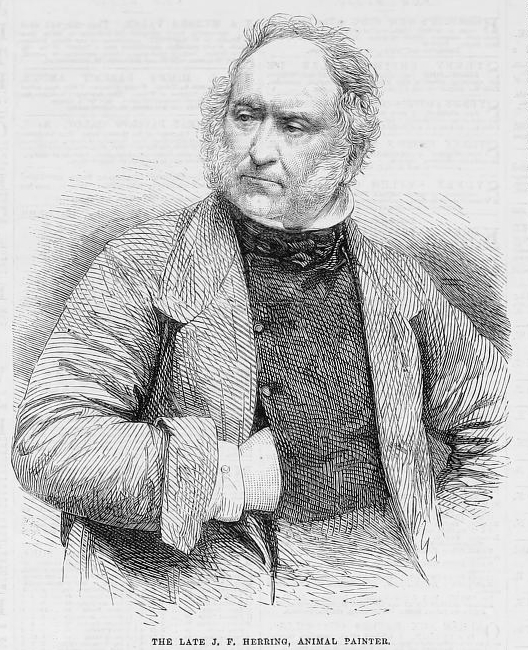
Why John Frederick Herring matters
John Frederick Herring Sr. was one of the leading sporting and animal painters of Victorian England, best known for racehorse portraits, hunting scenes, and farmyard genre pictures painted with a coachman's eye for equine anatomy. For a collector, he matters as a benchmark name in British sporting art: a painter with sustained royal patronage, decades of institutional exhibition history, and museum holdings across the major London collections, whose market today rewards careful attribution over headline chasing.
- Born
- 1795-09-12, London, England
- Nationality
- British
- Media
- Painting
- Movement
- Victorian art, British sporting and animal painting
- Education
- No formal art school or degree documented. Informal youth tuition from a local artist, and possibly later informal tuition from Abraham Cooper during his time in Newmarket and London (unconfirmed).
- Signature motifs
- Racehorses and thoroughbreds, Farmyard and rural genre scenes
- Representation
- No living gallery or estate representation; historic artist traded on the secondary market, Works historically handled by dealers including Haynes Fine Art, London
By the numbers
- USD 23,900Auction high (confirmed)Welcome Rest, Heritage Auctions, 2006-05-04; higher unconfirmed aggregate figures also appear in market databases
- 1818 to 1865Royal Academy exhibitorNearly five decades of near-continuous exhibiting
- 1845Royal appointmentAnimal Painter to Her Royal Highness The Duchess of Kent
- Secondary marketRepresented byNo living gallery or estate representation
Selected works
Click any work to view it full screen.
Biography
John Frederick Herring Sr. was born on 12 September 1795 in London. As a young man his interest in drawing led his father to send him to a local artist for a few lessons, an arrangement the sources describe as brief and informal rather than a structured education; no school, academy, or degree is documented for him. He worked in his youth as a coachman and sign painter, trades that put him in close daily contact with horses and gave him a practical, working knowledge of equine form that shows in his later paintings. He later moved from Doncaster to Newmarket and then to London, and some accounts suggest he may have received informal tuition from the painter Abraham Cooper during this period, though this is not firmly confirmed.
Herring began exhibiting at the Royal Academy in 1818 with Portrait of a Dog, and continued showing there almost every year until 1865. He also exhibited at the British Institution from 1830 to 1865, and at the Society of British Artists from 1836 to 1852, becoming a member in 1841 and Vice-President in 1842. His reputation drew royal attention: in 1840 he was invited to Paris by the French heir to the throne to paint a set of five horses, and in 1845 he was appointed Animal Painter to Her Royal Highness The Duchess of Kent. Queen Victoria and Prince Albert also commissioned work from him in the mid-1840s. In 1853 he moved to Meopham Park in Kent, where he lived until his death on 23 September 1865. Some market sources place his death in nearby Tonbridge, likely reflecting the closest town to his Kent estate rather than a separate location.
His son, John Frederick Herring Jr (1815 to 1907), worked in a related style and exhibited and sold under a very similar name, which continues to require care when attributing unsigned or ambiguously signed sporting pictures to father or son.
Critical reception
Herring was ranked by contemporaries alongside Sir Edwin Landseer as one of the foremost animal painters of mid-nineteenth-century Britain, a reputation built over nearly five decades of near-continuous exhibiting at the Royal Academy, the British Institution, and the Society of British Artists. Modern institutional assessments continue to treat him as the leading British sporting and animal painter of his day, a period when, before the spread of photography, such painting held wide popular appeal. His work remains concentrated in major British public collections, including Tate Britain, the Royal Academy, the National Portrait Gallery, the Victoria and Albert Museum, Kenwood House, and the Wallace Collection.
Market
Herring's auction market is difficult to benchmark from public reporting alone. The clearest confirmed result available is Welcome Rest, which sold for USD 23,900 at Heritage Auctions on 4 May 2006. Some market-data aggregators cite a much higher figure, around USD 2,098,500, as his auction high, but that figure could not be traced to a specific work, sale house, or sale date in available sourcing, so it is reported here only as an unconfirmed data point rather than a verified record. Herring has a long, active secondary market with many recorded auction results across multiple houses, though the large majority sell well below any of these headline figures. Because he shares a name and subject matter with his son, and because no catalogue raisonne exists to anchor attribution, buyers should expect that price and desirability vary sharply with confirmed authorship, subject, and condition rather than tracking a single smooth market curve.
Top auction results
| Work | Price | Sale |
|---|---|---|
| Welcome Rest | USD 23,900 | Heritage Auctions, 2006-05-04 |
Selected exhibitions
| Years | Exhibition | Venues |
|---|---|---|
| 1818 to 1865 | Annual exhibitor | Royal Academy of Arts, London |
| 1830 to 1865 | Annual exhibitor | British Institution, London |
| 1836 to 1852 | Member (1841); Vice-President (1842) | Society of British Artists, London |
| 1818 | Portrait of a Dog | Royal Academy of Arts, London |
| 1847 | The Frugal Meal | London (specific venue not confirmed) |
| 2026 | The Tradition of Sporting Art: Works by John Frederick Herring Senior and Sir Edwin Landseer | Dreweatts, United Kingdom |
Museum collections
- Tate Britain, London
- Royal Academy of Arts, London
- National Portrait Gallery, London
- Victoria and Albert Museum, London
- Kenwood House, London
- Wallace Collection, London
- Watford Museum Collection of Fine Art, Watford
Awards and honors
- Appointed Animal Painter to Her Royal Highness The Duchess of Kent (1845)
- Vice-President, Society of British Artists (1842)
- Elected member, Society of British Artists (1841)
- Invited to Paris by the French heir to the throne to paint five royal horses (1840)
Authentication and provenance
No catalogue raisonne.
No published catalogue raisonne has been identified for Herring. Works are typically authenticated through period expertise, provenance research, and comparison with signed and dated examples, a task complicated by the existence of his son, John Frederick Herring Jr, who worked in a related style and is sometimes conflated with the father on unsigned or ambiguously signed pictures.
Primary reference: https://www.tate.org.uk/art/artists/john-frederick-herring-252
What collectors should know
Herring is a historic, deceased artist with no living gallery or estate representation; his work moves entirely through the secondary market, auction houses, and specialist dealers. There is no catalogue raisonne, so provenance, signature analysis, and comparison to firmly documented works matter more than usual, particularly given the overlap in subject matter and signature style with his son, John Frederick Herring Jr. The clearest confirmed sale for his work is a relatively modest USD 23,900 (2006); higher figures reported in some market databases could not be independently verified to a specific work, house, or date. Buyers should weigh any headline number against a much larger body of more modestly priced, routinely traded sporting pictures rather than treating a single figure as representative of typical market pricing.
Further reading and resources
Data current as of 2026-07-10.

