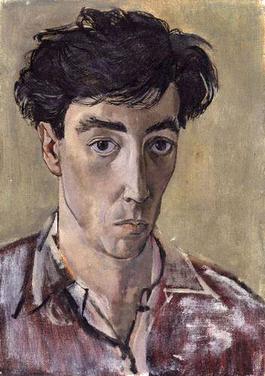
Why John Minton matters
John Minton was one of the central figures of British Neo-Romanticism in the years after the Second World War, a painter, illustrator, and stage designer whose work was widely exhibited and critically discussed during his lifetime. As a tutor in the painting school of the Royal College of Art from 1949 to 1956, he taught a generation of British artists, reportedly including Peter Blake, Frank Auerbach, Bridget Riley, and Joe Tilson. For collectors, Minton is a case study in a mid-century British market that is thin at auction and largely unregulated by a catalogue raisonne, but that is backed by serious institutional standing, including holdings at Tate and a major 2017 centenary exhibition that reasserted his critical importance.
- Born
- 1917-12-25, Great Shelford, Cambridgeshire, England
- Nationality
- British
- Media
- Painting, Illustration, Stage design
- Movement
- Neo-Romanticism, Post-war British art
- Education
- Northcliff House, Bognor Regis, 1925 to 1932; Reading School, 1932 to 1935; St John's Wood School of Art, 1935 to 1938; no degree documented
- Signature motifs
- Neo-Romantic landscape, Book and magazine illustration
By the numbers
- 1917 to 1957Life datesDied by suicide, age 39
- USD 271,400Auction highSpencer Churchill (1952), Christie's London, 19 March 2026 (best documented result)
- 1949 to 1956RCA tutorPainting School, Royal College of Art
- 2017Centenary exhibitionPallant House Gallery, Chichester
Biography
Francis John Minton, known professionally as John Minton, was born on 25 December 1917, the second of three sons of a solicitor father and his wife, in Great Shelford, Cambridgeshire, England. He was educated at Northcliff House in Bognor Regis from 1925 to 1932, at Reading School from 1932 to 1935, and at St John's Wood School of Art from 1935 to 1938, after which he spent a period studying in France. No university degree is documented for him.
Minton became a leading figure in the postwar British Neo-Romantic movement, working across painting, book and magazine illustration, and stage design. He held a series of solo exhibitions at the Lefevre Gallery in London through the late 1940s and 1950s, and travelled to Jamaica around 1950 to 1951, a trip that produced a body of watercolours shown in a solo exhibition at the Lefevre Gallery in September 1951, an oil painting accepted into the Royal Academy Summer Exhibition that same year, a feature in Vogue, and decorative work for the Festival of Britain's Dome of Discovery. Alongside his painting practice, he taught at Camberwell School of Art and the Central School of Art and Design before becoming a tutor in the Royal College of Art's painting school from 1949 to 1956.
Minton struggled for much of his adult life with alcoholism, depression, and anxiety connected to his sexuality as a gay man in Britain at a time when homosexual acts between men were criminalized. On 20 January 1957, he died by suicide from an overdose of sleeping tablets at his home, 9 Apollo Place in Chelsea, London, dying on the way to St Stephen's Hospital, Chelsea. He was 39.
Critical reception
Minton's critical standing has moved in a long arc: highly celebrated in his own lifetime, then relatively overlooked for decades after his death, then substantially reassessed from the 1990s onward. A 1994 retrospective, said to have been curated by his biographer Frances Spalding, is credited with reminding audiences of the range of his gifts, though the venue for that show is not confirmed in available sources. The fullest reappraisal came with John Minton: A Centenary at Pallant House Gallery in Chichester in 2017, described by the gallery as the first major exhibition of his work in over twenty years. Reviews of that show were broadly positive, emphasizing the vitality of the work alongside the tragedy of his biography. The critical consensus treats Minton's biography and his art as inseparable, reading his late work in particular through the lens of the personal struggles that ended his life.
Market
Public auction data for Minton is comparatively thin, and the record is not as cleanly documented as for many artists of his stature. The best-documented result identified is Spencer Churchill (1952), reported to have sold for USD 271,400 at Christie's Modern British and Irish Art Day Sale in London on 19 March 2026, reportedly well above its estimate. A separate price database entry lists a higher figure, roughly GBP 293,000 (about USD 364,152 at the time), but without a work title, sale date, or auction house attached to it, so it cannot currently be confirmed as a verified record. Collectors should treat the Minton auction record as provisional and confirm current pricing directly with Modern British specialists before relying on any single figure.
Top auction results
| Work | Price | Sale |
|---|---|---|
| Spencer Churchill (1952) | USD 271,400 | Christie's, London, 2026-03-19 |
Selected exhibitions
| Years | Exhibition | Venues |
|---|---|---|
| 1945 to 1956 | Solo exhibitions | Lefevre Gallery, London (five to seven one-man shows, reported inconsistently across sources) |
| 1951 | Jamaica watercolours | Lefevre Gallery, London |
| 1951 | Royal Academy Summer Exhibition | Royal Academy, London (Jamaican Village exhibited) |
| 1951 | Festival of Britain, Dome of Discovery | London (decorative work, with assistants) |
| 1994 | Retrospective, curated by Frances Spalding | Venue not specified in available sources |
| 2017 | John Minton: A Centenary | Pallant House Gallery, Chichester |
Museum collections
- Tate, London
- Pallant House Gallery, Chichester
Authentication and provenance
No catalogue raisonne.
No catalogue raisonne has been located for Minton. Frances Spalding's biography of the artist is widely cited as a scholarly reference, and secondary market works are typically vetted through auction house specialists in Modern British art. No current gallery or estate representation could be confirmed.
Primary reference: https://www.tate.org.uk/art/artists/john-minton-1644
What collectors should know
There is no catalogue raisonne for John Minton, so provenance and attribution rest on the artist's exhibition history and scholarship built around Frances Spalding's biography of the artist. No current gallery or estate representation could be confirmed for the artist. His market spans paintings, watercolours, and a substantial body of book and magazine illustration, and collectors should be clear about which category a given work falls into, since these have different audiences and price levels. Because the auction record for his major paintings is thin and not fully reconciled across public databases, collectors should treat any single high sale price as a data point to be verified rather than a settled benchmark.
Further reading and resources
Data current as of 2026-07-11.

