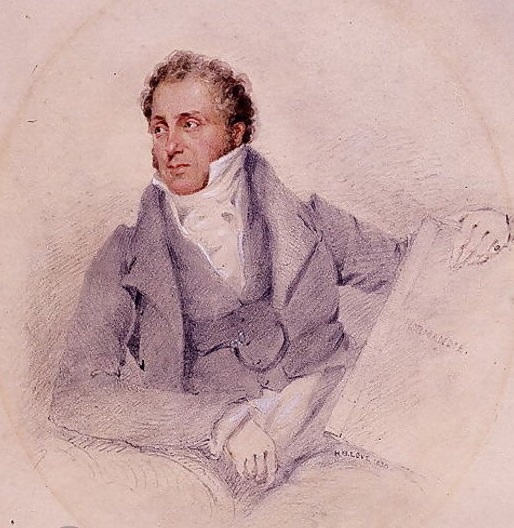
Why John Sell Cotman matters
John Sell Cotman is, with John Crome, one of the two central figures of the Norwich School, England's first significant provincial art movement, and one of the great innovators of British watercolour technique. His flat washes and simplified, almost abstract compositions of Norfolk coastline, Welsh castles, and Yorkshire bridges pushed the medium toward a structural clarity that later watercolourists and printmakers studied closely. For a collector, he represents a historically important but thinly traded market, one where museum depth (Tate, the British Museum, the V&A, the Met, and others) is far greater than the number of works that change hands at a competitive level each year.
- Born
- 1782-05-16, Norwich, Norfolk, England
- Nationality
- English (British)
- Media
- Watercolour, Etching, Oil painting
- Movement
- Norwich School, British Romanticism
- Education
- Norwich Grammar School, entered as a non-paying pupil, 3 August 1793. No formal art academy training; studied informally in London from about 1798, including within Dr Thomas Monro's circle.
- Signature motifs
- Norfolk and Yorkshire landscapes, Architectural antiquities of abbeys and churches, Flat-wash watercolour technique
By the numbers
- GBP 338,500Auction highPart of the Refectory of Walsingham Abbey, Norfolk, Bonhams London, 6 July 2011
- President, 1811Norwich Society of ArtistsElected head of the Norwich School's exhibiting society
- 1800Royal Academy debutSix watercolours accepted for the annual exhibition
- 8+ institutionsMajor collectionsTate, British Museum, V&A, Met, Yale Center for British Art, and others
Selected works
Click any work to view it full screen.
Biography
John Sell Cotman was born on 16 May 1782 in Norwich, Norfolk, the son of Edmund Cotman, a barber and haberdasher, and Ann Cotman. He entered Norwich Grammar School as a non-paying pupil on 3 August 1793, under headmaster Dr Forster. Around 1798, showing a clear preference for art over the family business, he moved to London for study. He had no formal art academy training; instead he worked for a time for the print publisher Rudolph Ackermann and joined the informal sketching circle around the physician and collector Dr Thomas Monro, where he met and worked alongside J. M. W. Turner, Thomas Girtin, and Peter de Wint.
By 1800 Cotman was accomplished enough to have six watercolours accepted at the Royal Academy's annual exhibition, and that year the Society of Arts awarded him a large silver palette for a drawing of a mill. He continued to exhibit at the Royal Academy until 1806, then returned to Norwich, where he worked as a drawing master and portrait painter and became a leading exhibitor with the Norwich Society of Artists, serving as its president from 1811. His 1808 Norwich exhibition alone included sixty-seven works. In 1812 the antiquary and collector Dawson Turner engaged him as drawing master to his wife and daughters, a relationship that supported extensive tours of Normandy and led to his illustrated volume Architectural Antiquities of Normandy (1822), which broadened his reputation beyond East Anglia. In 1823 he opened his own School of Drawing in Norwich. He was elected an associate exhibitor of the Society of Painters in Water-Colours in 1825 and contributed regularly to its exhibitions through 1839. In January 1834, partly on Turner's recommendation, he was appointed Master of Landscape Drawing at King's College School in London, a post he held until his death.
Cotman died on 24 July 1842 in London, reportedly of natural decay, and was buried in the cemetery behind St John's Wood Chapel. Two of his sons, Miles Edmund Cotman and John Joseph Cotman, were also painters working in related styles, a fact that collectors should keep in mind when assessing attribution. His personal effects, prints, and books were sold at auction at Christie's shortly after his death for a modest total, a sharp contrast to the scale his individual works can now command.
Critical reception
Nineteenth-century biographical sources, including the Dictionary of National Biography, already noted that Cotman's reputation had increased significantly in the decades after his death, praising his originality as a colourist and draughtsman. His standing was reinforced by a series of institutional exhibitions, including shows at the Burlington Fine Arts Club in 1888, the Royal Academy's Winter Exhibition of Old Masters in 1892, and repeated British Museum displays through the twentieth century. A dedicated retrospective titled simply "Cotman" traveled from the Victoria and Albert Museum in 1982 to the Whitworth Art Gallery in Manchester the same year, cementing his place alongside Crome as the twin pillars of the Norwich School. Later curatorial writing, including British Museum exhibition material, has continued to point to his spare line and flat wash as qualities that appealed to critics of the print revival, though no single verbatim critical assessment is settled enough in the record to quote directly here.
Market
Cotman's market is that of a historically important but sparsely traded artist. The all-time auction record is GBP 338,500, set at Bonhams in London on 6 July 2011 for the watercolour Part of the Refectory of Walsingham Abbey, Norfolk, more than four times the previous record of GBP 80,500 cited by Bonhams at the time. Results below that level vary enormously by subject, medium, and condition, with smaller or later works sometimes selling for a few hundred pounds and finer, well-provenanced watercolours reaching into the tens of thousands. As with many artists of his period, there is no single continuous price index; each sale needs to be read against the specific work, its date within his career, and its exhibition and provenance history.
Top auction results
| Work | Price | Sale |
|---|---|---|
| Part of the Refectory of Walsingham Abbey, Norfolk (2011) | USD 531,000 (GBP 338,500) | Bonhams, London, 2011-07-06 |
Selected exhibitions
| Years | Exhibition | Venues |
|---|---|---|
| 1800 | Annual exhibition | Royal Academy, London |
| 1807 to 1809 | Annual exhibitions | Norwich Society of Artists, Norwich |
| 1825 to 1839 | Annual exhibitions | Society of Painters in Water-Colours, London |
| 1888 | Cotman drawings | Burlington Fine Arts Club, London |
| 1892 | Winter Exhibition of Old Masters | Royal Academy, London |
| 1934 | Exhibition of English Art | British Museum, London |
| 1982 | Cotman | Victoria and Albert Museum, London (Aug to Oct) |
| 1982 | Cotman | Whitworth Art Gallery, Manchester (Nov to Dec) |
Museum collections
- Tate, London
- British Museum, London
- Victoria and Albert Museum, London
- Fitzwilliam Museum, Cambridge
- Norwich Castle Museum and Art Gallery, Norfolk Museums Collections
- Leeds Art Gallery (the Cotman Collection)
- Yale Center for British Art, New Haven
- Metropolitan Museum of Art, New York
Awards and honors
- Large silver palette, Society of Arts, London (1800)
- President, Norwich Society of Artists (1811)
- Elected Associate Exhibitor, Society of Painters in Water-Colours (1825)
- Appointed Master of Landscape Drawing, King's College School, London (1834)
Authentication and provenance
No catalogue raisonne.
No published catalogue raisonne of Cotman's work has been confirmed. Leeds Art Gallery's Cotmania project offers an online catalogue and archive of the works it holds, but it is not a comprehensive scholarly catalogue raisonne covering his full output. Works entering the market are typically authenticated through major auction houses and specialist dealers in British works on paper, with attention to provenance given the existence of two painter sons who worked in related styles.
Primary reference: https://artuk.org/discover/artists/cotman-john-sell-17821842
What collectors should know
There is no published catalogue raisonne of Cotman's work, and the closest thing to a comprehensive online catalogue, the Cotmania project associated with Leeds Art Gallery, covers that institution's own substantial holdings rather than his full output. Provenance and expert authentication matter more than usual for this artist because his sons, Miles Edmund Cotman and John Joseph Cotman, worked in closely related styles, and the family's paper and drawing stock has at times complicated attribution. The wide spread between his lower-value sales and his 2011 record price also means collectors should treat any single quoted "average" for his market with caution and focus instead on the specific work, its date, medium, and documented exhibition history.
Further reading and resources
Data current as of 2026-07-16.

