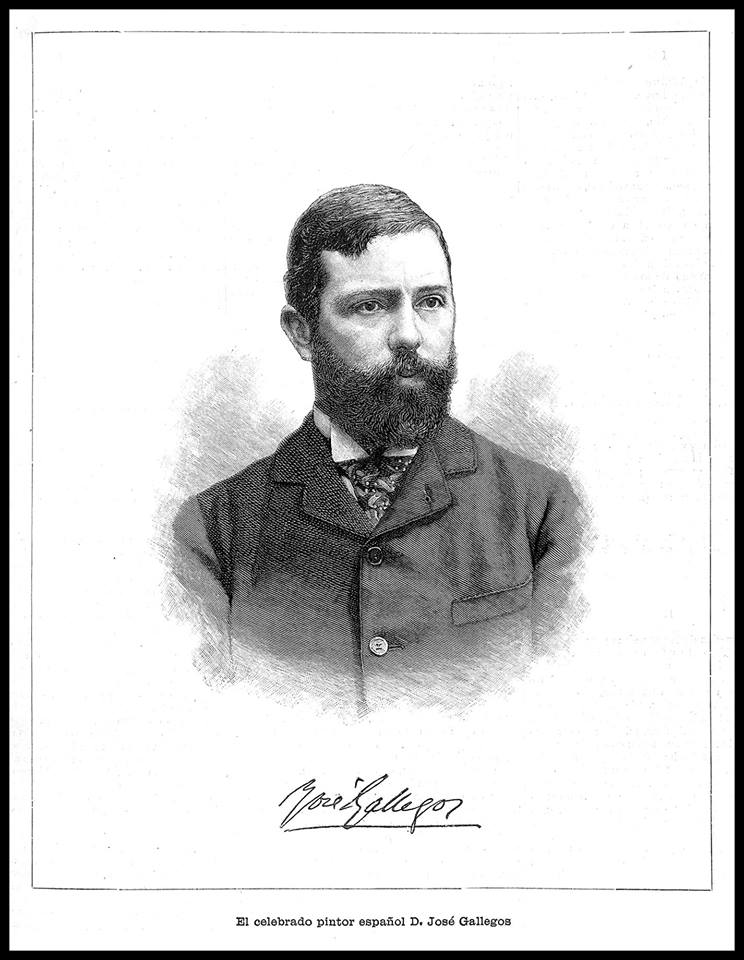
Why Jose Gallegos y Arnosa matters
Jose Gallegos y Arnosa was a Spanish painter of the generation that followed Mariano Fortuny into the international market for polished genre scenes, religious processions, and Orientalist subjects painted in Madrid, Rome, and Tangier. He is not a blue-chip name today, but he was a genuinely international success in his own lifetime, winning a gold medal at the 1891 Berlin International Exhibition of Fine Arts and placing work in exhibitions from Rome to Dublin. For collectors, he represents a well-documented but modestly priced corner of nineteenth-century academic painting, where careful attention to provenance and dating matters more than headline auction results.
- Born
- 1859-05-03, Jerez de la Frontera, Spain
- Nationality
- Spanish
- Media
- Painting
- Movement
- Academic painting, Orientalism
- Education
- Early training at the school of the Academy of Fine Arts of Santo Domingo, Jerez de la Frontera. Enrolled 1873 at the Real Academia de Bellas Artes de San Fernando, Madrid, studying under Federico de Madrazo (one Christie's catalogue note instead names Raimundo Madrazo). From 1878, further study in Rome at the Accademia Chigi and the Circolo Internazionale di Belle Arti.
- Signature motifs
- Clerical and religious processions, Orientalist genre scenes of Tangier, Interiors of libraries and sacristies
By the numbers
- EUR 31,000Auction highIn the Library, Lempertz, Cologne, exact date unconfirmed
- Gold Medal, Berlin 1891Major honorInternational Exhibition of Fine Arts
- 1859 to 1917LivedJerez de la Frontera, Spain, to Anzio, Italy
- No current gallery documentedRepresented byHistorically shown by the dealer Arthur Tooth and Sons, London
Selected works
Click any work to view it full screen.
Biography
Jose Gallegos y Arnosa was born in Jerez de la Frontera, Spain, on 3 May. Wikipedia and the artist's own dedicated biographical site give the birth year as 1857, while auction houses and museum sources, including Sotheby's, Christie's, Lempertz, Museo Carmen Thyssen Malaga, and Coleccion BBVA, give 1859. This dossier follows the auction and museum convention while flagging the conflict.
He began his artistic training locally, at the school run by the Academy of Fine Arts of Santo Domingo in Jerez. At sixteen, with the support of the patron Guillermo Garvey, he moved to Madrid and enrolled at the Real Academia de Bellas Artes de San Fernando in 1873. Most Spanish and museum sources name Federico de Madrazo as his principal teacher, though a Christie's catalogue note instead credits Raimundo Madrazo. After completing his studies in Madrid, he traveled to Tangier, where he built up a body of work that he brought back to Madrid for a well-received solo exhibition. In 1878 he went to Rome to continue his training at the Accademia Chigi and the Circolo Internazionale di Belle Arti, and Rome became a base for much of his later career alongside Madrid.
Gallegos built his reputation on carefully finished genre paintings of clergy, religious processions, and Orientalist scenes set in Tangier. He exhibited at the International Exhibition of Art in Rome in 1883, won a third class medal at the Exposicion Nacional de Bellas Artes in Madrid in 1884 for Botin de guerra, and reached the high point of his career in 1891, when Wedding in the Sacristy of the Cathedral of Seville won the gold medal at the International Exhibition of Fine Arts in Berlin. He continued to exhibit internationally, including at the Irish International Exhibition in Dublin in 1907.
He died in Anzio, Italy, on 20 September 1917, per English and Spanish Wikipedia; no further detail on the cause of death was located in the sources reviewed for this profile.
Critical reception
No exact, independently verifiable quotations from named critics in major outlets have been located for Gallegos. What survives instead is a consistent narrative of contemporary success: an early solo exhibition in Madrid that critics reportedly praised, and medals at the 1884 Madrid national exhibition and the 1891 Berlin international exhibition. Museum and market summaries consistently frame him as an artist admired for technical polish and for delivering recognizably Spanish subject matter to an international audience, and that framing is the throughline of his reception both in his own time and today.
Market
Gallegos's market is small and thinly traded compared to that of his contemporary Fortuny. The highest price documented in this dossier is EUR 31,000, including premium, for In the Library, recorded in Lempertz's Cologne artist index; the exact sale date could not be confirmed from the available catalogue entry. A second work sold through the Spanish platform Setdart for EUR 28,000, per ArsMagazine market coverage, though the specific title and sale date are not confirmed. His work otherwise appears steadily but modestly at European auction houses, including Christie's and Duran Subastas, and no current gallery or estate representation could be confirmed; historically he was represented by the London dealer Arthur Tooth and Sons.
Top auction results
| Work | Price | Sale |
|---|---|---|
| In the Library | EUR 31,000 | Lempertz, Cologne, Germany |
Selected exhibitions
| Years | Exhibition | Venues |
|---|---|---|
| 1883 | International Exhibition of Art | Rome, Italy |
| 1884 | Exposicion Nacional de Bellas Artes (Botin de guerra, third class medal) | Madrid, Spain |
| 1891 | International Exhibition of Fine Arts (Gold Medal, Wedding in the Sacristy of the Cathedral of Seville) | Berlin, Germany |
| 1907 | Irish International Exhibition (no. 354, lent by the artist) | Dublin, Ireland |
Museum collections
- Coleccion BBVA, Madrid
- Museo Carmen Thyssen, Malaga
Awards and honors
- Third class medal, Exposicion Nacional de Bellas Artes, Madrid, for Botin de guerra (1884)
- Gold Medal, International Exhibition of Fine Arts, Berlin, for Wedding in the Sacristy of the Cathedral of Seville (1891)
Authentication and provenance
No catalogue raisonne.
No catalogue raisonne has been published and no certificate-of-authenticity program is documented. An academic doctoral thesis studies his oeuvre alongside the painter Salvador Sanchez Barbudo, but this is scholarly research, not a catalogue raisonne. Attribution and provenance for his work rely on auction house cataloguing and museum documentation.
Primary reference: https://www.carmenthyssenmalaga.org/en/artista/jose-gallegos-y-arnosa
What collectors should know
Gallegos is a documented, exhibited, and medaled nineteenth-century Spanish painter with work in institutional collections including Coleccion BBVA and Museo Carmen Thyssen Malaga, and a work formerly in the William Randolph Hearst collection. There is no catalogue raisonne, so provenance research and comparison against known exhibited works are the main tools for authentication. Even his birth year is disputed between 1857 and 1859 depending on the source, which is a useful reminder that basic biographical facts for artists of this period can still carry real uncertainty. Prices have stayed in the low five figures at auction, making him a modest, research-intensive entry point into the academic and Orientalist market rather than a blue-chip holding.
Further reading and resources
Data current as of 2026-07-16.

