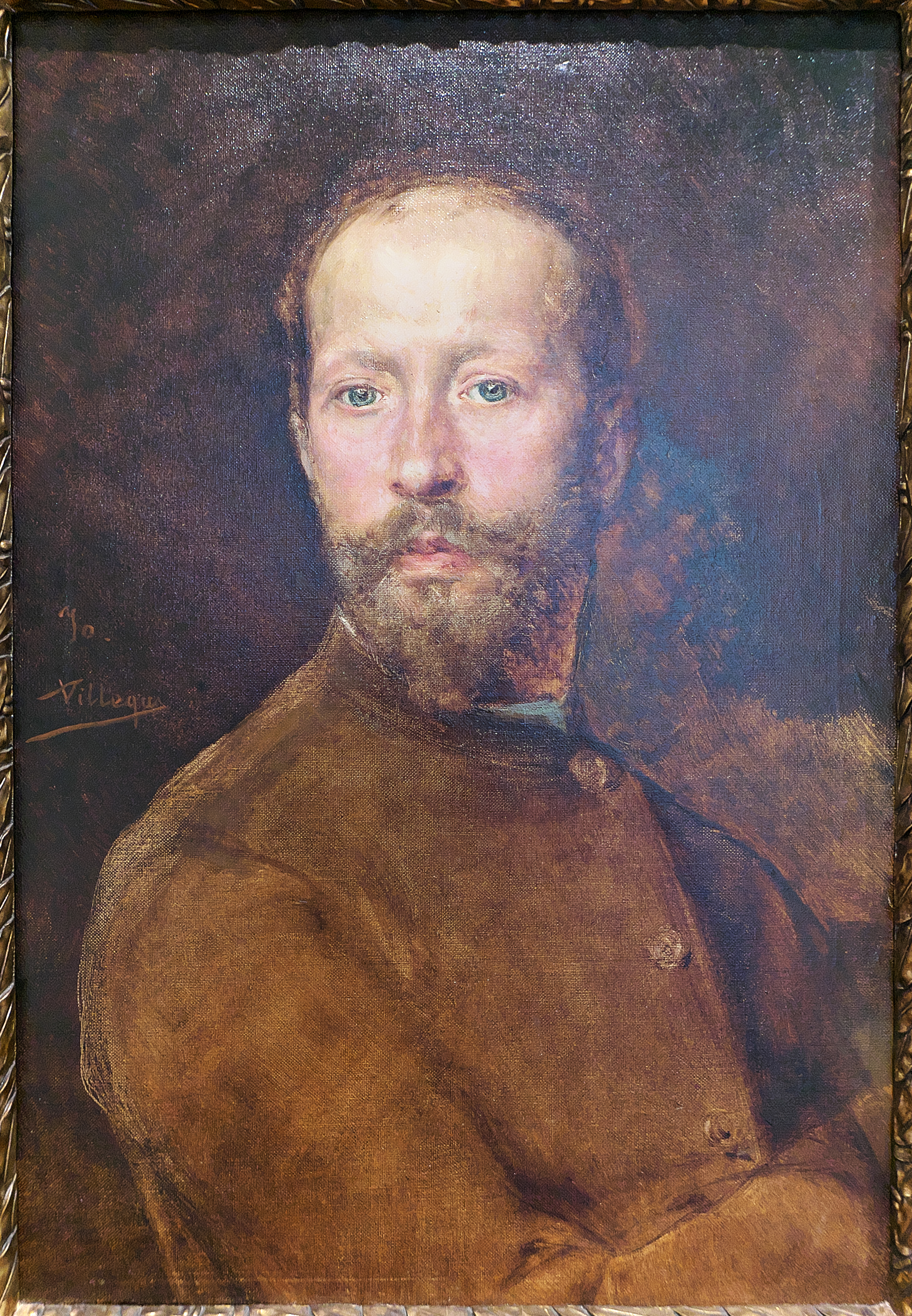
Why José Villegas Cordero matters
José Villegas Cordero (1844 to 1921) was one of the most institutionally prominent Spanish painters of his generation, a genre and history painter who trained alongside Mariano Fortuny's circle in Rome and then returned home to spend seventeen years as director of the Museo del Prado. For a collector, he represents a category of blue-chip nineteenth-century Spanish academic and Orientalist painting that carries deep museum validation but a comparatively thin and historically dated auction record.
- Born
- 1844-08-26, Seville, Spain
- Nationality
- Spanish
- Media
- Painting
- Movement
- 19th-century Spanish academic painting, Orientalism
- Education
- Escuela de Bellas Artes de Sevilla (Seville School of Fine Arts); earlier apprenticeship under Jose Maria Romero Lopez in Seville; studio training under Federico de Madrazo in Madrid
- Signature motifs
- Andalusian and Moroccan genre scenes, Historical and costumbrista subjects, Society portraiture
By the numbers
- USD 770,000Auction highSiesta, Sotheby's New York, 23 May 1989
- 1901 to 1918Museo del Prado directorshipServed as director of Spain's national museum
- None confirmedCurrent representationWorks trade on the secondary and auction market
Selected works
Click any work to view it full screen.
Biography
Villegas Cordero was born on 26 August 1844 in Seville. He was apprenticed early to the painter José María Romero López before enrolling at the Escuela de Bellas Artes de Sevilla, the Seville School of Fine Arts.
He then traveled to Madrid, where he trained in the studio of Federico de Madrazo. At the end of 1868 he moved to Rome, joining a circle of Spanish painters gathered there around Mariano Fortuny. He remained based in Italy for more than thirty years, exhibiting and selling work across Europe and America.
His later career brought major institutional responsibility. During his decades in Rome he also served as director of the Real Academia de España en Roma, the Spanish Academy in Rome, though the exact starting year is not confirmed in the sources reviewed for this profile. He returned to Madrid to become director of the Museo del Prado in 1901, a post he held until 1918. He is described in multiple sources as a highly decorated artist, though a detailed record of his individual prizes and honors could not be confirmed. He died in Madrid on 9 November 1921.
Critical reception
No exact, attributable critical quotations from named critics in major outlets could be confirmed for this profile. What is well documented is the institutional arc of his reputation: his early association with the circle of Spanish painters gathered around Fortuny in Rome, his later directorship of the Real Academia de España en Roma, and his seventeen-year directorship of the Museo del Prado from 1901 to 1918 all point to an artist whose standing was measured as much by institutional trust as by studio output. That standing has persisted in scholarship: his painting Moroccans Examining Arms was included in the 2005 Albuquerque Museum exhibition and catalogue Prelude to Spanish Modernism: Fortuny to Picasso, which places him within the Orientalist lineage running from Fortuny toward the threshold of twentieth-century Spanish modernism.
Market
Villegas Cordero's best-documented all-time auction result is Siesta, which sold for USD 770,000 at Sotheby's New York on 23 May 1989, a price Sotheby's has since described as having broken the auction record for the artist at the time. A different painting also titled Siesta sold for a considerably lower USD 446,328 at Sotheby's London in 2014, the highest price recorded for his work since 2000; the two same-titled paintings are distinct works and should not be conflated when comparing prices. His market today runs almost entirely through the secondary and auction channel, including Sotheby's, Christie's, and Spanish houses such as Subastas Segre, Subastas Fígaro, and Durán, rather than through any confirmed gallery or estate representation.
Top auction results
| Work | Price | Sale |
|---|---|---|
| Siesta (1989) | USD 770,000 | Sotheby's, New York, 1989-05-23 |
Selected exhibitions
| Years | Exhibition | Venues |
|---|---|---|
| 1917 | Exposición Nacional de Bellas Artes | Madrid, Spain |
| 19th century, exact dates not confirmed | Naples Exhibition | Naples, Italy |
| 19th century, exact dates not confirmed | Venice Biennale (Esposizione Internazionale d'Arte di Venezia) | Venice, Italy |
| 2005 | Prelude to Spanish Modernism: Fortuny to Picasso | Albuquerque Museum, New Mexico (catalogue inclusion of Moroccans Examining Arms) |
Museum collections
- Museo del Prado, Madrid
- Smithsonian American Art Museum, Washington, D.C.
- Joslyn Art Museum, Omaha
- Colección BBVA, Madrid
- Banco de España Collection, Madrid
Awards and honors
- Director, Museo del Prado, Madrid (served to 1918) (1901)
- Director, Real Academia de España en Roma (Spanish Academy in Rome), exact year not confirmed
Authentication and provenance
No catalogue raisonne.
No catalogue raisonne has been identified for Villegas Cordero, and no gallery or estate currently represents him. Works are catalogued and authenticated through museum provenance records, documented exhibition history, and the cataloguing departments of major auction houses.
Primary reference: https://en.wikipedia.org/wiki/José_Villegas_(painter)
What collectors should know
There is no catalogue raisonne for Villegas Cordero and no current gallery or estate representation, so provenance, museum exhibition history, and auction house cataloguing carry more of the authentication burden than they would for an artist with an active market infrastructure. Collectors should also be careful with his name, which appears in sources and sale catalogues both as José Villegas Cordero and as José Villegas y Cordero, and with his titles, since at least two different paintings called Siesta have sold at very different price points. His presence in institutional collections, including the Museo del Prado, the Smithsonian American Art Museum, the Joslyn Art Museum, and Spanish corporate collections such as the Colección BBVA and the Banco de España, signals lasting historical importance even though his public auction turnover remains limited.
Further reading and resources
Data current as of 2026-07-18.

