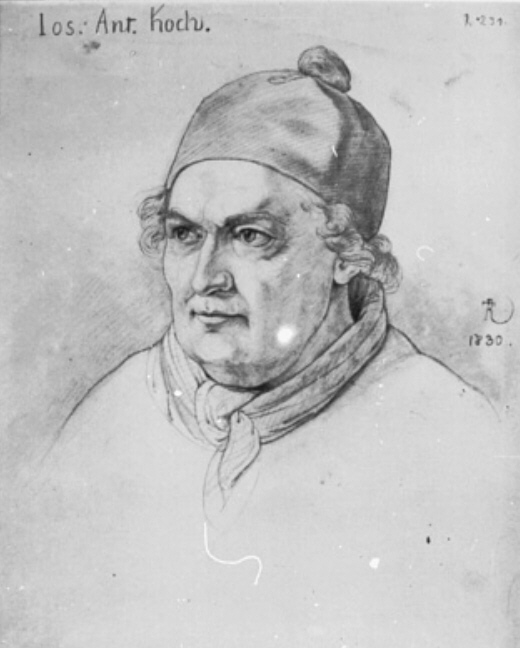
Why Joseph Anton Koch matters
Joseph Anton Koch is remembered as one of the founding figures of heroic, idealized landscape painting, the German-speaking tradition that treated landscape with the moral seriousness and compositional rigor previously reserved for history painting. Working mainly in Rome across four decades, he became a central figure for the German and Austrian artists who gathered there, including the Nazarene painters, and his work now anchors the early nineteenth century German and Austrian holdings of major museums such as the Metropolitan Museum of Art, the Städel Museum, and the British Museum. For collectors, he represents an established, museum-validated name in a market segment where verified auction data is scarce and each sale carries outsized weight.
- Born
- 1768-07-27, Obergiblen, Elbigenalp, Tyrol, Austria
- Nationality
- Austrian
- Media
- Painting, Drawing, Etching
- Movement
- Neoclassicism, German Romanticism
- Education
- Catholic seminary, Dillingen (two years); sculpture apprenticeship, Augsburg; Hohe Karlsschule, Stuttgart, 1785 to 1791; further study in Rome under Asmus Jacob Carstens, from 1795
- Signature motifs
- Heroic idealized landscape, Alpine and Italian mountain scenery with mythological or biblical staffage
By the numbers
- Approx. USD 3.59M (unverified lot)Reported auction highAggregate figure reported by MutualArt; the specific work, sale date, and auction house could not be independently confirmed
- 1768 to 1839Life datesTyrolean-born painter, based in Rome for most of his career
- Neoclassicism to RomanticismMovementRegarded as a founder of heroic, idealized landscape painting
Selected works
Click any work to view it full screen.
Biography
Joseph Anton Koch was born on 27 July 1768 in Obergiblen, part of Elbigenalp, in the Tyrol. He first studied for two years at the Catholic seminary in Dillingen, then trained briefly with a court sculptor in Augsburg after the Bishop of Augsburg recognized his talent. In 1785 he entered the Hohe Karlsschule in Stuttgart, a strict military academy that combined academic and artistic training. He remained there until 1791, absorbing the political ferment of the French Revolution before leaving the school without completing its program.
In 1794 Koch received a stipend for a three-year sojourn in Italy, and he settled in Rome in 1795, where he studied under the Neoclassical painter Asmus Jacob Carstens. Rome became his base for the rest of his career, and he developed the style of heroic, idealized landscape for which he is known: dramatic Alpine and Italian scenery populated with biblical or mythological figures. He was supported over the years by patrons including Crown Prince, later King, Ludwig I of Bavaria, who purchased his work. In the months before his death he also received an annual allowance from the Austrian Emperor Ferdinand I. Koch died on 12 January 1839 in Rome and was buried in the Teutonic Cemetery beside St. Peter's Basilica.
Critical reception
Art historians have long treated Koch as the founding figure of heroic, idealized landscape painting, a tradition that gave Alpine and Italian scenery the compositional weight and moral seriousness of history painting. Standard reference sources describe him as perhaps the most significant Neoclassical landscape painter of his generation, and he is widely credited with pioneering the heroic landscape genre in the tradition of Poussin and Claude Lorrain. His fresco cycle illustrating Dante for the Casino Massimo in Rome, painted alongside the Nazarene circle around 1825, is frequently cited as the clearest demonstration of his ambition to give landscape painting the narrative and moral scope of history painting. That reputation, built during his lifetime through patrons such as Crown Prince Ludwig of Bavaria, has held steady in subsequent museum scholarship.
Market
Koch's auction market is thin, and precise, itemized sale records are hard to verify from public sources. The aggregator MutualArt reports a realized price as high as USD 3,587,126 for a Koch painting, but the specific work, sale date, and auction house behind that figure could not be independently confirmed for this profile, and other databases, including Artnet, askART, and HENI, show only auction estimates rather than confirmed hammer prices in their public listings. Given how little verified public sales data exists, any single reported figure should be read as approximate rather than as a confirmed record, and should not be treated as evidence of a continuous price history.
Selected exhibitions
| Years | Exhibition | Venues |
|---|---|---|
| 2011 | Joseph Anton Koch in Rome: Drawings from the Graphic Collection of the Academy of Fine Arts Vienna | Academy of Fine Arts Vienna, Graphic Collection |
Museum collections
- The Metropolitan Museum of Art, New York
- Städel Museum, Frankfurt
- Academy of Fine Arts Vienna, Graphic Collection
- British Museum, London
Awards and honors
- Travel stipend for a three-year sojourn in Italy, enabling his move to Rome (1794)
- Annual allowance from Emperor Ferdinand I of Austria, granted months before his death (1838)
Authentication and provenance
No catalogue raisonne.
No published catalogue raisonne has been confirmed for Koch. Works are documented and verified through museum collection catalogues, such as those of the Städel Museum and the Metropolitan Museum of Art, and through auction house and scholarly provenance research rather than a certificate program.
Primary reference: https://sammlung.staedelmuseum.de/en/person/koch-joseph-anton
What collectors should know
No published catalogue raisonne for Koch has been confirmed, so provenance and attribution rest on museum collection catalogues, most notably those of the Städel Museum and the Metropolitan Museum of Art, along with established auction house and scholarly research. His work appears in major public collections, including the Metropolitan Museum of Art, the Städel Museum, the Academy of Fine Arts Vienna, and the British Museum, which supports long-term institutional interest but does not translate into frequent market activity. Collectors should treat any reported auction figure for Koch with caution given how little verified, itemized sale data is publicly available, and should expect that any work offered for sale will need careful provenance and attribution review given the absence of a definitive catalogue.
Further reading and resources
Data current as of 2026-07-09.

