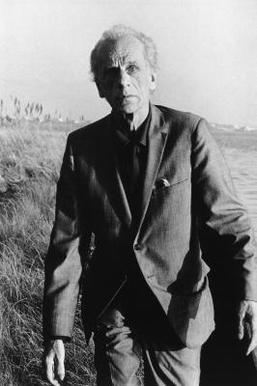
Why Joseph Cornell matters
Joseph Cornell is one of the most singular figures in twentieth-century American art, the largely self-taught inventor of the glass-fronted "shadow box," an assemblage of found ephemera, maps, ball bearings, cordial glasses, and printed paper arranged into small, dreamlike worlds. He worked outside any school or movement, largely from his family's home in Flushing, Queens, yet his boxes are now held by nearly every major museum of modern art in the United States and Europe. For a collector, Cornell represents a rare case of an artist whose historical importance is settled and whose supply is genuinely scarce, since he made his work slowly, by hand, over four decades and left no catalogue raisonne to fully map it.
- Born
- 1903-12-24, Nyack, New York, USA
- Nationality
- American
- Media
- Assemblage, Box construction, Collage
- Movement
- Surrealism, Assemblage art
- Education
- Phillips Academy, Andover, through 1921. No college degree is documented; largely self-taught as an artist.
- Signature motifs
- Shadow box, Found-object assemblage
- Representation
- Estate administered by the Joseph and Robert Cornell Memorial Foundation, Gagosian (exhibition collaboration with the Foundation, 2025 to 2026)
By the numbers
- USD 7.78MAuction highReported record price by market aggregators (MutualArt, Artsy); the underlying work, auction house, and sale date are not independently confirmed in public sources.
- 1968Award of MeritAmerican Academy and Institute of Arts and Letters
- Guggenheim (1967), Met (1970), MoMA (1980), SFMOMA (2007), Royal Academy (2015)Major retrospectives
- 15+ major institutionsMuseum collectionsIncluding MoMA, Guggenheim, Tate, and the National Gallery of Art
Biography
Joseph Cornell was born on December 24, 1903, in Nyack, New York. He attended Phillips Academy in Andover, Massachusetts, through 1921, and that period is his only documented formal schooling; he never attended college and had no formal art training. In 1929 his family moved to Flushing, Queens, to a house on Utopia Parkway that became his home and workshop for the rest of his life, and where he built his boxes largely alone, working with materials gathered from secondhand bookstores, dime stores, and his own collections of ephemera.
Cornell developed his assemblage practice independently of any school, though his work was closely aligned with Surrealism through the found-object and collage techniques he shared with that circle. His reputation grew steadily through museum exhibitions rather than through a conventional gallery career. In 1967 he had a retrospective at the Solomon R. Guggenheim Museum in New York and an exhibition at the Pasadena Art Museum in California, both described as critical successes. In 1968 the American Academy and Institute of Arts and Letters gave him its Award of Merit. In 1970 the Metropolitan Museum of Art mounted a retrospective of his work curated by Henry Geldzahler.
Cornell died at his home in Flushing, Queens, on December 29, 1972, a few days after his sixty-ninth birthday, of apparent heart failure. His death was reported in The New York Times on December 31, 1972. His estate is now administered by the Joseph and Robert Cornell Memorial Foundation, created by his will.
Critical reception
Cornell's critical standing rests on his unlikely position as a self-taught outsider who nonetheless became central to how museums tell the story of American Surrealism and assemblage. Institutions describe him as a foundational figure who elevated the box, an ordinary domestic object, into a major sculptural form built from paper ephemera and small found objects. That reputation was cemented by a run of major museum exhibitions across his life and after his death, including the 1967 Guggenheim and Pasadena shows, the 1970 Metropolitan Museum retrospective curated by Henry Geldzahler, a 1980 Museum of Modern Art retrospective tied to that museum's fiftieth anniversary, a 2007 retrospective organized by SFMOMA that traveled to the Smithsonian American Art Museum and the Peabody Essex Museum, and "Joseph Cornell: Wanderlust" at the Royal Academy of Arts in London in 2015, which traveled to the Kunsthistorisches Museum in Vienna. The continuing interest of a major commercial gallery like Gagosian in staging shows built around his studio, decades after his death, points to a critical consensus that has only deepened over time.
Market
Cornell's auction market is thin by design: he worked slowly, sold sparingly during his lifetime, and left a body of work that surfaces at auction only occasionally. Market aggregators including MutualArt and Artsy cite an auction record of approximately USD 7.78 million for Cornell, though the specific work, auction house, and sale date behind that figure are not independently confirmed in public sources.
In the decades after his death, his estate was represented by dealers including Leo Castelli, Richard Feigen, and James Corcoran. More recently, Gagosian collaborated with the Joseph and Robert Cornell Memorial Foundation on a major exhibition in Paris, "The House on Utopia Parkway," running from December 2025 to March 2026, and Schoelkopf Gallery in New York has also mounted focused Cornell exhibitions. Works entering the secondary market are sometimes estate stamped, which collectors should look for as a baseline provenance marker.
Top auction results
| Work | Price | Sale |
|---|---|---|
| Not publicly identified (record price only) | USD 7,781,000 |
Selected exhibitions
| Years | Exhibition | Venues |
|---|---|---|
| 1967 | Retrospective | Solomon R. Guggenheim Museum, New York |
| 1967 | Exhibition | Pasadena Art Museum, California |
| 1970 | Retrospective, curated by Henry Geldzahler | Metropolitan Museum of Art, New York |
| 1980 | Retrospective, part of MoMA's 50th anniversary program | Museum of Modern Art, New York |
| 2007 | Retrospective | San Francisco Museum of Modern Art, traveled to Smithsonian American Art Museum and Peabody Essex Museum |
| 2015 | Joseph Cornell: Wanderlust | Royal Academy of Arts, London, traveled to Kunsthistorisches Museum, Vienna |
| 2022 | 50th anniversary commemorative exhibition | Fralin Museum of Art, University of Virginia |
| 2025 to 2026 | The House on Utopia Parkway: Joseph Cornell's Studio Re-Created by Wes Anderson | Gagosian, Paris |
Museum collections
- Museum of Modern Art, New York
- Solomon R. Guggenheim Museum, New York
- Smithsonian American Art Museum, Washington, D.C.
- National Gallery of Art, Washington, D.C.
- Art Institute of Chicago
- Menil Collection, Houston
- Tate, London
Awards and honors
- Award of Merit, American Academy and Institute of Arts and Letters (1968)
Authentication and provenance
No catalogue raisonne.
No published catalogue raisonne has been confirmed. Works are administered and, in some cases, estate stamped by the Joseph and Robert Cornell Memorial Foundation, which also licenses reproduction rights through the Artists Rights Society.
Primary reference: https://cornellmemorialfoundation.org/
What collectors should know
There is no confirmed catalogue raisonne of Cornell's work, so provenance and studio or Foundation verification carry unusual weight; look for estate stamps and a documented chain of ownership back to the artist's studio or his early dealers. Auction supply is genuinely limited and prices are concentrated in a small number of headline sales, so any single result, including the reported record price, should be read against that scarcity rather than as a smooth trend line. Because Cornell made objects by hand over a long career with no assistants and no market strategy in the contemporary sense, condition and completeness of the individual box matter more than they would for an artist with a larger, more standardized output.
Further reading and resources
Data current as of 2026-07-09.

