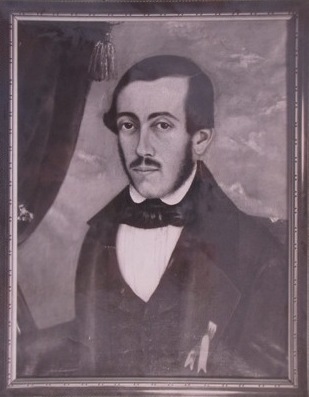
Why Juan Leon Palliere matters
Juan Leon Palliere is one of the principal visual chroniclers of nineteenth-century Rio de la Plata life, a French-trained, Brazilian-born painter and lithographer whose decade in Buenos Aires produced the images against which much of the region's gaucho and rural iconography is still measured. For a collector, he represents a historical, museum-anchored market: works are scarce at auction, held mostly in institutions, and valued as much for documentary and art-historical importance as for scale.
- Born
- 1823-01-01, Rio de Janeiro, Brazil
- Nationality
- French
- Media
- Painting, Lithography, Watercolor
- Movement
- Costumbrismo, Academic art
- Education
- Atelier of Francois-Edouard Picot, Paris, from 1836; Academia Imperial de Belas Artes, Rio de Janeiro, from 1848; Academie de France, Rome, from 1850; engraving course, Paris, 1853
- Signature motifs
- Gauchos and pampas life, Costumbrista scenes of the Rio de la Plata
By the numbers
- Not independently confirmedAuction recordNo verifiable public sale price, house, and date could be established for this artist as of 2026-07-16
- 1823 to 1887Lived
- 1868 to 1882Paris SalonExhibited Argentine-themed works after returning to France
- None documentedGallery representation
Selected works
Click any work to view it full screen.
Biography
Juan Leon Palliere, also recorded as Jean Leon Pallière, was born on 1 January 1823 in Rio de Janeiro, Brazil, to French parents. His father, Armand Julien Palliere, was a painter at the court of Emperor Pedro I of Brazil, and the family registered Juan Leon as a French citizen. The family moved to Paris around 1830, and from 1836, at age thirteen, he trained in the Paris atelier of Francois-Edouard Picot.
He returned to Rio de Janeiro in 1848 and enrolled at the Academia Imperial de Belas Artes, studying under Felix Taunay. In 1849 he received a scholarship from the Academy that funded further study in Europe, and from 1850 he studied at the Academie de France in Rome. He extended his time in Europe with an engraving course in Paris in 1853, and his European training continued to about 1855.
From late 1855 to 1866 he lived in Buenos Aires, where he documented gauchos, pulperias, and rural customs of the Argentine Pampas in paintings, watercolors, and drawings. This body of work, later gathered in the lithographic set Album Palliere, Escenas Americanas, published in Buenos Aires in 1864 to 1865, became a central visual record of Argentine rural life in the mid-nineteenth century. He exhibited in Rio de Janeiro at the Academia Imperial de Belas Artes in 1852 and, after returning to France in 1866, showed works with Argentine themes at the Paris Salon between 1868 and 1882.
He married Luise Astree Chavanneau in 1878. He died on 12 February 1887 in Lorris, France.
Critical reception
Palliere has long been treated as a foundational recorder of Rio de la Plata rural life. Brazilian critic Gonzaga Duque Estrada praised his skill and his handling of biblical and allegorical subjects in an 1888 history of Brazilian art. Argentine art historian Julio Payro, cited in later press coverage, credited him as an especially sharp and sensitive chronicler of Argentine rural life in the early years of national organization. Argentine press coverage as recent as 2022 has continued to frame him as, in effect, a graphic historian of the Pampas, underscoring the durability of that reading of his work.
Market
Palliere's market is thin and largely historical, and no fully verifiable public auction record, with a confirmed work, price, sale house, and date, could be established from available sources. French market valuation guides place paintings signed Jean Leon Palliere in a broad range of roughly EUR 1,000 to 80,000, with drawings and watercolors in a lower EUR 300 to 30,000 band, reflecting wide variance by subject and quality rather than a single benchmark price. There is no published catalogue raisonne; attribution rests on museum records and auction-house cataloguing.
Selected exhibitions
| Years | Exhibition | Venues |
|---|---|---|
| 1852 | 12a Exposicao Geral de Belas Artes | Academia Imperial de Belas Artes, Rio de Janeiro |
| 1868 to 1882 | Salon de Paris | Salon de Paris, Paris |
| 1855 to 1866 | Residency documenting gaucho and rural life | Buenos Aires, Argentina |
| 2016 | Alegoria as Artes, Leon Palliere | Curated retrospective, Brazil |
| 2022 | RED Palliere: el arte de los pintores viajeros | Argentina |
Museum collections
- Museo Nacional de Bellas Artes, Buenos Aires
- Fondo Nacional de las Artes, Buenos Aires
- The Metropolitan Museum of Art, New York
Awards and honors
- Scholarship (beca), Academia Imperial de Belas Artes, Rio de Janeiro, funding further study at the Academie de France, Rome (1849)
Authentication and provenance
No catalogue raisonne.
No published catalogue raisonne has been confirmed for this artist. Works are typically authenticated through museum records, such as those of the Museo Nacional de Bellas Artes, and through auction-house cataloguing, including Christie's.
Primary reference: https://www.christies.com/en/lot/lot-6393219
What collectors should know
There is no gallery or estate currently representing Palliere; his work reaches the market through museum-adjacent channels and the secondary auction market rather than a primary dealer. With no catalogue raisonne, provenance and museum or auction-house cataloguing carry substantial weight in authentication. Because confirmed public sale data is limited and no single auction result can currently be verified as an authoritative record, collectors should treat any price figures with caution and verify current listings and comparable sales directly with specialist Latin American and French auction departments before relying on them.
Further reading and resources
Data current as of 2026-07-16.

