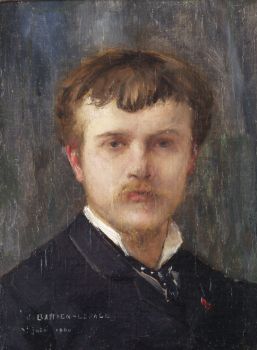
Why Jules Bastien-Lepage matters
Jules Bastien-Lepage was one of the most influential French painters of the late nineteenth century, a bridge figure between academic Salon painting and the Naturalist movement that followed Courbet and Millet. His plein-air treatment of rural labor and his direct, unsentimental peasant portraits shaped a generation of painters across Europe, including the Newlyn School painters in England. For a collector, he represents a historically important but market-thin artist: his major paintings anchor the permanent collections of the Musee d'Orsay, the Metropolitan Museum of Art, and the National Gallery of Victoria, while his auction presence remains modest and infrequent.
- Born
- 1848-11-01, Damvillers, France
- Nationality
- French
- Media
- Painting
- Movement
- Naturalism, Realism
- Education
- Collège de Verdun (from age 11); École des Beaux-Arts, Paris, under Alexandre Cabanel, circa 1868 to 1871
- Signature motifs
- Rural naturalism, Peasant genre scenes
By the numbers
- USD 2.28MAuction highPortrait of Sarah Bernhardt, Christie's, 2022
- 1879Legion of HonourAwarded following Salon success with Potato Gatherers
- DeceasedStatus1848 to 1884, age 36
- No current gallery or estateRepresentationWorks trade on the secondary market only
Selected works
Click any work to view it full screen.
Biography
Jules Bastien-Lepage was born on 1 November 1848 in Damvillers, in the Meuse department of France. His first teacher was his father, also an artist, and from age eleven he attended the College de Verdun. At nineteen, with his secondary schooling complete, he moved to Paris in 1867 to pursue art, initially supporting himself with a job at the Central Postal Administration while attending evening classes at the Ecole des Beaux-Arts. He resigned after about six months to study full time, enrolling under the name "Jules Bastien" in 1868 and training under the academic painter Alexandre Cabanel. He won first place for drawing and completed three years at the school, a period interrupted by his enlistment during the Franco-Prussian War of 1870.
His Salon debuts in 1870 and 1872 attracted little notice, but Portrait de mon grand-pere earned him a third-class medal at the 1874 Salon. In 1875 his Annunciation was passed over for the official Prix de Rome but given a consolation prize, the Premier Second Grand Prix. His breakthrough came at the 1879 Salon, where Potato Gatherers and his Portrait of Sarah Bernhardt brought wide acclaim and led to his appointment as a Chevalier of the Legion of Honour that same year. Joan of Arc, now in the Metropolitan Museum of Art, followed at the 1880 Salon, and in 1883 he was made a Knight in Belgium's Order of Leopold.
Bastien-Lepage died on 10 December 1884 at his studio on rue Legendre in Paris, at the age of thirty-six, after a rapid decline in his health during his final months. Accounts of the precise medical cause vary, with some describing a form of cancer and others a prolonged, undiagnosed illness; no single authoritative medical source has been confirmed. A memorial retrospective of more than two hundred of his works opened the following year at the Hotel de Chimay at the Ecole des Beaux-Arts, and the Musee d'Orsay has since mounted a major exhibition dedicated to his work.
Critical reception
Bastien-Lepage was recognized in his own time as heir to the realist tradition of Courbet and Millet, and Emile Zola discussed him in those terms as a leading figure of what Zola characterized as a softened, more publicly palatable form of realism. His Joan of Arc drew strong reactions at the 1880 Salon, including enthusiastic praise from the critic and painter Marie Bashkirtseff, who described being deeply moved by the work's mysterious and inspired quality, alongside criticism from others who found the painting's mix of naturalistic peasant figure and visionary saints uneasy. Modern museum scholarship, including essays from the National Gallery of Victoria and the Musee d'Orsay, treats him as a pivotal figure whose rural genre scenes and portraits helped define Naturalism as a distinct movement and whose early death cut short what many critics regarded as a still-developing, highly promising career.
Market
Bastien-Lepage's auction market is thin relative to his historical stature, a common pattern for nineteenth-century academic and Naturalist painters whose reputations rest primarily on museum holdings rather than sustained secondary-market turnover. His all-time auction high is Portrait of Sarah Bernhardt (1879), which sold for USD 2,280,000 at Christie's on 20 October 2022. No later sale exceeding that figure has been identified. Because he died in 1884 with no estate or foundation, there is no current gallery or estate representation; his paintings circulate through auction houses and private dealers handling nineteenth-century European art.
Top auction results
| Work | Price | Sale |
|---|---|---|
| Portrait of Sarah Bernhardt (1879) (1879) | USD 2,280,000 (USD 2,280,000) | Christie's, 2022-10-20 |
Selected exhibitions
| Years | Exhibition | Venues |
|---|---|---|
| 1874 | Paris Salon | Salon, Paris (Portrait de mon grand-pere, third-class medal) |
| 1875 | Prix de Rome competition | Ecole des Beaux-Arts, Paris (Annunciation, consolation prize) |
| 1879 | Paris Salon | Salon, Paris (Potato Gatherers; Portrait of Sarah Bernhardt) |
| 1880 | Paris Salon | Salon, Paris (Joan of Arc) |
| 1885 | Posthumous retrospective | Hotel de Chimay, Ecole des Beaux-Arts, Paris (over 200 works) |
| Year not confirmed | Jules Bastien-Lepage (1848 to 1884) | Musee d'Orsay, Paris |
Museum collections
- Musée d'Orsay, Paris
- Metropolitan Museum of Art, New York
- National Gallery of Victoria, Melbourne
Awards and honors
- Third-class medal, Paris Salon (1874)
- Premier Second Grand Prix (Prix de Rome consolation prize) (1875)
- Chevalier, Legion of Honour (France) (1879)
- Knight, Order of Leopold (Belgium) (1883)
Authentication and provenance
No catalogue raisonne.
No published catalogue raisonne has been identified, and the artist left no estate or foundation. Authentication of works relies on provenance history, nineteenth-century Salon and exhibition records, and documentation held by the museums that own his major paintings.
Primary reference: https://www.musee-orsay.fr/en/program/whats-on/exhibitions/presentation/jules-bastien-lepage-1848-1884
What collectors should know
There is no catalogue raisonne and no estate or foundation for Bastien-Lepage, so provenance research and museum documentation carry significant weight in authentication. His market is defined by infrequent, high-value sales rather than steady turnover, and his reputation is driven far more by institutional holdings, at the Musee d'Orsay, the Met, and the National Gallery of Victoria, than by auction volume. Collectors should treat any single auction result, including the 2022 Sarah Bernhardt sale, as a data point from a thin market rather than as evidence of a broad, liquid trading history.
Further reading and resources
Data current as of 2026-07-09.

