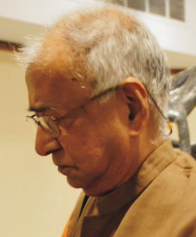
Why K. G. Subramanyan matters
K. G. Subramanyan was one of the central figures of Indian modernism, a painter, muralist, printmaker, and teacher whose narrative, folk-inflected style helped define the Baroda School and shaped generations of Indian artists through his decades of teaching in Santiniketan and Baroda. His posthumous inclusion in documenta 14 in 2017 confirmed his standing on the international stage. For a collector, he is a historically important, museum-anchored artist whose market runs mainly through Indian auction houses rather than the international blue-chip circuit, which makes provenance and sourcing discipline especially important.
- Born
- 1924-02-05, Kuthuparamba, Kerala, India
- Nationality
- Indian
- Media
- Painting, Sculpture, Printmaking, Muralist
- Movement
- Indian Modernism, Contextual Modernism, Baroda School
- Education
- B.A. Economics, Presidency College, Madras (interrupted M.A.); Kala Bhavana, Visva-Bharati University, Santiniketan, 1944 to 1948; Slade School of Fine Art, London, British Council Research Scholar, 1955 to 1956
- Signature motifs
- Narrative figuration, Folk and mythological imagery, Murals and terracotta relief
- Representation
- Not formally confirmed; no current gallery or estate representation identified. Works trade primarily through Indian auction houses (Saffronart, AstaGuru, Christie's) and DAG maintains an active artist page.
By the numbers
- 2012Padma VibhushanIndia's second-highest civilian honor
- 2017Documenta 14Posthumous inclusion, Kassel
- 1981, 2003RetrospectivesBharat Bhavan, Bhopal; National Gallery of Modern Art, New Delhi and Mumbai
Biography
Kalpathi Ganpathi Subramanyan was born on 5 February 1924 in Kuthuparamba, Kerala, India. He first studied economics at Presidency College, Madras, where he was drawn into the Quit India movement, was imprisoned, and was subsequently debarred from completing a master's degree. He turned to art, studying at Kala Bhavana, the art faculty of Visva-Bharati University in Santiniketan, from 1944 to 1948, under Nandalal Bose, Benode Behari Mukherjee, and Ramkinkar Baij. In 1955 and 1956 he studied briefly at the Slade School of Fine Art in London as a British Council research scholar.
Subramanyan spent most of his teaching career at the Faculty of Fine Arts, Maharaja Sayajirao University in Baroda (Vadodara), where he became a central figure of what is known as the Baroda School, working across painting, mural, terracotta relief, printmaking, children's book illustration, and writing on art. He received India's three principal civilian honors for the arts: the Padma Shri in 1975, the Padma Bhushan in 2006, and the Padma Vibhushan in 2012. He died on 29 June 2016 in Vadodara, Gujarat, India, at the age of 92.
Critical reception
Subramanyan is consistently described in the literature as one of the pioneers of Indian modern art and a defining teacher of the Baroda School, credited with fusing folk and popular imagery, mythological narrative, and a modernist visual language across painting, murals, and terracotta relief. His 1981 retrospective at Bharat Bhavan, Bhopal, and the large 2003 retrospective at the National Gallery of Modern Art in New Delhi and Mumbai, curated by R. Siva Kumar, both affirmed his institutional standing during his lifetime. His posthumous appearance in documenta 14 in 2017, with the mural "The War of the Relics" and the terracotta reliefs "Anatomy Lesson 1 to 5," introduced his late work to an international exhibition audience and reinforced readings of his practice as a sustained meditation on violence, belief, and modernity. No exact, independently verifiable critic quotations from major outlets could be confirmed for this profile.
Market
A reliable, fully documented all-time auction record for Subramanyan could not be confirmed from available sources. Reported top results cluster in the range of roughly USD 180,000 to 185,000 for individual lots, including a figure cited on the artist's own website for "Mask, Icon, Mount, Mascot," but no single source confirms the currency, sale house, and exact sale date together for a top lot. AstaGuru's Collectors' Choice sale in June 2026 is reported to have set a new auction record for the artist with "Figures with Mystical Birds (Diptych)," though the exact realized price was not available in the sources reviewed. His secondary market runs largely through Indian houses, principally Saffronart, AstaGuru, and Christie's, with far fewer public sales than the scale of his museum reputation might suggest. Collectors should treat any single published "record" figure as a snapshot rather than a settled benchmark and verify directly with the auction house.
Selected exhibitions
| Years | Exhibition | Venues |
|---|---|---|
| 1963 | 57th International Biennial Exhibition | Sao Paulo Biennale, Brazil (Medallion of Honourable Mention) |
| 1968 | First International Triennale | New Delhi (Gold Medal) |
| 1981 | Retrospective | Bharat Bhavan, Bhopal |
| 2003 | K. G. Subramanyan, A Retrospective | National Gallery of Modern Art, New Delhi and Mumbai (curated by R. Siva Kumar) |
| 2017 | documenta 14 | Kassel, Germany (posthumous, works including 'The War of the Relics' and 'Anatomy Lesson 1 to 5') |
Museum collections
- Metropolitan Museum of Art, New York
- National Gallery of Modern Art, New Delhi
- Kiran Nadar Museum of Art, New Delhi
- Lalit Kala Akademi, New Delhi
- Jehangir Nicholson Art Foundation, Mumbai
- Piramal Art Foundation, Mumbai
- Roopankar Museum of Fine Arts, Bharat Bhavan, Bhopal
- Kala Bhavana, Visva-Bharati University, Santiniketan
Awards and honors
- Padma Vibhushan (2012)
- Padma Bhushan (2006)
- Kalidas Samman (1981)
- Padma Shri (1975)
- Gold Medal, First International Triennale, New Delhi (1968)
- Lalit Kala Akademi National Award (1965)
- Medallion of Honourable Mention, Sao Paulo Biennale (1963)
Authentication and provenance
No catalogue raisonne.
No published catalogue raisonne has been confirmed for this artist. Works are generally verified through provenance history, family and estate records, and the specialist Indian auction houses, chiefly Saffronart, AstaGuru, and Christie's, that handle most of his secondary market.
Primary reference: https://dagworld.com/k.g.subramanyan.html
What collectors should know
There is no confirmed published catalogue raisonne for Subramanyan, so provenance research, family and estate records, and the records of the specialist auction houses that handle most of his work are the practical basis for authentication. His market is thin relative to his museum stature, with a comparatively small number of public sales concentrated in Indian salesrooms, and reported top prices differ somewhat across sources, so collectors should confirm any specific sale directly with the auction house rather than relying on a single secondary citation.
Further reading and resources
Data current as of 2026-07-13.

