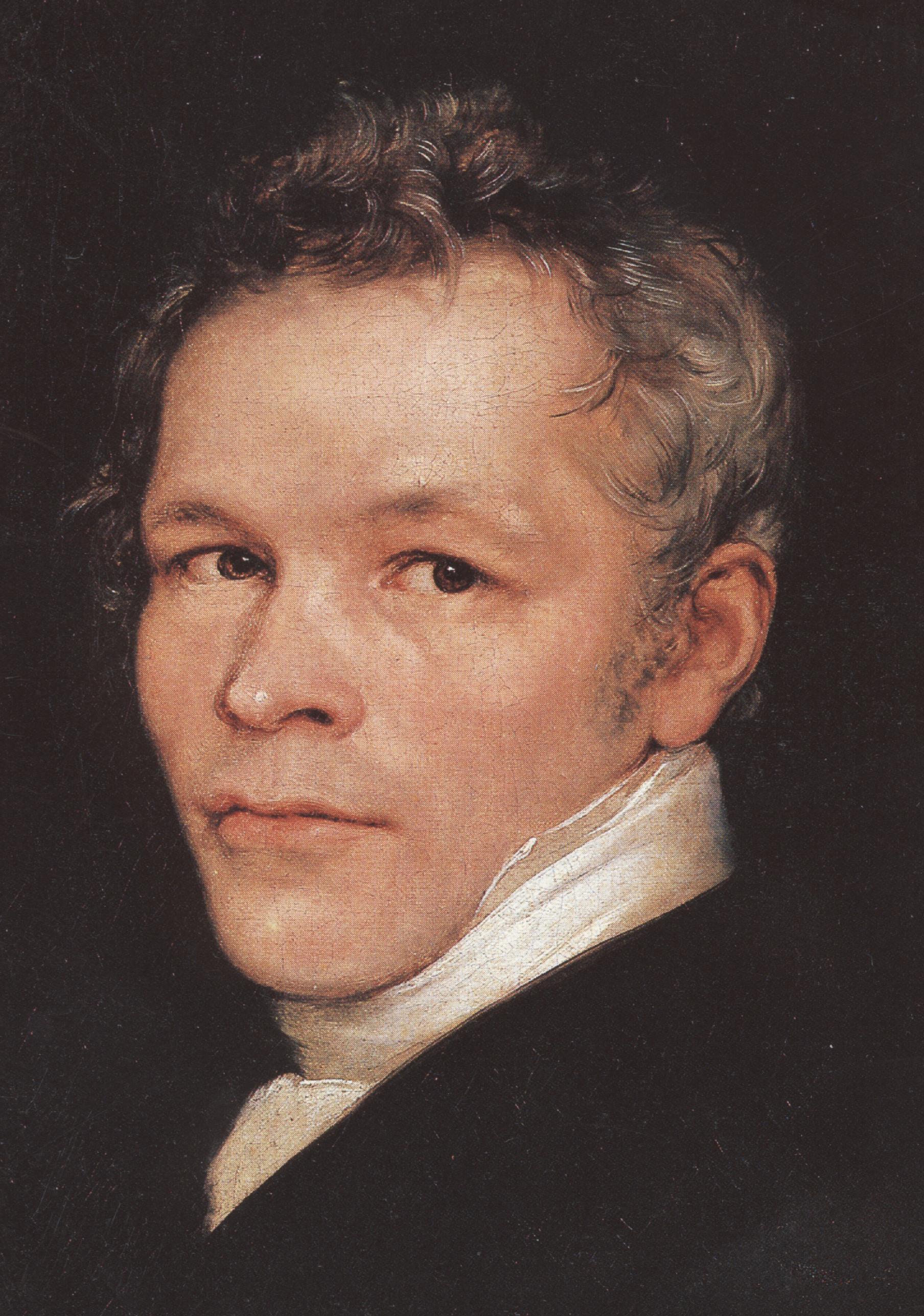
Why Karl Friedrich Schinkel matters
Karl Friedrich Schinkel, who lived from 1781 to 1841, was the leading Prussian architect, urban planner, and painter of the early nineteenth century, and the figure most responsible for the neoclassical face of Berlin. For collectors he matters less as a painter for sale at volume and more as a foundational design intelligence: the Altes Museum, the Neue Wache, the Schauspielhaus, and the Friedrichswerdersche Kirche all carry his authorship, and his surviving drawings, stage designs, and furniture are the objects that occasionally reach the market. His legacy is preserved primarily in state museum collections rather than through a commercial gallery system.
- Born
- 1781-03-13, Neuruppin, Margraviate of Brandenburg, Prussia (now Germany)
- Nationality
- German (Prussian)
- Media
- Architecture, Painting, Drawing
- Movement
- Neoclassicism, Gothic Revival
- Education
- Berlinisches Gymnasium zum Grauen Kloster, Berlin, to Easter 1798; private architectural training under David and Friedrich Gilly, 1798 to 1800; enrolled at the Berlin Bauakademie, 1799
- Signature motifs
- Neoclassical civic architecture, Gothic Revival church design, stage and theatre design for the Prussian court
By the numbers
- 1781 to 1841LifespanBorn Neuruppin, died Berlin
- Elected 1811Prussian Academy of ArtsOrdinary member, Royal Prussian Academy of Arts
- EUR 456,000Auction highPainting, Gothic Church on a Rock by the Sea, Lempertz; exact sale date not independently confirmed
- 6,000+ worksKupferstichkabinett holdingsArtist's legacy collection, Staatliche Museen zu Berlin
Selected works
Click any work to view it full screen.
Biography
Karl Friedrich Schinkel was born on 13 March 1781 in Neuruppin, in the Margraviate of Brandenburg, Prussia. His family moved to Berlin in the mid 1790s, where he attended the Berlinisches Gymnasium zum Grauen Kloster, completing his schooling at Easter 1798. He then spent two years, from 1798 to 1800, in private architectural training under David and Friedrich Gilly, and in 1799 enrolled at the newly founded Berlin Bauakademie for a short course of study. He passed the state surveyor's examination in 1799, the professional credential that, rather than a university degree, qualified him to practice.
Schinkel rose through the Prussian building administration to become the state's chief architect and city planner, shaping Berlin's public buildings in a neoclassical idiom while also designing in the Gothic Revival style for churches such as the Friedrichswerdersche Kirche. He worked as a painter, stage designer for the Prussian court theatre, and furniture designer alongside his architectural practice. He was elected an ordinary member of the Royal Prussian Academy of Arts in 1811 and went on to receive honorary memberships from academies in Paris, Copenhagen, Rome, Munich, St. Petersburg, New York, and London, along with Prussian and Greek state honors between 1821 and 1836.
Schinkel died on 9 October 1841 in Berlin, following several strokes and a year of declining health. He was buried on 12 October 1841 at the Dorotheenstadt Cemetery in Berlin.
Critical reception
Schinkel is treated in standard art historical and museum reference sources as one of the greatest German architects and a design genius of the nineteenth century, credited as a leading figure in both the International Neoclassical and Gothic Revival movements. His reputation rests heavily on institutional recognition: his own legacy archive of more than 6,000 works is held by the Kupferstichkabinett of the Staatliche Museen zu Berlin, and major museum retrospectives, including "Karl Friedrich Schinkel. Geschichte und Poesie" at the Kulturforum Berlin in 2012 to 2013 and "Karl Friedrich Schinkel: Architekt, Maler, Designer" in Munich in 2013, have reinforced his status as a foundational figure across architecture, painting, and design. No exact verbatim quotation from a named critic in a major contemporary outlet could be confirmed in the available research, so none is reproduced here.
Market
Schinkel's market is thin and dominated by drawings, architectural designs, theatre decoration prints, and furniture rather than paintings, because the great majority of his built and painted work sits in state and museum hands rather than in private circulation. The best documented auction result identified is a painting, Gothic Church on a Rock by the Sea (Gotische Kirche auf einem Felsen am Meer), listed at EUR 456,000 including premium in the Lempertz artist index; the exact sale date could not be independently confirmed. The next highest documented result is Kopie nach, Landschaft mit Pilger (Copy after, Landscape with Pilgrim), which sold for EUR 62,500 including premium at Ketterer Kunst, Munich (Auktion 427); its exact date is likewise unconfirmed. Other documented sales, including an October 2013 Christie's New York lot of a Schinkel theatre-decoration publication for USD 15,000, have sold well below those figures.
Top auction results
| Work | Price | Sale |
|---|---|---|
| Gothic Church on a Rock by the Sea (Gotische Kirche auf einem Felsen am Meer) | EUR 456,000 (incl. premium) | Lempertz, Germany (exact city and date not independently confirmed) |
Selected exhibitions
| Years | Exhibition | Venues |
|---|---|---|
| 2012 to 2013 | Karl Friedrich Schinkel. Geschichte und Poesie | Kulturforum, Staatliche Museen zu Berlin |
| 2013 | Karl Friedrich Schinkel: Architekt, Maler, Designer | Kunsthalle der Hypo-Kulturstiftung, Munich |
| 1997 | Visionary Palaces: Designs by Karl Friedrich Schinkel | National Galleries of Scotland, Edinburgh |
| not dated in dossier | Karl Friedrich Schinkel. Designs for Sculptors | Staatliche Museen zu Berlin |
| ongoing | Focus on Schinkel: A Look at His Life and Work | Friedrichswerdersche Kirche, Staatliche Museen zu Berlin |
Museum collections
- Kupferstichkabinett, Staatliche Museen zu Berlin
- Alte Nationalgalerie, Staatliche Museen zu Berlin
- Friedrichswerdersche Kirche (Schinkel Museum), Berlin
- Metropolitan Museum of Art, New York
- National Galleries of Scotland, Edinburgh
- Kunstgewerbemuseum, Berlin
- Stiftung Preussische Schlosser und Garten Berlin-Brandenburg
Awards and honors
- Ordinary member, Royal Prussian Academy of Arts, Berlin (1811)
- Order of the Red Eagle, 3rd Class, Prussia (1821)
- Foreign member, Academie des Beaux-Arts, Paris (1823)
- Cross of the Commander, Royal Greek Order of the Saviour, Greece (1836)
Authentication and provenance
No catalogue raisonne.
No published catalogue raisonne has been identified for Schinkel. The principal reference archive is the artist's own legacy collection of more than 6,000 works held by the Kupferstichkabinett, Staatliche Museen zu Berlin, corroborated by the Deutsche Biographie and other state archival records.
Primary reference: https://schinkel.smb.museum/index.php?page_id=1&lang=en
What collectors should know
Schinkel's market is defined by scarcity rather than by scale: the objects that trade are almost entirely drawings, designs, prints, and furniture, since his architecture and most of his paintings are permanently held by state institutions. There is no published catalogue raisonne, so verification relies on the artist's own archive at the Kupferstichkabinett in Berlin and on published state and museum records. The highest price identified, EUR 456,000 for the painting Gothic Church on a Rock by the Sea at Lempertz, and the EUR 62,500 result for Kopie nach, Landschaft mit Pilger at Ketterer Kunst, both come from auction house indices that do not publish an exact sale date, so collectors should treat any Schinkel "record" figure with some caution until it can be checked against a dated primary sale record.
Further reading and resources
Data current as of 2026-07-16.

