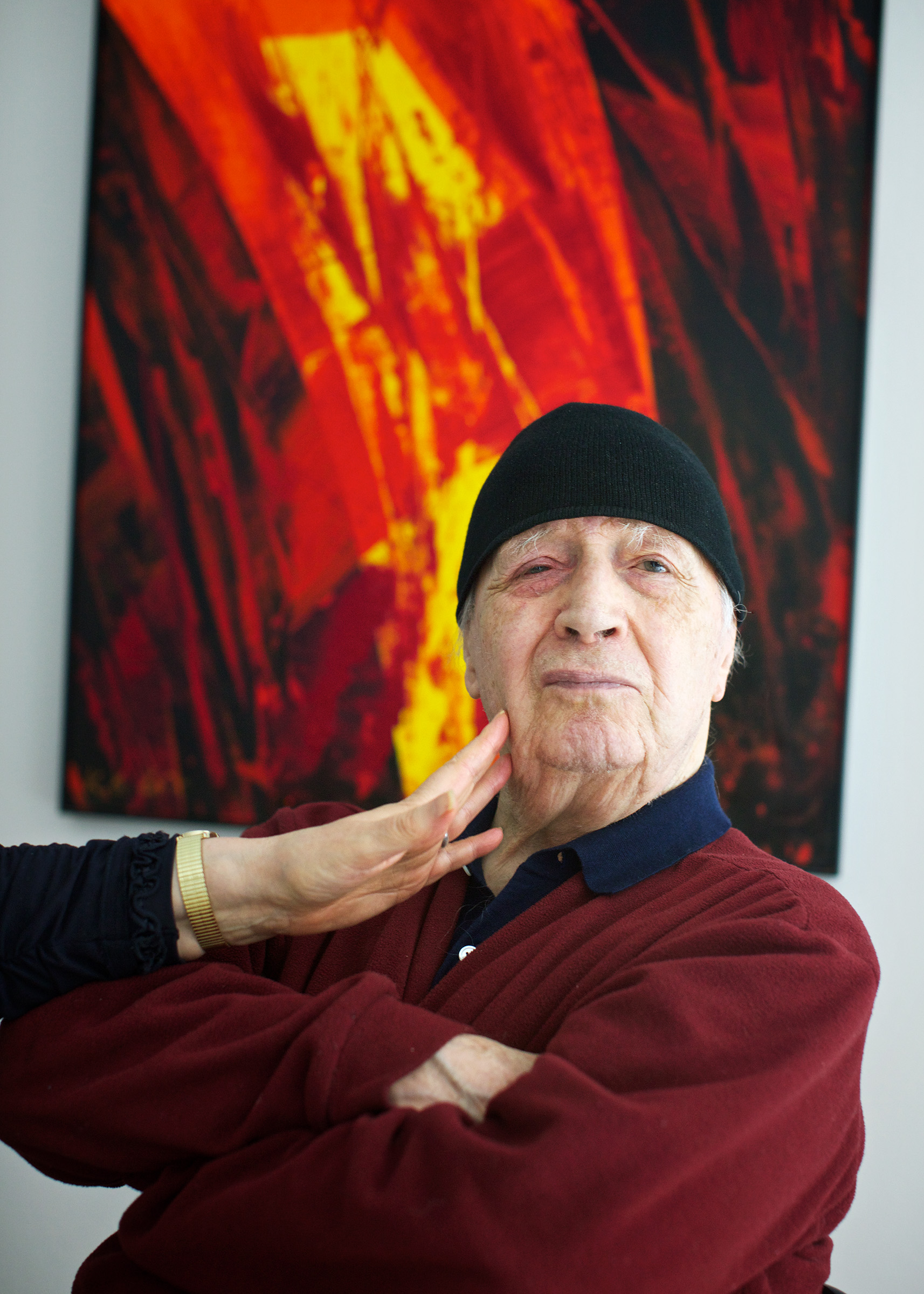
Why Karl Otto Götz matters
Karl Otto Götz, generally known simply as Karl Otto in market contexts, is one of the founding figures of German Art Informel, the postwar European movement in gestural, spontaneous abstraction. He bridged a prewar training in applied arts with a long teaching career at the Kunstakademie Düsseldorf, and his paintings now sit in major German museums and in the National Gallery of Art in Washington, D.C. For a collector, he is a useful case study in the gap that can open between deep museum and critical recognition and a comparatively shallow, thin auction market.
- Born
- 1914-02-22, Aachen, Germany
- Nationality
- German
- Media
- Painting, Drawing, Printmaking
- Movement
- Art Informel, Tachisme
- Education
- Kunstgewerbeschule Aachen, 1932 to 1933; one semester, Dresden Art Academy, 1941 (no completed degree documented)
- Signature motifs
- Gestural brushwork, Calligraphic abstraction
- Representation
- "K.O. Götz und Rissa Stiftung (estate)"
By the numbers
- EUR 170,800Auction highBrien-Elven, Ketterer Kunst, Munich, 2013 (about USD 234,000)
- 1958, 1968Venice Biennale29th and 34th Venice Biennale
- 1959documentadocumenta II, Kassel
- Bundesverdienstkreuz I. Klasse, 2007Federal honorFederal Cross of Merit, First Class
Selected works
Click any work to view it full screen.
Biography
Karl Otto Götz was born on 22 February 1914 in Aachen, Germany. He began painting while still in secondary school, against his father's wish that he train as a textile engineer, and from 1932 to 1933 he attended the Kunstgewerbeschule Aachen, the city's school of arts and crafts, where he studied still life and life drawing and began engaging seriously with avant-garde and abstract painting. In 1941, while serving as a Luftwaffe officer during the Second World War, he was granted leave for one semester of study at the art academy in Dresden. No completed university degree in art is documented for him.
After the war, Götz became a central figure in the German wing of Art Informel. He took part in the first major CoBrA group exhibition in Amsterdam in 1949, and his international standing was confirmed through inclusion in the 29th Venice Biennale in 1958 and documenta II in Kassel in 1959; he returned to the Venice Biennale in 1968. In 1959 he was appointed Professor of Free Painting at the Kunstakademie Düsseldorf, a post he held for roughly two decades until his retirement in 1979.
From 1975 he lived and worked in Wolfenacker, in the Niederbreitbach area of the Westerwald, together with the artist Rissa, his wife and creative partner. He died at his home there on 19 August 2017, at the age of 103. Following his death, the K.O. Götz und Rissa Stiftung became the primary custodian of his estate, including loans of major works such as Jonction III (1991) to the Deutscher Bundestag in Berlin.
Critical reception
Museums and reference institutions consistently describe Götz as one of the most significant German painters of the postwar period and a leading figure of German Art Informel. His honors reflect this standing: the Kunstpreis Junger Westen (1948), the Marzotto Prize for European Painting (1962), the Verdienstorden of North Rhine-Westphalia (1989), the Staatspreis für Malerei of Rhineland-Palatinate (1996), and the Bundesverdienstkreuz I. Klasse, awarded in 2007 for his importance to modern painting in Germany after the Second World War. The Neue Nationalgalerie in Berlin mounted a comprehensive retrospective of his work in 2013, and the Saarlandmuseum followed with a centenary retrospective in 2014. On his death in 2017, the Nationalgalerie in Berlin issued a formal statement of mourning, and German and international press marked the loss of one of the last major figures of the immediate postwar abstract generation.
Market
Public auction data for Götz is comparatively thin relative to his museum standing. The highest price identified for his work is EUR 170,800, about USD 234,000, for Brien-Elven, sold at Ketterer Kunst in Munich on 7 December 2013. Other recorded results, including sales handled by Lempertz, have cleared well below that level, for example EUR 84,000 and EUR 64,800, pointing to a market with a wide gap between typical results and the top end. No single gallery is documented as the exclusive representative of his estate; the K.O. Götz und Rissa Stiftung functions as the estate's custodial body, while several German galleries, including Galerie Maulberger in Munich and Galerie Lochner in Dachau, have mounted exhibitions of his work in recent years.
Top auction results
| Work | Price | Sale |
|---|---|---|
| Brien-Elven (2013) | USD 234,064 (EUR 170,800) | Ketterer Kunst, Munich, 2013-12-07 |
Selected exhibitions
| Years | Exhibition | Venues |
|---|---|---|
| 1949 | First major CoBrA group exhibition | Amsterdam |
| 1958 | 29th Venice Biennale | Venice |
| 1959 | documenta II | Kassel |
| 1968 | 34th Venice Biennale | Venice |
| 1983 | Westkunst, Zeitgenössische Kunst seit 1939 | Cologne |
| 2004 | K.O. Götz. Ein Rückblick. Aktuelle Arbeiten. | Suermondt-Ludwig-Museum and Ludwig Forum für Internationale Kunst, Aachen |
| 2013 | Retrospective | Neue Nationalgalerie, Berlin |
| 2014 | K.O. Götz. Impuls und Intention | Saarlandmuseum, Saarbrücken |
Museum collections
- Deutscher Bundestag, Berlin (on loan from the K.O. Götz und Rissa Stiftung)
- Suermondt-Ludwig-Museum, Aachen
- Rheinisches Landesmuseum, Bonn
- Saarlandmuseum, Saarbrücken
- Kunstsammlungen Chemnitz
- Neue Nationalgalerie, Berlin
- National Gallery of Art, Washington, D.C.
Awards and honors
- Bundesverdienstkreuz I. Klasse (Federal Cross of Merit, First Class) (2007)
- Staatspreis für Malerei des Landes Rheinland-Pfalz (1996)
- Verdienstorden des Landes Nordrhein-Westfalen (1989)
- Marzotto Preis, Prize for European Painting (1962)
- Westfälischer Kritikerpreis (circa 1955 to 1956) (1956)
- Honorary doctorate, Kunstakademie Münster (2010)
Authentication and provenance
No catalogue raisonne.
No published catalogue raisonne is confirmed. The K.O. Götz und Rissa Stiftung, the artist's foundation, is the primary custodial body for the estate and the main point of reference for provenance.
Primary reference: https://en.wikipedia.org/wiki/Karl_Otto_G%C3%B6tz
What collectors should know
Because no catalogue raisonne is confirmed, provenance for works attributed to Götz should be checked against the K.O. Götz und Rissa Stiftung, the estate's custodial foundation. His auction market is shallow: a small number of high results, led by Brien-Elven at Ketterer Kunst in 2013, sit well above a larger base of results in the tens of thousands of euros, so any single sale should be read in that context rather than as a stable benchmark. Collectors should also confirm which "Karl Otto" a given work refers to, since the name is shared with an unrelated nineteenth-century German painter and porcelain painter and with a mid-twentieth-century opera singer and actor; the artist covered here is Karl Otto Götz, the Art Informel painter and longtime Düsseldorf professor.
Further reading and resources
Data current as of 2026-07-16.

