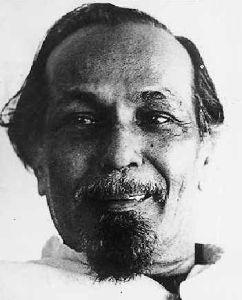
Why K.C.S. Paniker matters
K.C.S. Paniker is one of the founding figures of Indian modernism outside Bombay and Delhi, the artist most closely identified with the Madras Art Movement and with the search for a modern visual language rooted in Indian, rather than European, sources. As principal of the Government College of Fine Arts in Chennai and founder of the Cholamandal Artists' Village in 1966, he shaped an entire generation of South Indian artists as much through teaching and institution-building as through his own painting. For collectors, he represents an artist whose historical importance is well established in Indian museums but whose auction market, thin for decades, has only recently produced results that reflect that importance.
- Born
- 1911-05-31, Malabar district, Kerala or Coimbatore, Tamil Nadu, India (sources disagree)
- Nationality
- Indian
- Media
- Painting
- Movement
- Madras Art Movement, Post-independence Indian modernism
- Education
- Government School of Arts and Crafts, Madras (now Government College of Fine Arts, Chennai), diploma 1940, studied 1936 to 1940
- Signature motifs
- Words and Symbols series, Calligraphic script-based abstraction
By the numbers
- USD 576,000Auction high1964 painting, Sotheby's New York, Asia Week sale, exact year unconfirmed
- Cholamandal Artists' Village, 1966Founded
- circa 1964 to 1967National Award for Paintingexact year varies across sources
- No confirmed current gallery or estate representationRepresented by
Biography
K.C.S. Paniker, born Kovalezhi Cheerampathoor Sankaran Paniker, was born on 31 May 1911. Sources disagree on the exact place, citing either Veliyankode in Kerala's Malabar district or Coimbatore in Tamil Nadu. He received general schooling in Kerala and Tamil Nadu through the late 1920s and began college studies that he discontinued in 1928, after his father's death, to work at the Indian Telegraph Department. In 1936, at age twenty-five, he enrolled at the Government School of Arts and Crafts in Madras, graduating with a diploma in 1940. He was soon appointed a painting instructor at the same institution and became its principal in 1957, a post he held until 1967.
Through the 1940s and early 1950s he was active in the Progressive Painters' Association in Madras, exhibiting in Madras, Bombay, Calcutta, and New Delhi. His international profile opened in 1954 with one-man exhibitions at India House in London and in Paris and Lille, France. Over the following two decades his work moved toward the metaphysical, script-like abstraction for which he is best known, including the Words and Symbols series, and he represented India at major international exhibitions including the VI Sao Paulo Biennale in 1961, the Tokyo Biennale, London's Festival Hall Exhibition around 1965, and the Venice Biennale in 1967, the period in which he also received the National Award for Painting. In 1966 he founded the Cholamandal Artists' Village near Madras, an artists' commune that remains central to the history of modern art in South India. He was elected a Fellow of the Lalit Kala Akademi in 1976 and, that same year, donated his surviving body of work to the state of Kerala, which established a gallery in his name beside the Napier Museum in Thiruvananthapuram. He died in Madras, now Chennai, on 16 January 1977; a minority of sources give the date as 15 January.
Critical reception
Paniker is consistently placed at the center of the Madras Art Movement, the mid-twentieth-century effort to build a modern Indian art vocabulary distinct from both colonial academic realism and imported Western abstraction. His later Words and Symbols paintings, which fold calligraphic, script-like marks into layered abstract fields, are widely treated as his signature achievement and as an attempt to root abstraction in indigenous visual and philosophical traditions rather than in European precedent. His parallel role as an educator and institution builder, first as principal of the Government College of Fine Arts in Chennai and then as a founder of the Cholamandal Artists' Village, is generally credited with giving South Indian modernism an institutional base it had previously lacked. No verifiable verbatim critical quotation from a named critic in a major outlet could be confirmed for this profile.
Market
Paniker's market has long been thin relative to his historical standing, with most documented sales in the low five to low six figures. Aggregated auction databases had for years pointed to Sotheby's London's May 2007 sale of Love for GBP 33,600 as his top price, and Roseberys London later reported a result of GBP 78,240 on a work that it described as one of the highest prices recorded for the artist. Those figures were surpassed by a 1964 painting that sold for USD 576,000 at Sotheby's New York in a spring Asia Week sale, a result Artnet reported as a standout among South Asian modernists. The exact year, sale date, and lot title of that result are not fully specified in available reporting.
Top auction results
| Work | Price | Sale |
|---|---|---|
| Title not confirmed (1964 painting) (1964) | USD 576,000 | Sotheby's, New York |
Selected exhibitions
| Years | Exhibition | Venues |
|---|---|---|
| 1941 to 1953 | Early solo and Progressive Painters' Association exhibitions | Chennai, Delhi, Bombay, Calcutta |
| 1954 | One-man exhibition | India House, London |
| 1954 | Solo exhibitions | Paris and Lille, France |
| 1961 | VI Sao Paulo Biennale | Sao Paulo, Brazil |
| 1965 | Festival Hall Exhibition | London |
| 1967 | Venice Biennale | Venice, Italy |
| 1968 to 1976 | Triennale of World Art, India (I, II, III) | New Delhi |
| 2008 to 2009 | Modern India | Institut Valencia d'Art Modern and Casa Asia, Valencia, Spain |
Museum collections
- K.C.S. Paniker Gallery, Napier Museum, Thiruvananthapuram, Kerala
- National Gallery of Modern Art, New Delhi
Awards and honors
- Fellow, Lalit Kala Akademi (1976)
- Nominated one of Nine Eminent Artists and Executive Board Member, Lalit Kala Akademi (1954)
- National Award for Painting (year cited as 1964 to 1967 across sources) (1964)
Authentication and provenance
No catalogue raisonne.
No catalogue raisonne is confirmed. Paniker's oeuvre is documented mainly through his 1976 donation to the state of Kerala, held at the K.C.S. Paniker Gallery beside the Napier Museum, and through National Gallery of Modern Art holdings in New Delhi.
Primary reference: https://dagworld.com/k.c.s.paniker.html
What collectors should know
There is no catalogue raisonne for Paniker, and no gallery or estate is currently documented as his exclusive representative; the strongest authentication anchor is the artist's own 1976 donation of his surviving work to the state of Kerala, now held at the K.C.S. Paniker Gallery in Thiruvananthapuram, alongside holdings at the National Gallery of Modern Art in New Delhi. His auction history is comparatively sparse, so the USD 576,000 Sotheby's New York result should be read as a single high point in a small dataset rather than a stable price floor. Basic biographical details, including his exact birthplace, exact death date, and the precise year of his National Award for Painting, vary slightly between otherwise reliable sources, so collectors should expect and cross-check minor discrepancies in published material.
Further reading and resources
Data current as of 2026-07-16.

