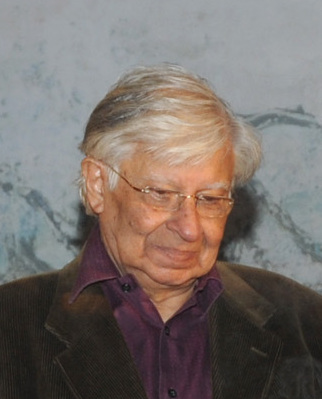
Why Krishen Khanna matters
Krishen Khanna is the last living member of the Progressive Artists' Group, the circle of Bombay-based painters, including F.N. Souza, M.F. Husain, and S.H. Raza, who redefined Indian art after independence. Now past his hundredth birthday, he remains a working painter whose Bandwalla series and Partition-era imagery have made him a bridge between that founding generation and today's market. For a collector, he represents a rare case of a living artist whose historical importance is already settled while his auction market is still forming.
- Born
- 1925-07-05, Lyallpur, British India (now Faisalabad, Pakistan)
- Nationality
- Indian
- Media
- Painting
- Movement
- Progressive Artists' Group, Modern Indian art
- Education
- Sacred Heart High School, Lahore; Imperial Service College, Windsor, England (Rudyard Kipling Scholarship, 1938 to 1942); Government College, Lahore, BA Honours in English Literature, 1944; evening classes at the Mayo School of Art, Lahore, from 1944.
- Signature motifs
- Bandwalla brass-band musicians, "The Last Supper" theme, Partition and displacement, Urban laborers and truck drivers
- Representation
- "DAG (Delhi Art Gallery), New Delhi", "Art Alive Gallery, New Delhi", "Grosvenor Gallery, London", "Dhoomimal Gallery, New Delhi"
By the numbers
- approx. USD 984KAuction highThe Last Supper; auction house and exact sale date not independently confirmed
- Last living memberProgressive Artists' Groupfounding generation of Indian modernism, formed 1947
- 2011Padma BhushanIndia's third-highest civilian honor
- 2025Centenaryborn 5 July 1925
Biography
Krishen Khanna was born on 5 July 1925 in Lyallpur, British India, now Faisalabad, Pakistan. He was educated at Sacred Heart High School in Lahore before winning a Rudyard Kipling Scholarship to the Imperial Service College in Windsor, England, where he studied from 1938 to 1942. He returned to Lahore and completed a BA Honours in English Literature at Government College in 1944, taking evening classes at the Mayo School of Art in the same period. The 1947 Partition of India forced his family to relocate, and Khanna spent over a decade working in banking before turning to painting full time.
He joined the Progressive Artists' Group in 1949 and held his first solo exhibition in 1955 at the United States Information Service in Chennai. His reputation grew through international exposure and fellowships that took him to the United States, including an artist residency at American University in Washington, D.C., in the early 1960s. His Bandwalla paintings, depicting the brass-band musicians of Indian weddings and street processions, and his recurring treatment of "The Last Supper," became signature bodies of work. He continues to live and work in New Delhi and Gurugram, and his hundredth year, in 2025, was marked with retrospectives and an India Art Fair program.
Critical reception
Recent profiles frame Khanna as a living link to the founding moment of Indian modernism rather than as a historical figure. AstaGuru's artist profile, written as he neared his centenary, states that "he stands as the last surviving member of the iconic Progressive Artists' Group." Architectural Digest's 2025 feature, titled "At 99, Krishen Khanna is one of India's oldest living artists," likewise treated him as an active, still-working painter rather than an artist of the past. His Progressive Artists' Group affiliation is consistently treated as inseparable from his critical standing, and his Bandwalla paintings and Partition-era imagery remain the works most often cited in that context.
Market
Khanna's highest recorded auction price is for The Last Supper, reported at approximately USD 984,133 (INR 8,66,03,709). The specific auction house and the exact sale date for this result are not independently confirmed in currently available sources. That figure sits well above the bulk of his market: recent results at houses such as Saffronart in 2025 and 2026 have run in the tens of thousands of dollars, so the record reflects a single strong result for a major work rather than a market-wide price level. His work is currently shown by a constellation of galleries, with DAG (Delhi Art Gallery) most consistently cited as his current representative platform, alongside Art Alive Gallery and Dhoomimal Gallery in New Delhi and Grosvenor Gallery in London. No source identifies a single exclusive representative or estate structure, consistent with his status as a still-practicing artist. No catalogue raisonne has been identified for his output.
Top auction results
| Work | Price | Sale |
|---|---|---|
| The Last Supper | USD 984,133 (INR 8,66,03,709 (as reported)) |
Selected exhibitions
| Years | Exhibition | Venues |
|---|---|---|
| 2026 | Krishen Khanna: Across the Century | ICIA, New Delhi, 21 to 25 January 2026 |
| 2025 to 2026 | Krishen Khanna: The Centenarian Master | Antarang Art Gallery, India Art Fair, Gurugram, 21 December 2025 to 11 January 2026 |
| 2016 | Krishen Khanna: Drawings and Paintings | Vadehra Art Gallery, New Delhi |
| 2015 | When the Band Begins to Play... | Grosvenor Gallery, London |
| 2010 | Retrospective | Lalit Kala Akademi galleries, Rabindra Bhavan, New Delhi, approximately 120 works |
| 1955 | First solo exhibition | United States Information Service (USIS), Chennai |
Museum collections
- National Gallery of Modern Art, New Delhi
- Jehangir Nicholson Foundation, Mumbai (CSMVS)
Awards and honors
- Padma Bhushan (2011)
- Lalit Kala Ratna, Lalit Kala Akademi (2004)
- Padma Shri (1990)
- Lalit Kala Akademi National Award (1965)
Authentication and provenance
No catalogue raisonne.
No published catalogue raisonne has been identified and no formal certificate-of-authenticity program is documented for this artist. The galleries that currently exhibit his work, along with market platforms that track his auction history, are the primary points of reference for provenance.
Primary reference: https://www.grosvenorgallery.com/artists/61-krishen-khanna/overview/
What collectors should know
Because Khanna is represented, in the loose sense, by several galleries rather than one exclusive dealer or estate, and because no catalogue raisonne exists, provenance research benefits from cross-checking multiple gallery and auction sources rather than relying on a single authority. His market shows a wide gap between a strong single record price and typical recent secondary-market results, so collectors should treat the record price as an outlier tied to a major, historically resonant work rather than as representative pricing. As a living artist still active in his studio, current authentication channels are unusually direct compared to many historical figures, which is a meaningful advantage for buyers now.
Further reading and resources
Data current as of 2026-07-10.

