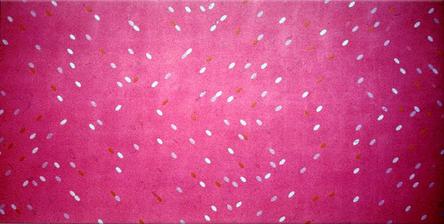
Why Larry Poons matters
Larry Poons is one of the last living links to the New York painting scene of the early 1960s, an artist who moved from the optical vibration of his early dot paintings into decades of poured and thrown color-field abstraction without ever leaving New York's major museum collections. For a collector, he represents a rare case of continuous, unbroken practice across more than sixty years, still producing new work and still showing with active galleries in 2026.
- Nationality
- American
- Media
- Painting
- Movement
- Op Art, Color Field
- Education
- New England Conservatory of Music, Boston, composition studies, 1955 to 1957, no degree documented. School of the Museum of Fine Arts, Boston, enrolled 1959; whether he completed a degree there is not documented in sources consulted.
- Signature motifs
- "Op-art dot paintings", "Poured and thrown paint abstraction"
- Representation
- Yares Art, Almine Rech
By the numbers
- USD 1.16MAuction highLittle Sangre de Christo (1964); sold November 12, 2014, per Heritage Auctions; specific auction house not confirmed in sources reviewed
- 1937, Tokyo, JapanBornTo American parents
- First solo show 1963 to presentCareer spanGreen Gallery, New York, to current gallery exhibitions
- Yares Art; Almine RechRepresented by
Biography
Larry Poons was born in 1937 in Tokyo, Japan, to American parents. He first trained as a musician, studying composition at the New England Conservatory of Music in Boston from 1955 to 1957. After seeing an exhibition of Barnett Newman's paintings in New York in 1959, he gave up music and enrolled at the School of the Museum of Fine Arts, Boston, later moving to New York to pursue painting full time.
His first solo exhibition opened in 1963 at Richard Bellamy's Green Gallery. Through the 1960s he became known for tightly ordered fields of dots and ellipses that produced an optical vibration, work that placed him at the center of the Op Art conversation and earned inclusion in the Museum of Modern Art's landmark 1965 survey "The Responsive Eye." In 1969, curator Henry Geldzahler included him, as its youngest artist, in "New York Painting and Sculpture, 1940 to 1970" at the Metropolitan Museum of Art, and the Whitney Museum included him again in its 1973 biennial.
Through the 1970s his painting shifted toward pouring, throwing, and building up thick, physical paint surfaces, a body of work sometimes called his "Throw Decade" and later reassessed in a dedicated 2018 exhibition at Yares Art in New York. He also taught painting at the Art Students League of New York, though the exact years of his teaching tenure are not documented in the sources reviewed. As of 2026 he continues to paint and exhibit, splitting his time between studios in New York City and East Durham, New York, and showing new work at Almine Rech and Yares Art.
Critical reception
Poons's reputation was made early: inclusion in "The Responsive Eye" at MoMA in 1965 tied him to the Op Art moment, and his presence, as its youngest artist, in Henry Geldzahler's 1969 Metropolitan Museum survey confirmed his standing among his generation's leading painters. Critics have long pointed to color as the throughline of his career, arguing that a commitment to saturated, allover fields of color persisted even as his methods moved from tightly ordered dots to poured and thrown paint. That continuity, sustained across six decades and multiple stylistic phases, is the recurring theme in writing about his work.
Market
Poons's clearest documented auction result is Little Sangre de Christo (1964), reported at USD 1,157,000 and sold on November 12, 2014, per Heritage Auctions market data. This is the highest reported auction price for his work. The specific auction house is not named in the sources reviewed, so it is left unconfirmed here. A market analysis published by HENI puts his cumulative auction turnover at roughly USD 14.1 million over 26 years, a figure consistent with steady but comparatively modest secondary-market volume for an artist of his museum standing.
Top auction results
| Work | Price | Sale |
|---|---|---|
| Little Sangre de Christo (1964) | USD 1,157,000 | 2014-11-12 |
Selected exhibitions
| Years | Exhibition | Venues |
|---|---|---|
| 2026 | Kentucky Cols. | Almine Rech, Paris, Turenne |
| 2021 | Larry Poons | Almine Rech, London, first exhibition with the gallery |
| 2018 | Larry Poons: Ruffles Queequeg and The Throw Decade Paintings, 1971 to 1981 | Yares Art, New York |
| 2008 | Color as Field: American Painting, 1950 to 1975 | Denver Art Museum; traveled to Smithsonian American Art Museum and Frist Center for the Visual Arts |
| 1973 | Whitney Biennial 1973: Contemporary American Art | Whitney Museum of American Art, New York |
| 1969 | New York Painting and Sculpture, 1940 to 1970 | Metropolitan Museum of Art, New York, curated by Henry Geldzahler |
| 1965 | The Responsive Eye | Museum of Modern Art, New York |
| 1963 | First solo exhibition | Green Gallery, New York |
Museum collections
- Solomon R. Guggenheim Museum, New York
- Los Angeles County Museum of Art
- National Gallery of Art, Washington, D.C.
- Museum of Fine Arts, Boston
Authentication and provenance
No catalogue raisonne.
No published catalogue raisonne has been confirmed for this artist as of this writing. Verification runs through the artist's current galleries, Yares Art and Almine Rech.
Primary reference: https://www.yaresart.com/artists/larry-poons
What collectors should know
Poons has no confirmed catalogue raisonne, so provenance and verification through his current galleries, Yares Art and Almine Rech, carry extra weight. Public auction results for his work are relatively few in number and span a wide range of prices depending on period and scale, so any single result should be read against the specific work and decade it comes from rather than as a smooth market trend. His continued, active studio practice into 2026 and his presence in major museum collections remain the strongest signals of his long-term standing.
Further reading and resources
Data current as of 2026-07-10.

