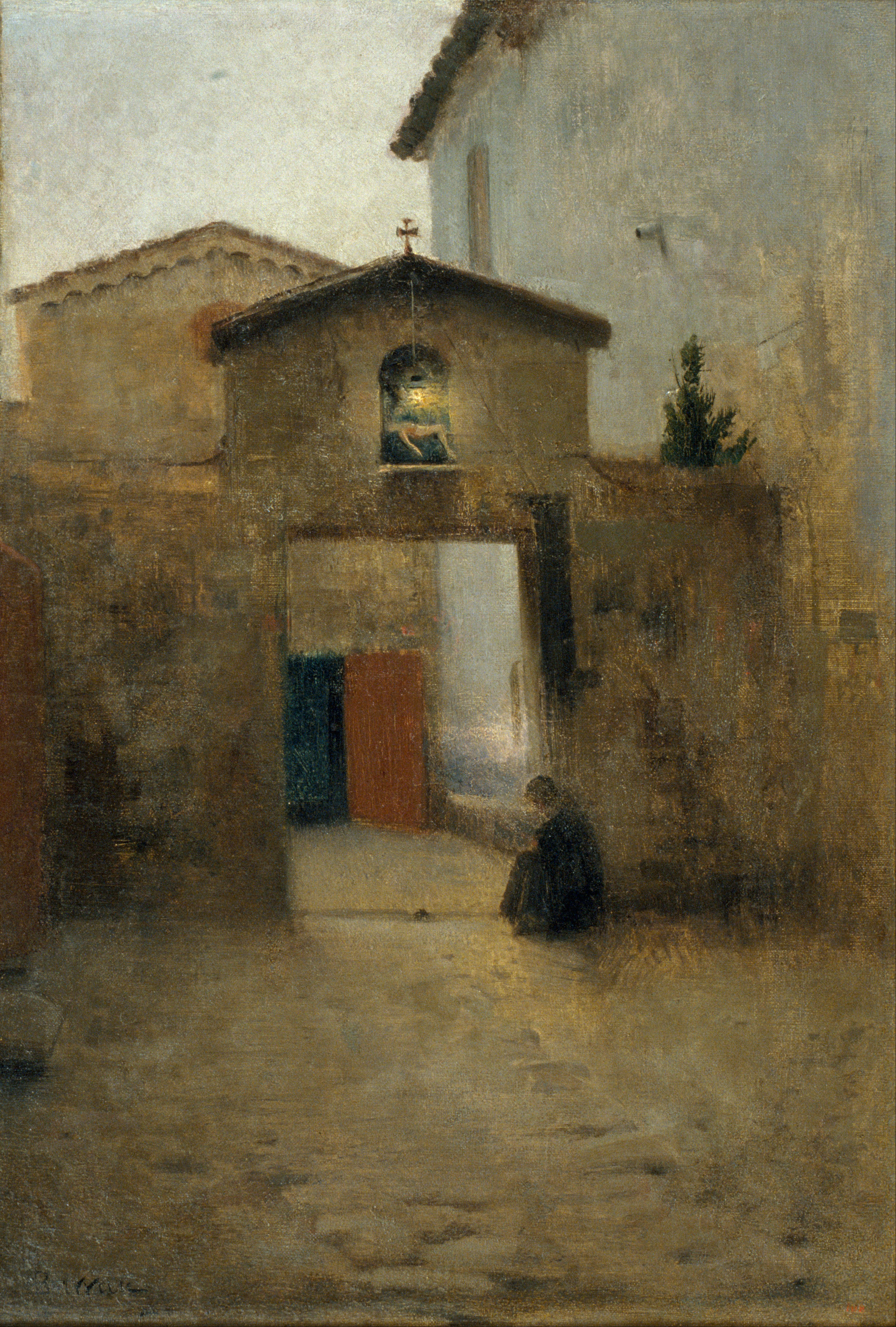
Why Laureano Barrau matters
Laureano Barrau is a bridge figure between Catalan academic training and the international Salon culture of the late nineteenth and early twentieth centuries. Trained in Barcelona, Madrid, Paris, and Rome, he built a long career as a Paris Salon exhibitor known for sunlit Mediterranean and Balearic scenes, and today his work sits in national museums in Spain and Latin America as well as in a museum built specifically around his output on Ibiza. For a collector, he is a study in a historical, museum-documented Spanish painter whose market is thin and whose current commercial representation is unconfirmed.
- Born
- 1863-12-27, Barcelona, Spain
- Nationality
- Spanish
- Media
- Painting
- Movement
- Academic Salon painting, Spanish Luminism
- Education
- Escola de Belles Arts de Barcelona (La Llotja), under Antoni Caba, to c. 1882; copied Old Masters at the Museo del Prado, Madrid, from 1882; Academie des Beaux-Arts, Paris, under Jean-Leon Gerome, from 1884 on a Pension Fortuny; Rome, 1885 to 1888, resident at Villa Strohl-Fern; Academie Carriere, Paris, from 1889
- Signature motifs
- "Mediterranean and Balearic coastal light", "Ibiza fisherwomen and beach scenes", "Catalan and Ampurdan rural genre scenes"
By the numbers
- 1887 to 1935Career spanAnnual exhibitor, Paris Salon
- Pension Fortuny, 1884HonorMunicipal scholarship funding study in Paris and a three-year pension in Rome, 1885 to 1888
- Galeria Barrau, IbizaMuseumMuseum dedicated to the artist, reopened 2014 with close to 200 works
- No verified record priceAuction marketPublic auction sources do not establish a confirmed all-time high as of 2026
Biography
Laureano Barrau (also recorded as Laureano Barrau Bunol, or in Catalan, Laurea Barrau) was born in Barcelona on 27 December 1863. After completing his bachillerato he briefly enrolled in Barcelona's School of Engineering to follow his father's profession, while also taking drawing and painting classes at the city's School of Fine Arts, known as La Llotja, under Antoni Caba. He soon committed fully to art, and in 1882 traveled to Madrid to study and copy the Spanish Old Masters at the Museo del Prado.
In August 1884, at age twenty, the City of Barcelona awarded him the Pension Fortuny, a municipal scholarship comparable to the French Prix de Rome, which funded further study in Paris at the Academie des Beaux-Arts under Jean-Leon Gerome. The pension then took him to Rome from 1885 to 1888, where he was based at Villa Strohl-Fern and studied the Italian masters. In 1889 he returned to Paris and enrolled at the Academie Carriere. He went on to exhibit at the Paris Salon nearly every year from 1887 to 1935, and around 1891 was named a member (socio) of the Salon de la Societe Nationale des Beaux-Arts.
Barrau divided his later career between Spain, France, and the Balearic Islands, eventually settling on Ibiza, where the light and coastal life of Santa Eularia des Riu became a recurring subject in his painting. He died there on 21 October 1957. Some sources give 25 October 1957 for his death, and older auction catalogues have mistakenly listed 1950; the 21 October 1957 date is the one given in the more fully sourced Spanish-language biographical record. His widow, Berta Valier, later opened a small museum in the couple's house in Puig de Missa; in 2014 the town council of Santa Eularia des Riu opened the Galeria Barrau to house a permanent collection of nearly 200 of his paintings donated to the parish.
Critical reception
Barrau's contemporaries were struck above all by his handling of light. The critic Paul Adam, writing in the Paris paper Le Journal, described him this way: "He has captured the truth of strong sunlight and has embodied its radiance with such surety in his paintings that they illuminate the entire gallery." His Ibiza and Balearic beach scenes have more recently been grouped by dealers such as Colnaghi, in a 2021 exhibition of Spanish landscape painters, alongside Joaquin Sorolla, Ignacio Zuloaga, and Hermenegildo Anglada Camarasa, a pairing that situates him within the broader turn-of-the-century Spanish interest in outdoor light and coastal subject matter.
Market
No verifiable all-time auction record price for Laureano Barrau could be confirmed from public auction sources as of this writing. Available public listings show comparatively modest figures: a Subastas Segre lot sold for 280 euros, and Ansorena catalogue entries for Ibiza beach scenes have carried starting prices in the range of 12,000 to 18,000 euros, with one such work (Joven con sombrilla en la playa, 1925) traceable in provenance to a Christie's London sale of Spanish pictures on 15 February 1990. None of these figures should be treated as a confirmed record, since realized hammer prices for the higher-estimate lots were not available. His paintings circulate mainly through Spanish auction houses, and there is no confirmation of any current gallery or estate holding exclusive representation of his work.
Selected exhibitions
| Years | Exhibition | Venues |
|---|---|---|
| 1887 to 1935 | Paris Salon | Societe des Artistes Francais / Societe Nationale des Beaux-Arts, Paris |
| 1888 | Exposicion Internacional de Barcelona | Barcelona |
| 1892 | Exposicion Nacional de Bellas Artes | Madrid |
| 1904 | Exposicion Nacional de Bellas Artes | Madrid |
| 1918 | Solo exhibition | Madrid |
| 1920 | Solo exhibition | Buenos Aires |
| 1924 | Solo exhibition | Henry Reinhardt Gallery, New York |
| 2014 | Reopening of the Galeria Barrau | Santa Eularia des Riu, Ibiza |
Museum collections
- Museu Nacional d'Art de Catalunya, Barcelona
- Museo Nacional del Prado, Madrid
- Museo Nacional Centro de Arte Reina Sofia, Madrid
- Museu Nacional de Belas Artes, Rio de Janeiro
- Fundacio Rafael Maso, Girona
- Galeria Barrau (Sala Barrau), Santa Eularia des Riu, Ibiza
Awards and honors
- Pension Fortuny, municipal scholarship of Barcelona, funding study in Paris and Rome (1884)
- Second medal, Exposicion Internacional de Barcelona (1888)
- Socio (member), Salon de la Societe Nationale des Beaux-Arts, Paris (1891)
- Third medal, Exposicion Nacional de Bellas Artes, Madrid, for Escardadoras (1892)
- Second prize, Exposicion Nacional de Bellas Artes, Madrid, for Taponeras del Ampurdan (1904)
Authentication and provenance
No catalogue raisonne.
No published catalogue raisonne has been confirmed. The largest concentrated body of the artist's work and related family records are held by the Galeria Barrau in Santa Eularia des Riu, Ibiza, a museum built around a donation of nearly 200 paintings from the artist's widow, Berta Valier. Provenance for individual works should be checked against that collection and against auction-house catalogue histories.
Primary reference: https://en.wikipedia.org/wiki/Laureano_Barrau
What collectors should know
Barrau's work has strong museum documentation, holdings in national collections in Spain and Brazil, and a dedicated museum on Ibiza, but the auction market is thin and unevenly recorded, and no confirmed record price could be established from public sources. There is no published catalogue raisonne, so provenance for individual works should be checked carefully against auction-house catalogue histories and against the collection and records held by the Galeria Barrau in Santa Eularia des Riu. Because no gallery or estate currently appears to represent his work, buyers should expect to transact primarily through secondary-market auction houses and dealers rather than through a managed primary market.
Further reading and resources
Data current as of 2026-07-16.

