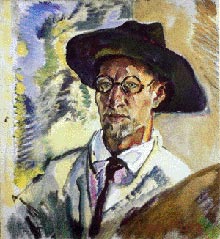
Why Leo Putz matters
Leo Putz was one of the leading painters of the Munich Jugendstil and Impressionist circle at the turn of the twentieth century, a founding-generation member of the Munich, Berlin, and Vienna Secessions and a central figure in the Munich artists' group Die Scholle. His work sits today in major German, Austrian, Hungarian, and South American museum collections, and his market, while modest by international standards, remains actively traded through German and Austrian specialist auction houses more than eighty years after his death.
- Born
- 1869-06-18, Merano (Meran), South Tyrol, then Austria-Hungary
- Nationality
- Austrian-German
- Media
- Painting, Printmaking
- Movement
- Jugendstil, Impressionism, Munich Secession
- Education
- Academy of Fine Arts, Munich, under Robert Poetzelberger, Gabriel von Hackl, and Paul Hoecker, circa 1885 to 1895 with interruptions; Academie Julian, Paris, under William Bouguereau and Jean-Joseph Benjamin-Constant, 1891 to 1892. No academic degree is documented; he received the Bavarian title of Professor in 1909.
- Signature motifs
- Sunlit garden and lake scenes, Nude figures in landscape
- Representation
- Galerie Schuller, Munich (secondary market), Gailer Fine Art, Chiemsee (secondary market)
By the numbers
- EUR 460,000Auction high (reported)Im herbstlichen Garten, circa 2006; auction house and exact date not confirmed in public sources
- 1869 to 1940LifespanBorn and died in Merano (Meran), South Tyrol
- Professor, 1909Bavarian titleAwarded together with Bavarian citizenship
- Munich, Berlin, ViennaSecession membershipsDeutsche Biographie
Selected works
Click any work to view it full screen.
Biography
Leo Putz was born on 18 June 1869 in Merano (Meran), South Tyrol, then part of Austria-Hungary. He moved to Munich to study art against his father's wishes, receiving his first drawing instruction from his stepbrother, the Munich Academy professor Robert Poetzelberger. He entered the Academy of Fine Arts, Munich, studying in the nature class of Gabriel von Hackl from 1888, then traveled to Paris in 1891 to study at the Academie Julian under William Bouguereau and Jean-Joseph Benjamin-Constant. After military service in 1892, he returned to Munich and continued his training in Paul Hoecker's painting class. His studies at the Munich Academy and in Paris spanned roughly 1885 to 1895 with interruptions, and no formal degree is documented from either institution.
Putz built his career in Munich, becoming a member of the Munich, Berlin, and Vienna Secessions and, alongside painters such as Reinhold Max Eichler, Fritz Erler, and Adolf Munzer, one of the leading figures of Die Scholle. In 1909 he acquired Bavarian citizenship, a prerequisite for the Bavarian title of Professor awarded to him that same year. Ketterer Kunst's biographical note dates his election as an honorary member of the Bavarian Academy of Fine Arts to 1923, though other secondary sources place this later in the 1920s without independent confirmation. Around 1929, according to secondary biographical sources, he is reported to have taught at the Escola Nacional de Belas Artes in Rio de Janeiro, though the exact dates and circumstances of this period are not fully corroborated. According to gallery biographical material, he was honored with a major exhibition in Germany in 1935, and in 1936, amid Nazi persecution, he left Germany and returned to his native Merano.
Leo Putz died on 21 July 1940 in Merano, then part of the Kingdom of Italy, following an operation. He is reportedly buried in Gauting, near Munich, according to several secondary sources, though this detail is not confirmed by the principal biographical dictionaries. Posthumous retrospectives followed in Innsbruck (1956), Munich (1962, 1981), and Merano (1980), and Galerie Schuller in Munich mounted a 140th-birthday exhibition in 2009.
Critical reception
Contemporary reception was favorable from early in Putz's career. A review in the Hungarian newspaper Alkotmany, published 22 April 1902, praised his painting Idyll following the work's showing at the Eighth International Art Exhibition in Munich in 1901 and at the Spring Exhibition at the Kunsthalle in Budapest in 1902. Later dealer and museum literature situates him among the leading painters of the Munich Die Scholle circle, alongside Reinhold Max Eichler, Fritz Erler, and Adolf Munzer, and credits him with several medals from 1905 onward, though the specific medals are not individually documented in available sources. Retrospectives in Innsbruck, Munich, and Merano between 1956 and 1981 helped restore his standing after the interruption of his career by Nazi-era persecution and his 1936 departure from Germany.
Market
Putz's auction market is fragmented across a small number of German and Austrian houses rather than concentrated in a single international benchmark sale. The figure most often cited as his highest price is EUR 460,000 for the painting Im herbstlichen Garten, referenced in German Wikipedia and in a biographical document citing a 2006 Handelsblatt report, but neither the auction house nor the exact sale date is confirmed in the available sources, so this should be treated as the most widely repeated figure rather than a fully documented record. A separate, better-sourced result is Hinter den Kulissen (Behind the Scenes), which sold for GBP 361,250 (roughly EUR 424,000) at auction in June 2009, described by one market summary as the highest price in its own dataset. Lempertz has also recorded a sale of Reigen 2. I. for EUR 111,600 including premium. Beyond these headline figures, Putz's works appear regularly at Lempertz, Ketterer Kunst, Neumeister, Dorotheum, and Im Kinsky, typically realizing results in the low to mid five figures in euros.
Top auction results
| Work | Price | Sale |
|---|---|---|
| Im herbstlichen Garten | EUR 460,000 (reported hammer price) | |
| Hinter den Kulissen (Behind the Scenes) (2009) | GBP 361,250 |
Selected exhibitions
| Years | Exhibition | Venues |
|---|---|---|
| 1901 | Eighth International Art Exhibition | Glaspalast, Munich |
| 1902 | Spring Exhibition | Kunsthalle (Mucsarnok), Budapest |
| 1935 | Major exhibition (venue not specified in sources) | Germany |
| 1956 | Retrospective exhibition | Innsbruck |
| 1962 | Retrospective exhibition | Munich |
| 1980 | Retrospective exhibition | Merano |
| 1981 | Retrospective exhibition | Munich |
| 2009 | 140th birthday exhibition | Galerie Schuller, Munich |
Museum collections
- Bayerische Staatsgemaldesammlungen, Munich
- Stadtische Galerie im Lenbachhaus, Munich
- Museum der bildenden Kunste, Leipzig
- Museum of Fine Arts (Szepmuveszeti Muzeum), Budapest
- Museo Nacional de Bellas Artes, Buenos Aires
- Palais Mamming Museum, Merano
Awards and honors
- Bavarian title of Professor (granted with Bavarian citizenship) (1909)
- Honorary Member, Bavarian Academy of Fine Arts (Ketterer Kunst; other sources place this later in the 1920s, unconfirmed) (1923)
Authentication and provenance
No catalogue raisonne.
No published catalogue raisonne has been identified for Putz. Works are generally authenticated through provenance research and the expertise departments of the German and Austrian auction houses and dealers that regularly handle his market, including Lempertz, Ketterer Kunst, Neumeister, Dorotheum, Im Kinsky, and Galerie Schuller.
Primary reference: https://www.deutsche-biographie.de/gnd118597205.html
What collectors should know
There is no published catalogue raisonne for Leo Putz, so buyers should expect authentication to rest on provenance and on the expertise departments of the auction houses and dealers that regularly handle his work, rather than on a single centralized reference. No gallery or foundation formally represents his estate in the way a living artist would be represented; Galerie Schuller in Munich and Gailer Fine Art in Chiemsee are the two dealers documented as actively buying and selling his paintings on the secondary market, alongside the auction houses named above. Because his highest reported price, EUR 460,000 for Im herbstlichen Garten, lacks a confirmed auction house, location, and date, collectors should treat it as an unverified benchmark and rely instead on the better-documented results, such as the GBP 361,250 sale of Hinter den Kulissen in 2009, when assessing likely value.
Further reading and resources
Data current as of 2026-07-16.

