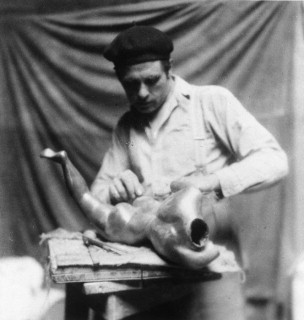
Why Leon Underwood matters
Leon Underwood occupies an unusual position in British art history: a working sculptor, painter, and printmaker whose greatest recognized legacy may be as a teacher. Through his years on staff at the Royal College of Art and through his own Brook Green School of Art in Hammersmith, he taught both Henry Moore and Barbara Hepworth, and Art UK describes him as an important link between the pre-war generation of Gaudier-Brzeska, Jacob Epstein, and Eric Gill and the modern British sculpture that followed. His own work, shaped by travel in Mexico and West Africa, has drawn periodic critical reappraisal, most notably around a major 2015 retrospective at Pallant House Gallery, even as his market has remained modest relative to his institutional standing.
- Born
- 1890-12-25, London, England (Shepherd's Bush)
- Nationality
- British
- Media
- Sculpture, Painting, Printmaking
- Movement
- Modern British sculpture
- Education
- Regent Street Polytechnic, 1907 to 1910; Royal College of Art, 1910 to 1913, diploma awarded on resit 1914; Slade School of Fine Art, 1919 to 1920 (refresher course)
- Signature motifs
- Stylized human figure, Sculpture informed by Mexican and West African travel
- Representation
- The Redfern Gallery, London (estate)
By the numbers
- 1920Prix de RomeArt scholarship prize, declined travel to Italy
- Henry Moore, Barbara HepworthNotable studentsRoyal College of Art (Moore) and Brook Green School of Art (Hepworth)
- The Redfern Gallery, London (estate)Represented by
- Pallant House Gallery, 2015Major retrospectiveLeon Underwood: Figure and Rhythm
Selected works
Click any work to view it full screen.
Biography
George Claude Leon Underwood, known professionally as Leon Underwood, was born on 25 December 1890 in Shepherd's Bush, London, the eldest child of an art and print dealer and a dressmaker. He studied at Regent Street Polytechnic from 1907 to 1910, then won a scholarship to the Royal College of Art, where he studied from 1910 to 1913 and received a diploma on resit in 1914. He served in the First World War with the Royal Engineers, reaching the rank of Captain, and afterward spent a year, 1919 to 1920, in a refresher course at the Slade School of Fine Art under Henry Tonks.
In 1920 he was awarded the Prix de Rome, which he chose not to use for travel to Italy, and joined the Royal College of Art as assistant master for life drawing, teaching there from 1920 to 1923; Henry Moore was among his students. In 1921 he opened the Brook Green School of Art in his Hammersmith studio, running it intermittently until 1938 and teaching Barbara Hepworth there as well. Travel proved formative to his art: he visited Mexico in 1928 and West Africa in 1945, and both trips left a lasting mark on his treatment of the human figure in sculpture and painting. He served again in the Second World War with a Civil Defence Camouflage unit from 1939 to 1942.
Later in his career he had solo shows and retrospectives at galleries including the Kaplan Gallery (1961), the Minories Art Gallery in Colchester (1969), and Thomas Agnew and Sons (1973). Leon Underwood died on 9 October 1975 in London.
Critical reception
Underwood's reputation has rested heavily on his role as a teacher and on periodic institutional rediscovery of his own work. Art UK notes that from the 1960s critics began to speak of him as the "father of modern sculpture in Britain," citing both his stylized, streamlined forms and the influence of his teaching on Moore and Hepworth. Pallant House Gallery's 2015 retrospective, Leon Underwood: Figure and Rhythm, was presented as the first major retrospective of his work in over 45 years and described him as "the precursor of modern sculpture in Britain," part of a periodic critical reassessment of his standing in twentieth century British art.
Market
Underwood's public market is thin. Dealer listings for his prints and works on paper, for example at Abbott and Holder and at Jenna Burlingham Gallery, typically sit in the low thousands of pounds, and available research could not establish a verified all-time auction record, price, house, or date for his work. His estate is handled by the Redfern Gallery in London, which remains the most direct source for provenance and current availability. Collectors should treat any single auction result for this artist with caution given the small number of public sales identified in current research.
Selected exhibitions
| Years | Exhibition | Venues |
|---|---|---|
| 1925 to 1966 | Summer Exhibition | Royal Academy of Arts, London (exhibited 1925, 1937, 1964, 1966) |
| 1934 | Solo exhibition | Leicester Galleries, London |
| 1957 | Group exhibition with Hepworth, Moore, Marini, and Epstein | Zwemmer Gallery, London |
| 1961 | Retrospective | Kaplan Gallery, London |
| 1969 | Retrospective | Minories Art Gallery, Colchester |
| 1973 | Leon Underwood, Mexico and After | Thomas Agnew and Sons, London |
| 1996 | Retrospective | The Redfern Gallery, London |
| 2015 | Leon Underwood: Figure and Rhythm | Pallant House Gallery, Chichester |
Museum collections
- Tate, London
- Victoria and Albert Museum, London
- National Portrait Gallery, London
- British Museum, London
- Ashmolean Museum, Oxford
- Brooklyn Museum, New York
Awards and honors
- Prix de Rome (art) (1920)
- Jean Masson Medal, Society of Portrait Sculptors (1961)
Authentication and provenance
No catalogue raisonne.
No catalogue raisonne covering the artist's full body of work has been confirmed. One dealer source references a sculpture catalogue raisonne by Ben Whitworth, published by Lund Humphries in 2000, but this could not be corroborated by additional sources in this research pass. His estate is represented by the Redfern Gallery, London, which is the primary point of reference for provenance and attribution questions.
Primary reference: https://www.redfern-gallery.com/artists/61-leon-underwood/
What collectors should know
Underwood's museum presence is substantial, with works held by Tate, the Victoria and Albert Museum, the National Portrait Gallery, the British Museum, and other major institutions, but no catalogue raisonne covering his full body of work has been confirmed and his auction market is comparatively undocumented and thin. His estate is represented by the Redfern Gallery in London, the natural point of contact for provenance questions. Given the scarcity of confirmed public sale data, collectors should rely on the estate and on institutional exhibition history rather than on any single auction result when assessing value.
Further reading and resources
Data current as of 2026-07-16.

