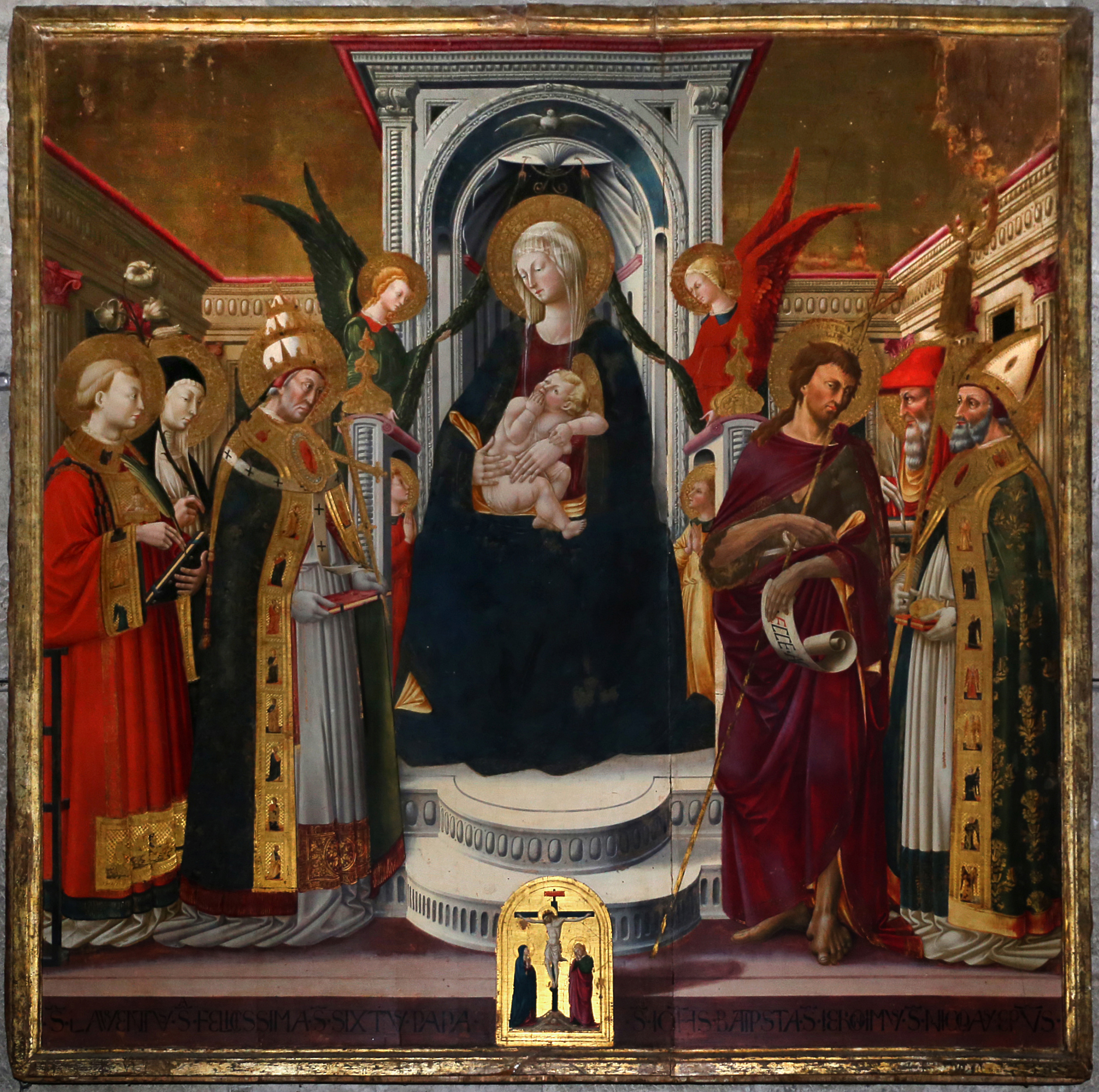
Why Lorenzo Bicci (Bicci di Lorenzo) matters
This profile resolves to Bicci di Lorenzo, a Florentine panel and fresco painter (1373 to 1452) who ran one of the enduring family workshops of the late Gothic to early Renaissance transition in Florence. He is the historical link between two other documented painters, his father Lorenzo di Bicci and his son Neri di Bicci. Some reference sources use the shortened, family-name-first form "Lorenzo Bicci" for the father rather than for him, so that shorthand should not be read as evidence of a separate, third artist; this profile treats the name as most likely referring to this family chain, while noting the father-versus-son ambiguity below. The name is also unrelated to a living contemporary Italian painter of the same name, born in Pisa in 1969, who has no documented auction market presence. His significance is scholarly and institutional rather than driven by auction headlines: his work is held across European and American museum collections, but the market for it is thin, intermittent, and complicated by a long history of reattribution among the three generations of the same workshop.
- Nationality
- Italian
- Media
- Panel painting, Fresco
- Movement
- Late Gothic, Early Renaissance Florentine School
- Education
- No formal academy attended (predates the academy system); trained in the Florentine workshop of his father, the painter Lorenzo di Bicci. Exact training years are not documented.
- Signature motifs
- Gold-ground devotional panels, Fresco cycles for Florentine churches and guilds
By the numbers
- EUR 40,965Best-documented auction saleDorotheum, Vienna, 17 October 2017; a separate Koller sale reaching CHF 341,900 lacks a confirmed date and is not verified as higher or lower
- c. 1400 to 1452Active periodFlorence
- Continued his father's studioWorkshopSucceeded in turn by his son, Neri di Bicci
- NoneRepresentationHistorical estate; works trade through Old Master auction departments
Selected works
Click any work to view it full screen.
Biography
Bicci di Lorenzo was born in Florence, most commonly dated to 1373, though the biographical dictionary Treccani proposes a probable birth year of 1368 based on a 1446 tax declaration in which he states his age as 78. He was the son of the painter Lorenzo di Bicci (active from about 1370, died 1427) and trained in his father's workshop; no separate academy attendance is documented, since Florence in this period organized artistic training through guild-linked studios rather than schools.
He inherited and expanded the family workshop, producing devotional panels, altarpieces, and fresco cycles for Florentine churches and guilds. Documented works include the Annunciation Triptych of 1414, painted for San Lorenzo a Porciano and now in the Pieve di Santa Maria Assunta in Stia; the Enthroned Madonna of 1433, now in the Galleria Nazionale di Parma; and Saint Nicholas of Bari Banishing the Storm, dated 1433 to 1435 and held by the Ashmolean Museum in Oxford. He also painted the Coronation of the Virgin altarpiece originally installed in Santa Trinita, Florence, later relocated to Westminster Abbey in London. A number of frescoes long attributed to his father in Santa Maria del Carmine, Florence, and San Francesco, Arezzo, are now generally reassigned by scholars to Bicci di Lorenzo himself.
He died in Florence. The biographical dictionary Treccani gives the exact date as 6 May 1452 and states he was buried in the church of Santa Maria del Carmine; other standard reference sources confirm the year 1452 and the Florence burial but do not independently confirm the day. His workshop passed to his son, Neri di Bicci, who continued the family tradition into the second half of the fifteenth century.
Critical reception
The earliest and most influential account of his work comes from Giorgio Vasari's Lives of the Most Excellent Painters, Sculptors, and Architects, which discusses commissions from this family workshop, including a large 1418 fresco of Saint Thomas examining the wound in Christ's side. In the nineteenth century, the art historians Joseph Archer Crowe and Giovanni Battista Cavalcaselle revisited and in several cases reassigned frescoes previously credited to his father, Lorenzo di Bicci, to Bicci di Lorenzo instead, a reattribution pattern that modern museum catalogues continue to refine. No exact, reproducible quotation from a named critic in a major outlet could be confirmed for this artist specifically, so none is presented here. The consistent theme across sources, from Vasari onward, is workshop continuity: assessments of his work are inseparable from ongoing debate about where his father's hand ends and his own begins, and where his own ends and his son Neri's begins.
Market
The auction market for Bicci di Lorenzo is small and irregularly documented, which is typical for a workshop painter of this period whose panels are frequently reattributed. The best-documented recent result is a Dorotheum sale in Vienna on 17 October 2017, which realized EUR 40,965 (roughly USD 47,000 at contemporaneous exchange rates) for a lot catalogued under his name; the specific work title is not individually specified in the available source. A separate Koller Auktionen listing records a sale reaching CHF 341,900 including buyer's premium, but without a confirmed sale date or a clear breakdown between hammer price and premium, so it cannot be verified as a higher, comparable record and is not presented here as the artist's auction high.
Top auction results
| Work | Price | Sale |
|---|---|---|
| Old Master panel (lot title not individually specified in the available source) (2017) | USD 47,000 (EUR 40,965) | Dorotheum, Vienna, 2017-10-17 |
Museum collections
- Galleria dell'Accademia, Florence
- Ashmolean Museum, Oxford
- Fine Arts Museums of San Francisco (Legion of Honor)
- Wallraf-Richartz-Museum, Cologne
- Galleria Nazionale di Parma
- Museo Civico Amedeo Lia, La Spezia
Authentication and provenance
No catalogue raisonne.
No published catalogue raisonne exists for this artist. Attribution rests on connoisseurship dating back to Giorgio Vasari's Lives, on later reassessments by scholars such as Crowe and Cavalcaselle, and on ongoing museum curatorial review. Because he shared a workshop tradition with his father, Lorenzo di Bicci, and his son, Neri di Bicci, individual panels and frescoes are periodically reattributed among the three, and this reattribution history is the main authentication issue for any work offered as his.
Primary reference: https://en.wikipedia.org/wiki/Bicci_di_Lorenzo
What collectors should know
There is no catalogue raisonne for this artist, and no gallery or estate currently represents his work; pieces surface through the Old Master departments of major auction houses such as Sotheby's, Christie's, Dorotheum, and Koller. Because attribution within this three-generation family workshop (Lorenzo di Bicci, Bicci di Lorenzo, and Neri di Bicci) has shifted repeatedly under modern scholarship, and because the shorthand name "Lorenzo Bicci" is itself used inconsistently for father and son across sources, the single most important diligence step before any purchase is confirming which member of the workshop a specific panel or fresco is currently attributed to, and by whom. Auction volume is thin enough that any individual sale result, including the figures cited above, should be treated as a data point rather than a reliable market trend.
Further reading and resources
Data current as of 2026-07-18.

