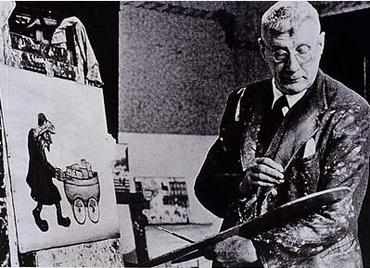
Why L.S. Lowry matters
L.S. Lowry is one of the most recognized names in modern British art, the painter who turned the mills, terraces, and crowds of the industrial North into a body of work that the public knows on sight. For a collector, he is a study in a durable, deeply national market: a long and well documented sales history, a clear and consistent visual identity, and demand anchored by British institutions and private buyers rather than by the global contemporary circuit. His best paintings sell in the millions, and his name recognition extends far beyond the usual art audience.
- Born
- 1887-11-01, Rusholme, Manchester, England
- Nationality
- British
- Media
- Painting, Drawing
- Movement
- Modern British, Naive painting
- Education
- Manchester Municipal College of Art (evening classes, 1905 to 1915); Salford School of Art (1915 to 1925)
- Signature motifs
- Industrial townscapes, Matchstick figures, Flake-white skies
- Representation
- Estate of L.S. Lowry
By the numbers
- GBP 7.8MAuction highGoing to the Match, Christie's London, 2022
- 1887 to 1976Active yearsBritish painter of the industrial North
- The Lowry, SalfordPrincipal collection
- Five, including a 1968 knighthoodHonours declined
Selected works
Click any work to view it full screen.
Biography
Laurence Stephen Lowry was born on 1 November 1887 in Rusholme, Manchester. He spent almost his entire life in and around Manchester and Salford, and for more than 40 years lived in Pendlebury, Lancashire, the industrial district that shaped his subject matter. He trained in the evenings while working during the day, studying at the Manchester Municipal College of Art from about 1905 to 1915 and at the Salford School of Art from 1915 to 1925.
For most of his working life Lowry was employed as a rent collector and clerk for the Pall Mall Property Company in Manchester, a job he kept until he retired in 1952 and largely concealed from the art world. He painted in his spare time, building the distinctive style for which he became known: crowded industrial townscapes set against pale, flake-white skies, populated by the simplified, elongated figures that the public nicknamed matchstick men. Alongside the busy street scenes he produced emptier, more austere works, portraits, seascapes reduced to sea and sky, and a body of more private drawings that surfaced after his death.
Recognition came slowly and then steadily. He was elected a Royal Academician in 1962. Lowry was also notable for what he refused: he declined five British honours over his lifetime, including a knighthood offered in 1968, the largest number of such refusals on record. He died on 23 February 1976, aged 88, only months before a major retrospective of his work opened at the Royal Academy of Arts in London.
Critical reception
Critical opinion on Lowry has shifted markedly over time. For much of his career he was dismissed in some London circles as a naive or Sunday painter, a label encouraged by the flat, shadowless figures, the absence of conventional weather and atmosphere, and his own self-deprecating account of his methods. That framing has been steadily revised. The 2013 Tate Britain retrospective, the first the museum devoted to him, was curated by the art historians T.J. Clark and Anne M. Wagner, who argued for Lowry as a serious painter of modern industrial life and placed him in a wider European tradition of depicting the working city. The recurring critical questions now concern how to read the work: whether the crowds are observed with affection, detachment, or something more melancholy, and how to weigh the emptier, stranger pictures against the familiar mill scenes. What is no longer seriously disputed is that the work holds a secure place in the story of twentieth century British art.
Watch
Market
Lowry's market is mature, liquid by the standards of a single-artist field, and strongly centered in the United Kingdom. His auction high is Going to the Match (1953), a painting of football supporters streaming toward the former Burnden Park ground of Bolton Wanderers, which sold for GBP 7.8 million (including buyer's premium, on a GBP 6.6 million hammer) at Christie's London on 19 October 2022. It was bought by The Lowry arts centre in Salford, which holds the largest public collection of his work. Other major industrial scenes have changed hands in the same range, including Sunday Afternoon (1957) at GBP 6.3 million at Christie's London in 2024 and A Northern Race Meeting (1956) at about GBP 5.3 million in 2018. A separate, active market exists for his prints.
Top auction results
| Work | Price | Sale |
|---|---|---|
| Going to the Match (1953) | USD 8,796,032 (GBP 7,846,500) | Christie's, London, 2022-10-19 |
| Sunday Afternoon (1957) | USD 8,024,085 (GBP 6,290,000) | Christie's, London, 2024-03-21 |
| A Northern Race Meeting (1956) | GBP 5.3M | Christie's, London, 2018-11-01 |
Selected exhibitions
| Years | Exhibition | Venues |
|---|---|---|
| 2013 | Lowry and the Painting of Modern Life | Tate Britain, London (first Tate retrospective) |
| 2014 | L.S. Lowry | Nanjing, China (first solo exhibition outside the United Kingdom) |
| 1976 | L.S. Lowry: Retrospective Exhibition | Royal Academy of Arts, London (opened months after his death) |
Museum collections
- Tate, London
- The Lowry, Salford
- Manchester Art Gallery
- The Whitworth, University of Manchester
- Government Art Collection, United Kingdom
- The Fitzwilliam Museum, Cambridge
Awards and honors
- Elected Royal Academician (RA) (1962)
- Honorary Master of Arts, University of Manchester (1945)
Authentication and provenance
No catalogue raisonne.
No single published catalogue raisonne covers the full output. Major works are verified through provenance, exhibition history, and specialist opinion, with reference to the standard monographs and the holdings of The Lowry, Salford.
Primary reference: https://www.tate.org.uk/art/artists/l-s-lowry-1533
What collectors should know
Lowry's market rewards specificity. The headline industrial townscapes, the crowded, instantly recognizable mill and match-day scenes, command the strongest prices, while lesser subjects, later repetitions, and works in weaker condition trade far below the records. Because there is no single comprehensive catalogue raisonne, provenance, exhibition history, and specialist opinion carry real weight, and the holdings and scholarship around The Lowry in Salford are an important reference point. The market is concentrated among British buyers and institutions, which gives it depth and continuity but also means demand is tied to the UK collecting base. For a collector, the strongest signals of durability are the long, well documented sales record and the deep institutional ownership of his best work; the main thing to watch is the wide gap in value between an iconic subject and an ordinary one.
Further reading and resources
Data current as of 2026-06-20.

