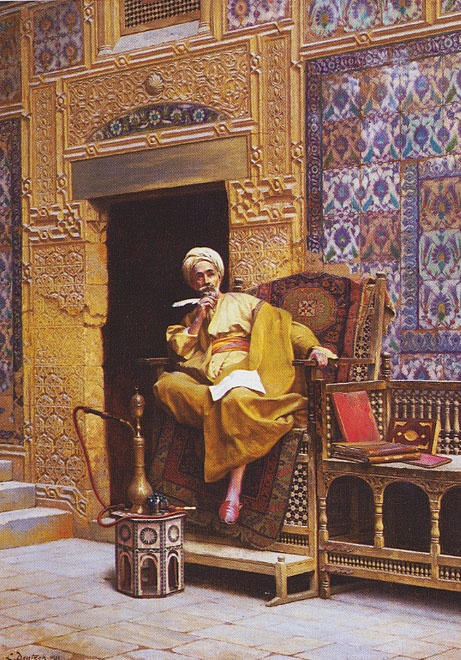
Why Ludwig Deutsch matters
Ludwig Deutsch is one of the most sought-after painters of the European Orientalist movement, prized for architecturally precise, jewel-like interiors of mosques, palaces, and Cairo street life rendered with an almost photographic control of light and costume detail. His academic training and small, meticulously worked output have made his paintings a benchmark for collectors of nineteenth-century Orientalist art, even though his market operates on a far smaller and less liquid scale than that of a modern or contemporary blue-chip artist.
- Born
- 1855-05-13, Vienna, Austrian Empire (now Austria)
- Nationality
- Austrian
- Media
- Painting
- Movement
- Orientalist, Academic art
- Education
- Vienna Academy of Fine Arts, circa 1872 to 1875, no confirmed degree documented
- Signature motifs
- Orientalist genre scenes, Mamluk and Ottoman architectural interiors, Meticulously rendered costume, armor, and metalwork
By the numbers
- GBP 989,000 (approx. USD 1.4M)Auction highThe Palace Guard, Sotheby's London. Exact sale date not confirmed in current research; other aggregators cite different, unverified figures.
- 1879Salon debutSalon des Artistes Francais, Paris
- Gold medal, 1900Exposition UniverselleParis World's Fair
- No confirmed current gallery or estate representationRepresented by
Selected works
Click any work to view it full screen.
Biography
Ludwig Deutsch was born on 13 May 1855 in Vienna, then part of the Austrian Empire. He trained at the Vienna Academy of Fine Arts, most consistently dated to around 1872 to 1875, though sources disagree on which instructors he studied under and no confirmed degree is documented. He relocated to Paris, where he settled and built his career, and by 1879 was exhibiting regularly at the Salon des Artistes Francais. His work there earned an honorable mention in 1888 and a third-class medal in 1907, alongside an undated second-class medal cited by at least one market source. In 1900 he was awarded a gold medal at the Exposition Universelle in Paris. One source, not independently corroborated, states that he became a naturalized French citizen around 1919 and began signing works as Louis Deutsch; this detail should be treated as provisional. He continued to paint Orientalist genre and architectural scenes, drawing on travel, photographs, and studio props, until his death in Paris on 9 April 1935.
Critical reception
Deutsch's reputation was built through repeated Salon participation and steady collector demand rather than through grand state honors. Beyond his Salon medals and the 1900 Exposition Universelle gold medal, at least one dealer source credits him with the Chevalier de la Legion d'honneur, though that claim rests on a single source and is not independently corroborated in current research. No exact, attributable critical quotation from a named critic in a major outlet could be confirmed either. What is well documented is the consistency of his recognition within the French academic exhibition system across nearly three decades, from his 1879 Salon debut through his 1907 medal, a track record that has anchored his standing among Orientalist specialists and museums that continue to hold and display his work.
Market
Deutsch's market is thin, specialized, and dominated by pre-auction attribution and provenance work rather than the frequent repeat sales seen for modern artists. The best-documented individual sale identified in current research is The Palace Guard, which realized approximately GBP 989,000 (about USD 1.4 million) at Sotheby's London; the exact calendar date of that sale could not be confirmed. Separately, at least one market aggregator lists a higher maximum realized price of approximately USD 5.3 million for an unnamed Deutsch painting, and a different secondary source cites roughly EUR 2.3 million for a work referred to as Guarding the Palace, again without naming the auction house or exact date. Neither of these higher figures is corroborated by a primary, dated auction record in current research, so collectors should treat any single number as provisional until a specific, dated auction house result is confirmed.
Top auction results
| Work | Price | Sale |
|---|---|---|
| The Palace Guard | USD 1,400,000 (GBP 989,000) | Sotheby's, London |
Selected exhibitions
| Years | Exhibition | Venues |
|---|---|---|
| 1879 to 1907 | Regular exhibitor | Salon des Artistes Francais, Paris |
| 1888 | Salon des Artistes Francais, honorable mention | Paris |
| 1900 | Exposition Universelle, gold medal | Paris |
| 1907 | Salon des Artistes Francais, third-class medal | Paris |
Museum collections
- Sharjah Art Museum, Sharjah
Awards and honors
- Honorable mention, Salon des Artistes Francais (1888)
- Gold medal, Exposition Universelle, Paris (1900)
- Third-class medal, Salon des Artistes Francais (1907)
- Second-class medal, Salon des Artistes Francais (year undocumented)
- Chevalier de la Legion d'honneur (single-source, unconfirmed elsewhere)
Authentication and provenance
No catalogue raisonne.
No published catalogue raisonne has been identified for Deutsch. Attribution and dating rely on auction house specialist departments and Orientalist-art scholarship, and no estate or foundation currently issues certificates of authenticity.
Primary reference: https://en.wikipedia.org/wiki/Ludwig_Deutsch
What collectors should know
No catalogue raisonne for Ludwig Deutsch has been identified, and no gallery or estate currently represents him or issues certificates of authenticity; attribution rests on auction house connoisseurship and provenance research. His auction record is genuinely uncertain: the best-documented individual sale is The Palace Guard at Sotheby's London for roughly GBP 989,000 (about USD 1.4 million), though the exact sale date is unconfirmed, while a materially higher aggregate figure circulates in market data without a named underlying sale, and collectors should not treat that higher number as confirmed. Given the small population of known works and infrequent sales, buyers should weigh provenance, exhibition history, and condition heavily, and should expect wide variance between comparable-looking results.
Further reading and resources
Data current as of 2026-07-09.

