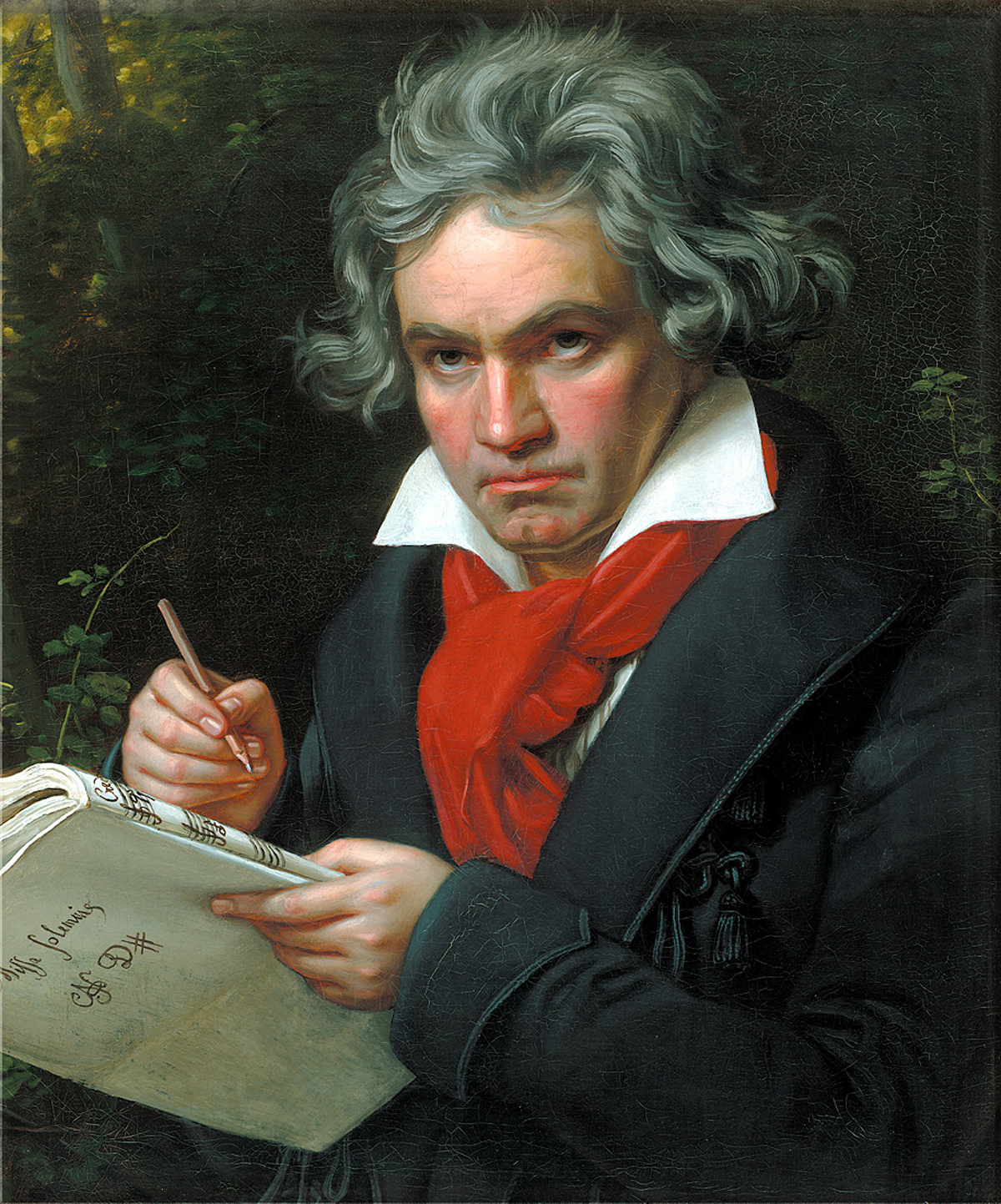
Why Ludwig van Beethoven matters
Ludwig van Beethoven, 1770 to 1827, is the composer against whom the Western concert repertoire is still measured, and for Masterworks Academy readers he is a useful case study in a different kind of market: the trade in historical autograph manuscripts and documents rather than paintings or sculpture. His nine symphonies, thirty two piano sonatas, and late string quartets remain core repertoire for every major orchestra and ensemble, and his surviving manuscripts, letters, and sketchleaves are the closest thing to primary source objects that his output produced. Because he left no paintings, prints, or sculpture, his profile also shows how the standard art market apparatus, a catalogue raisonne and gallery representation for physical artworks, simply does not map onto a composer, and what collectors of his manuscripts rely on instead.
- Born
- 1770-12-16, Bonn, Electorate of Cologne (present-day Germany)
- Nationality
- German
- Media
- Composition, Piano performance
- Movement
- Classical, Romantic
- Education
- Tirocinium Latin school, Bonn, to about age 11. Briefly enrolled at the University of Bonn, 1789, no degree documented. Studied privately with Christian Gottlob Neefe in Bonn, then with Joseph Haydn, Johann Georg Albrechtsberger, and Antonio Salieri in Vienna.
- Signature motifs
- Nine symphonies, including the choral Ninth, Late string quartets, Heroic-period works
By the numbers
- USD 3.47MManuscript auction highSymphony No. 9 autograph manuscript, Sotheby's London, 2003
- 9Completed symphonies
- 26 March 1827DiedVienna, age 56
- Beethoven-Haus, BonnLargest archiveAmong the world's largest Beethoven archives, per the institution; exact holding counts vary by source
Selected works
Click any work to view it full screen.
Biography
Beethoven was born in Bonn, in the Electorate of Cologne, and baptized on 17 December 1770. His exact birth date is not documented and is conventionally given as 16 December 1770. He received a limited general education at the Tirocinium, a Latin school in Bonn, leaving around age eleven to concentrate on music, and briefly attended lectures at the University of Bonn in 1789 without completing a degree. His formal musical training came privately, first from Christian Gottlob Neefe in Bonn in the early 1780s, and later in Vienna from Joseph Haydn, Johann Georg Albrechtsberger, and Antonio Salieri.
He settled in Vienna in 1792 and built his reputation there first as a virtuoso pianist and then, increasingly, as a composer. Beginning around 1798 he experienced progressive hearing loss that became total deafness by the 1810s, a condition he wrote about with anguish in the 1802 Heiligenstadt Testament, and it did not stop him from composing his most ambitious works, including the Ninth Symphony, in his later, profoundly deaf years. He never married and had no children of his own; a prolonged custody dispute over his nephew Karl, following the death of his brother, occupied much of his last decade.
Beethoven died in his apartment in the Schwarzspanierhaus in Vienna on 26 March 1827, at age 56, following a prolonged illness. Encyclopaedia Britannica and modern medical historical analysis attribute the death to cirrhosis of the liver and associated multisystem failure, with some research also examining lead exposure as a possible contributing factor. He is buried in Vienna, and his funeral is reported to have drawn a large public crowd.
Critical reception
Beethoven's standing among reference institutions and historians is close to unanimous: encyclopedic sources consistently describe him as among the greatest composers in the history of Western music, credited with an unmatched ability to expand the emotional and structural range of the symphony, sonata, and string quartet. That consensus was not immediate; his most demanding late works met a more mixed reception among contemporaries before later generations absorbed them. The view that hardened over the following century, and that persists today, is that Beethoven's symphonies and quartets set the direction for nineteenth century music and mark the hinge between the Classical and Romantic eras.
Market
Beethoven's manuscripts trade in a market defined by scarcity and by wide swings in price depending on the significance of the specific item. The record price for a Beethoven work is USD 3.47 million, paid for the working autograph manuscript of the Symphony No. 9 in D minor, Op. 125, at Sotheby's in London, reported as selling on or about 1 December 2003. That result was a record for a Beethoven manuscript at the time and, based on available reporting, has not been surpassed as of mid 2026.
Below that top tier, Beethoven material at auction has traded far more modestly. A signed letter requesting the return of sheet music realized USD 275,000 at Heritage Auctions, an autograph music manuscript sold for USD 225,000 in 2024, and individual signatures and sketchleaves have brought results ranging from the tens of thousands of dollars to the low hundreds of thousands. Estimates for autograph sketchleaves and canons at Sotheby's in recent years have generally sat in the GBP 60,000 to 200,000 range. The gap between the Ninth Symphony manuscript and everything else underscores how much a single, historically singular document can separate from the rest of an artist's market.
Top auction results
| Work | Price | Sale |
|---|---|---|
| Symphony No. 9 in D minor, Op. 125, autograph manuscript (2003) | USD 3,470,000 (GBP 2,100,000) | Sotheby's, London, 2003-12-01 |
Selected exhibitions
| Years | Exhibition | Venues |
|---|---|---|
| 2019 to 2020 | BTHVN2020, 250th anniversary of Beethoven's birth | Bonn and Vienna, multiple institutions |
| 1970 | Beethoven-Jahr 1970, bicentenary of Beethoven's birth | Beethoven-Haus, Bonn; Staatsbibliothek zu Berlin |
| 1927 | Centenary of Beethoven's death | Bonn and Vienna |
| 1889 | Opening of the Beethoven-Haus museum | Beethoven-Haus, Bonn |
| 1845 | Unveiling of the Beethoven Monument | Munsterplatz, Bonn |
Museum collections
- Beethoven-Haus, Bonn
- Wien Museum: Beethoven Museum Heiligenstadt, Pasqualatihaus, and Eroica-Haus, Vienna
- Ira F. Brilliant Center for Beethoven Studies, San Jose State University
- Haus der Musik, Vienna
Authentication and provenance
No catalogue raisonne.
No catalogue raisonne of artworks applies, since Beethoven produced manuscripts and letters rather than paintings or sculpture. Autograph scores, letters, and sketchleaves are authenticated through provenance research and comparison against the reference holdings of the Beethoven-Haus archive in Bonn, among the largest Beethoven collections in the world.
Primary reference: https://www.britannica.com/biography/Ludwig-van-Beethoven
What collectors should know
There is no catalogue raisonne to consult because Beethoven produced manuscripts and letters, not paintings or sculpture, and no gallery or estate represents his market the way a living artist's estate would. Authentication instead rests on manuscript provenance and comparison against the reference holdings of the Beethoven-Haus in Bonn, which is widely cited as among the largest Beethoven archives in the world, though exact holding counts vary by source. Given how thin the auction record is at the highest tier, a single exceptional document, such as the Ninth Symphony manuscript, can distort any sense of a typical price. Collectors should weigh the specific historical importance of an individual letter, sketch, or score rather than extrapolating from any one sale.
Further reading and resources
Data current as of 2026-07-16.

