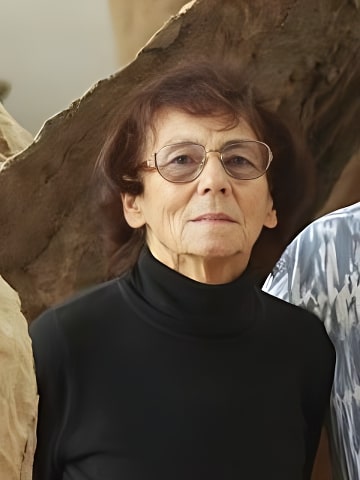
Why Magdalena Abakanowicz matters
Magdalena Abakanowicz was one of the defining sculptors to emerge from postwar Poland, an artist who turned woven fiber and burlap into monumental, often headless human figures that read as both intimate and mass-produced. For a collector, she matters as a rare case of an artist whose primary material, textile, was elevated from craft to major sculpture, and whose crowd installations remain fixtures of institutional collections from Chicago to Paris to London.
- Born
- 1930-06-20, Falenty, near Warsaw, Poland
- Nationality
- Polish
- Media
- Sculpture, Fiber art, Textile art
- Movement
- Fiber art, Postwar Polish sculpture
- Education
- State Higher School of Fine Arts (PWSSP), Sopot, 1949 to 1950; Academy of Fine Arts, Warsaw, diploma from the Faculty of Painting, field of textile/tapestry, 1954
- Signature motifs
- Headless human figures, Abakans (woven fiber sculptures), Crowd installations
- Representation
- Richard Gray Gallery (GRAY), Richard Saltoun Gallery
By the numbers
- USD 3.68M (PLN 13,617,361)Auction highBambini, Polswiss Art, Warsaw, 7 December 2021
- VIII Bienal de Sao Paulo, 1965Grand Prix
- MultipleHonorary doctoratesRoyal College of Art (1974), RISD (1992), Pratt Institute (2000)
- Richard Gray Gallery (GRAY); Richard Saltoun GalleryRepresented by
Selected works
Click any work to view it full screen.
Biography
Magdalena Abakanowicz was born on June 20, 1930, in Falenty, near Warsaw, Poland. After the Second World War her family moved through Tczew and Gdynia, where she completed secondary art schooling at the Public High School of Visual Arts, graduating in 1949. She then enrolled at the State Higher School of Fine Arts in Sopot to study textiles, but transferred after one year, in 1950, to the Academy of Fine Arts in Warsaw when the Sopot textile department closed. She graduated in 1954 with a diploma from the Faculty of Painting in the field of textile and tapestry, studying through the height of Socialist Realist orthodoxy in the Eastern Bloc.
In the 1960s she developed the "Abakans," large, freestanding, three-dimensional woven forms made of sisal, horsehair, and other fiber, that broke decisively from flat tapestry tradition and helped establish fiber as a sculptural medium. The Abakans won a gold medal and Grand Prix in applied arts at the VIII Bienal de Sao Paulo in 1965, and were shown to acclaim at the 1st International Biennial of Tapestry in Lausanne in 1962. From the 1970s onward she turned increasingly to burlap, resin, and bronze to create her best-known works: crowds of anonymous, headless, and often armless human figures installed in groups, exploring themes of individuality, conformity, and mass experience under totalitarian rule. She taught for 25 years as a professor at the University of Fine Arts in Poznan and was a visiting professor at UCLA in 1984.
Abakanowicz died on April 20, 2017, in Warsaw, Poland, at the age of 86. Her death was reported by major art press including Artnet News and the Los Angeles Times, both of which place her death in Warsaw that week; Tate and other institutions record her dates as 1930 to 2017.
Critical reception
Abakanowicz's critical standing rests on her role in moving fiber and textile from applied art into the language of major sculpture, and on the emotional and political charge of her crowd works. Critic Barbara Rose was among the writers who situated Abakanowicz's work in near-mythic, symbolic terms. Institutions have continued to affirm this reading in the years since her death: a major retrospective, Every Tangle of Thread and Rope, was mounted at Tate Modern in London in 2022 and 2023, and a first major monographic exhibition in Paris, La trame de l'existence, opened at the Musee Bourdelle in November 2025. Her work also remains active in dealer programming, with recent solo presentations at GRAY in New York and Chicago and a 2026 solo exhibition at the Helsinki Art Museum organized in coordination with the Abakanowicz Charitable Foundation.
Market
Abakanowicz's auction market is led by monumental installations rather than single small works. Her record is Bambini, an installation of headless, child-sized figures dating from 1998 to 1999, which sold at Polswiss Art in Warsaw on December 7, 2021, for 13,617,361 Polish zloty including fees, reported at the time as roughly 2.95 to 3.1 million euros and cited elsewhere at approximately USD 3.68 million. Coverage at the time described the sale as the highest price ever paid for a work of Polish art at auction, and as Abakanowicz's own auction record. Other public auction results for her sculptures and works on paper, tracked by houses such as Phillips and Rago, sit well below this figure, in the tens to low hundreds of thousands of dollars, so the Bambini result should be read as an outlier tied to a major installation rather than a typical comparable.
Top auction results
| Work | Price | Sale |
|---|---|---|
| Bambini | USD 3,682,894 (PLN 13,617,361 (incl. fees)) | Polswiss Art, Warsaw, Poland, 2021-12-07 |
Selected exhibitions
| Years | Exhibition | Venues |
|---|---|---|
| 2025 to 2026 | La trame de l'existence (The Thread of Life) | Musee Bourdelle, Paris |
| 2022 to 2023 | Every Tangle of Thread and Rope | Tate Modern, London |
| 2026 | Next is our skin | GRAY, New York |
| 2025 | Apparitions | GRAY, Chicago |
| 2026 | Magdalena Abakanowicz | Helsinki Art Museum (HAM) |
| 2013 | The Human Adventure | Akbank Art Center, Istanbul |
| 1965 | VIII Bienal de Sao Paulo | Sao Paulo, Brazil (Grand Prix in applied arts) |
| 1962 | 1ere Biennale Internationale de la Tapisserie | Lausanne, Switzerland |
Museum collections
- Museum of Modern Art, New York
- Metropolitan Museum of Art, New York
- Art Institute of Chicago
- Centre Georges Pompidou, Paris
- Tate, London
- National Gallery of Art, Washington, D.C.
- Stedelijk Museum, Amsterdam
- Storm King Art Center, New York
Awards and honors
- Grand Prix, VIII Bienal de Sao Paulo (1965)
- Honorary doctorate, Royal College of Art, London (1974)
- Leonardo da Vinci World Award of Arts, World Cultural Council (1999)
- Officier de l'Ordre des Arts et des Lettres, France (1999)
- Knight of the Order of Merit of the Italian Republic (2000)
Authentication and provenance
No catalogue raisonne.
No published catalogue raisonne is confirmed. Attribution and provenance are generally handled through the Abakanowicz Charitable Foundation together with the artist's galleries, Richard Saltoun Gallery and Richard Gray Gallery (GRAY).
Primary reference: https://www.richardgraygallery.com/artists/magdalena-abakanowicz
What collectors should know
Abakanowicz's market is thin and installation-driven: her all-time auction record comes from a single major sculptural installation sold in Warsaw, not from a deep, liquid trade in smaller works, so any comparison across sale prices should account for scale and medium. There is no confirmed catalogue raisonne, which places added weight on provenance research and on verification through the Abakanowicz Charitable Foundation and her galleries, Richard Saltoun Gallery and Richard Gray Gallery. Her deep museum footprint, spanning MoMA, the Metropolitan Museum, the Pompidou, Tate, and other major institutions, together with a steady cadence of posthumous museum and gallery exhibitions, is the strongest signal of her long-term standing.
Further reading and resources
Data current as of 2026-07-09.

