Margaret Macdonald Mackintosh
British, 1864 to 1933
Watercolour · Gesso panel · Metalwork · Textile design
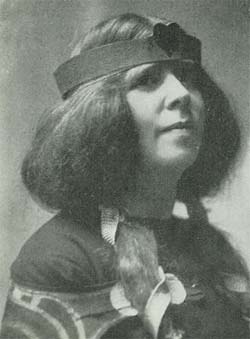
Why Margaret Macdonald Mackintosh matters
Margaret Macdonald Mackintosh was one of the most original decorative artists to emerge from the Glasgow Style, the distinctively Scottish strand of Art Nouveau that flourished from the 1890s through the First World War. As a founding member of "The Four," alongside her sister Frances Macdonald, her husband Charles Rennie Mackintosh, and Herbert McNair, she helped define a visual language of elongated figures, symbolist imagery, and gesso relief panels that shaped architecture, interior design, and graphic art across Europe. For decades after her death her individual contribution was often folded into her husband's reputation. A resurgence of scholarly and market interest, marked by the rediscovery of a group of her gesso panels in Vienna in 1990 and a 2008 auction result that set a record for a work of art from Scotland, has restored her as a subject in her own right.
- Born
- 1864-11-05, Tipton, Staffordshire, England, UK
- Nationality
- British
- Media
- Watercolour, Gesso panel, Metalwork, Textile design
- Movement
- Glasgow Style, Art Nouveau
- Education
- Orme Girls' School, Newcastle-under-Lyme, Staffordshire (secondary); Glasgow School of Art, day student in design courses, c. 1890 to mid-1890s; no degree conferred
- Signature motifs
- Gesso panel relief, Rose and rosebud imagery, Elongated female figures, Symbolist watercolours
By the numbers
- GBP 1.7M (about USD 3.3M)Auction highThe White Rose and the Red Rose, Christie's London, 2008
- Hunterian Art Gallery, University of GlasgowPrincipal collectionlargest single holding, over 40 works, plus the Mackintosh Estate archive
- Glasgow Style / Art NouveauMovement
Selected works
Click any work to view it full screen.
Biography
Margaret Macdonald was born on 5 November 1864 in Tipton, Staffordshire, England. She and her younger sister, Frances Macdonald, attended the Orme Girls' School in Newcastle-under-Lyme; the 1881 census lists Margaret, then aged 16, as a scholar. Around 1890 the family settled in Glasgow, and Margaret enrolled as a day student at the Glasgow School of Art, studying courses in design alongside Frances; the school's annual reports place her there in 1890 to 1891, and she left in the mid-1890s to set up an independent studio with her sister. Macdonald's training remained art-school based rather than a university degree.
At the Glasgow School of Art, Margaret and Frances became known as "the Macdonald Sisters" and worked in metalwork, embroidery, and textiles alongside painting and design. Their circle expanded to include the architect and designer Charles Rennie Mackintosh and his friend Herbert McNair, and together the four became known as "The Four," whose watercolours, posters, and metalwork drew international attention. Their work was shown at the fifth exhibition of the Arts and Crafts Exhibition Society in London in 1896 and at the eighth Vienna Secession exhibition in 1900, exhibitions that helped carry the Glasgow Style across the Continent.
Margaret Macdonald married Charles Rennie Mackintosh in 1900. The couple collaborated closely on major interior commissions, including tea rooms for the Glasgow restaurateur Catherine Cranston in 1900 and 1903 and the interiors of the Hill House in Helensburgh, where Margaret's gesso panels, textiles, and decorative schemes were integral to the finished rooms. In 1902 the couple presented "A Rose Boudoir" at the Esposizione Internazionale d'Arte Decorativa Moderna in Turin; the installation included large gesso panels, among them rose imagery that would recur throughout her career. Between 1895 and 1924 she contributed to more than 40 exhibitions across Europe and America, including with the Royal Glasgow Institute of the Fine Arts, the Royal Scottish Academy, and the Royal Scottish Society of Painters in Watercolour.
Charles Rennie Mackintosh died in December 1928. Margaret Macdonald Mackintosh died a little over four years later, on 7 January 1933, in Chelsea, London, at the age of 68. A small number of secondary reference sources give her death date as 10 January 1933, but the stronger weight of specialist sources, including the Glasgow School of Art Archives, places the date at 7 January.
Critical reception
Contemporary and later critics have consistently treated Margaret Macdonald Mackintosh's decorative work, and her partnership with Charles Rennie Mackintosh, as central to the Glasgow Style. The critic Amelia Levetus praised the couple's collaboration on Catherine Cranston's tea rooms, though the exact wording and original publication of her remarks could not be confirmed for this profile. Charles Rennie Mackintosh himself is recorded, including by the National Trust for Scotland, as crediting his wife with the greater share of genius in their partnership, though the precise wording of that remark could not be verified here. For much of the twentieth century, exhibition and market attention favored Mackintosh's architecture over Margaret's painting, textiles, and gesso work. That balance has shifted since the rediscovery of a group of her gesso panels at the Museum of Applied Arts in Vienna in 1990, and with subsequent acquisitions by Scottish national collections in the years since.
Market
Margaret Macdonald Mackintosh's auction market is small and dominated by a handful of major decorative works. Her all-time auction record is held by "The White Rose and the Red Rose" (1902), a gesso panel over hessian with glass beads, which sold for GBP 1,700,000 (about USD 3.3 million) at Christie's London in 2008, a price reported at the time as a record for a work of art from Scotland. Below that ceiling, results drop steeply: a 1908 watercolour, "Ophelia," sold for GBP 94,500 including premium at Lyon & Turnbull in Edinburgh, and "The Annunciation" (1896) sold for EUR 176,400 at the Italian auction house Ponte in 2024. The gap between the record gesso panel and more typical watercolour and works-on-paper results is the defining feature of her market.
Top auction results
| Work | Price | Sale |
|---|---|---|
| The White Rose and the Red Rose (1902) | USD 3,300,000 (GBP 1,700,000) | Christie's, London |
Selected exhibitions
| Years | Exhibition | Venues |
|---|---|---|
| 1895 to 1924 | More than 40 exhibitions across Europe and America | Royal Glasgow Institute of the Fine Arts; Royal Scottish Academy; Royal Scottish Society of Painters in Watercolour; Walker Art Gallery, Liverpool; venues on the Continent and in America |
| 1896 | Fifth Exhibition of the Arts and Crafts Exhibition Society | Arts and Crafts Exhibition Society, London |
| 1900 | Eighth Vienna Secession Exhibition | Vienna Secession, Vienna |
| 1900 to 1903 | Interiors for Miss Catherine Cranston's tea rooms | Glasgow |
| 1901 | Glasgow International Exhibition | Glasgow |
| 1902 | A Rose Boudoir, Esposizione Internazionale d'Arte Decorativa Moderna | Turin International Exhibition of Modern Decorative Art, Turin |
| 1990 | Rediscovery and permanent display of gesso panels | Museum of Applied Arts (MAK), Vienna |
Museum collections
- Hunterian Art Gallery, University of Glasgow
- Kelvingrove Art Gallery and Museum, Glasgow
- National Galleries of Scotland, Edinburgh
- National Museum of Scotland, Edinburgh
- Glasgow School of Art
- Museum of Applied Arts (MAK), Vienna
- The Hill House, National Trust for Scotland
Authentication and provenance
No catalogue raisonne.
No published catalogue raisonne exists for Margaret Macdonald Mackintosh and there is no certificate-of-authenticity program. The Hunterian Art Gallery at the University of Glasgow holds the largest single body of her work together with the Mackintosh Estate archive and functions as the principal reference point for attribution and study.
Primary reference: https://gsaarchives.net/collections/margaret-macdonald/
What collectors should know
There is no catalogue raisonne for Margaret Macdonald Mackintosh and no certificate-of-authenticity program. The Hunterian Art Gallery at the University of Glasgow, which holds the largest single group of her work along with the Mackintosh Estate archive, is the primary reference point for scholarship and attribution. Auction supply is thin and concentrated in works on paper, with the occasional major gesso panel commanding a price far above the rest of the market, so any single result, high or low, should not be read as representative. Provenance tied to the Mackintosh, Macdonald, or Cranston circles, and connection to documented interior commissions such as the Cranston tea rooms or the Hill House, materially affects value and should be checked against the Hunterian and Glasgow School of Art archives.
Further reading and resources
Data current as of 2026-07-16.

