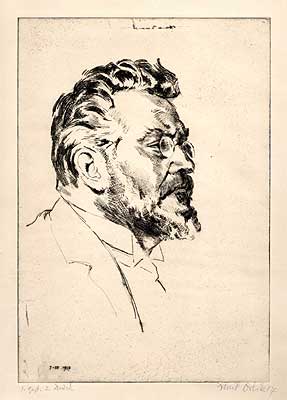
Why Max Slevogt matters
Max Slevogt is grouped with Max Liebermann and Lovis Corinth as one of the three central figures of German Impressionism, a painter, printmaker, and illustrator whose work sits in major German state collections and in institutions such as the National Gallery of Art in Washington. For a collector, he represents a well documented but comparatively thin market: broad institutional respect and a long auction history, set against a modest confirmed price ceiling and the absence of a published catalogue raisonne.
- Born
- 1868-10-08, Landshut, Kingdom of Bavaria, Germany
- Nationality
- German
- Media
- Painting, Printmaking, Illustration
- Movement
- German Impressionism, Munich Secession, Berlin Secession
- Education
- Akademie der Bildenden Künste, Munich, 1885 to 1889; Académie Julian, Paris, one term in 1889. No formal degree or diploma is documented from either institution.
- Signature motifs
- Egyptian light studies, Opera and theater portraiture, Book illustration
By the numbers
- EUR 721,500Auction highChristie's, 2015 (exact work title and sale city not publicly confirmed)
- 398+Lifetime auction appearancesLotSearch archive, cumulative lots recorded
- German ImpressionismMovementWith Max Liebermann and Lovis Corinth
Biography
Max Slevogt was born on 8 October 1868 in Landshut, in the Kingdom of Bavaria. After his father's death the family moved to Würzburg, where he completed his schooling. He studied painting at the Akademie der Bildenden Künste in Munich from 1885 to 1889, under teachers including Gabriel von Hackl, Karl Raupp, Ludwig Herterich, and Wilhelm von Diez, and spent a term at the Académie Julian in Paris in 1889. No source documents a formal degree from either school.
In 1893 he was a founding member of the Munich Secession and showed his painting Wrestling School at its first exhibition. In 1900 he represented German painting at the Exposition Universelle in Paris with a large canvas. He moved to Berlin in 1901, where he became a leading member of the Berlin Secession and worked chiefly as a portrait painter, including well known depictions of the singer Francisco d'Andrade; in 1912 the Nationalgalerie in Berlin acquired one of these portraits, an early institutional endorsement. He was appointed to the Prussian Academy of Arts in Berlin in 1914 and became head of a master studio there in 1917. A trip to Egypt produced a celebrated series of light studies later known as the Apotheosis of Light, most of which are today held by the Staatliche Kunstsammlungen Dresden. In 1928 he took part in the art competitions held alongside the Amsterdam Olympic Games. Slevogt died on 20 September 1932 at his estate, Neukastel, near Leinsweiler in the Rheinpfalz, of heart disease, and is buried near his home, the Slevogthof.
Critical reception
Slevogt is consistently discussed alongside Max Liebermann and Lovis Corinth as one of the three defining figures of German Impressionism. The Nationalgalerie's 1912 acquisition of his portrait of Francisco d'Andrade is treated in the literature as an early marker of institutional acceptance. More recent scholarly attention has focused on his 1914 Egypt journey, examined in the Albertinum's 2014 to 2015 exhibition To Egypt! The Travels of Max Slevogt and Paul Klee, and on the Museum der bildenden Künste Leipzig's 2020 reconstruction of the early Liebermann, Slevogt, and Corinth exhibitions the museum staged between 1903 and 1911. No verbatim critical assessment from a named critic in a major contemporary outlet could be confirmed for this profile; available sources are limited to museum, reference, and market-database summaries.
Market
Slevogt's auction market is large in volume but modest at its ceiling. His confirmed auction record is EUR 721,500 (about USD 809,035) for a painting sold at Christie's on 9 June 2015; the exact title and sale city are not confirmed in publicly accessible sources, and available market databases show no later sale exceeding that figure through mid-2026. LotSearch's archive records 398 auction lots for the artist, most sold in Germany, indicating a steady but not high-value secondary market; individual sale prices vary widely and, in the vast majority of cases, sit well below the 2015 record. No gallery or foundation currently identifies itself as the formal representative of the Slevogt estate; his work is traded mainly through German and international auction houses and through dealers who periodically offer individual pieces.
Top auction results
| Work | Price | Sale |
|---|---|---|
| Painting sold at Christie's, 2015 (exact title not publicly confirmed) (2015) | USD 809,035 (EUR 721,500) | Christie's, 2015-06-09 |
Selected exhibitions
| Years | Exhibition | Venues |
|---|---|---|
| 1893 | First Munich Secession Exhibition | Munich Secession, Munich |
| 1900 | Exposition Universelle | Paris |
| 1928 | Art Competitions, IX Olympiad | Amsterdam |
| 2014 to 2015 | To Egypt! The Travels of Max Slevogt and Paul Klee | Albertinum, Staatliche Kunstsammlungen Dresden |
| 2020 | Impressionismus in Leipzig 1900 to 1914: Liebermann, Slevogt, Corinth (Part 2: Slevogt) | Museum der bildenden Künste, Leipzig |
| 2025 to 2026 | Avantgarde: Max Liebermann und Impressionismus in Deutschland | Museum Barberini, Potsdam (works on loan from Landesmuseum Mainz) |
Museum collections
- Staatliche Kunstsammlungen Dresden, Albertinum
- Landesmuseum Mainz
- Nationalgalerie, Staatliche Museen zu Berlin
- National Gallery of Art, Washington, D.C.
- Max Slevogt-Galerie, Schloss Villa Ludwigshöhe, Edenkoben
Awards and honors
- Founding member, Munich Secession (1893)
- Leading member, Berlin Secession (1901)
- Appointed to the Prussian Academy of Arts, Berlin (1914)
- Head of a master studio, Prussian Academy of Arts, Berlin (1917)
Authentication and provenance
No catalogue raisonne.
No published catalogue raisonne has been confirmed for Slevogt in current research. Authentication in practice relies on museum provenance records, historical exhibition documentation, and auction house specialist review; institutions such as the Staatliche Kunstsammlungen Dresden and Landesmuseum Mainz hold documented core groups of his work.
Primary reference: https://sammlung.staedelmuseum.de/en/person/slevogt-max
What collectors should know
No published catalogue raisonne for Slevogt has been confirmed, so provenance research and specialist review carry more weight in authentication than they would for an artist with a settled scholarly catalogue. His single confirmed auction record, from 2015, is a useful benchmark but should be read alongside a long tail of far lower recent results, meaning outcomes for any individual work can vary widely depending on subject, medium, and period. Because no gallery or estate currently claims formal representation, buyers should expect to transact primarily through established auction houses and rely on museum and auction-house documentation rather than a single certifying authority.
Further reading and resources
Data current as of 2026-07-10.

