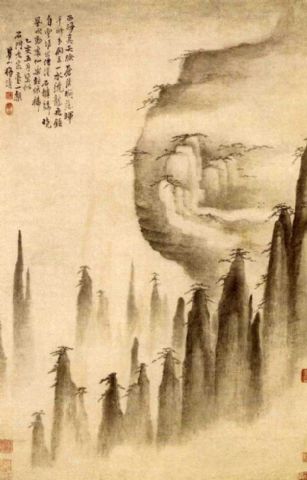
Why Mei Qing matters
Mei Qing is counted among the three great masters of the Anhui, or Huangshan, school of early Qing dynasty landscape painting, alongside Hongren and Shitao. He is significant for helping establish "real scene" landscape painting, an approach that grounded classical brush technique in the observed forms of an actual place, in his case the peaks of Mount Huang. His works are held in museum collections, including the Metropolitan Museum of Art, and he remains a documented, historically confirmed name in the classical Chinese painting market.
- Nationality
- Chinese
- Media
- Ink painting, Landscape painting, Calligraphy
- Movement
- Qing dynasty painting, Anhui (Huangshan) school
- Education
- Classical literati education; prefectural-level scholar (zhusheng), circa 1639; juren (provincial examination) degree, 1654
- Signature motifs
- Mount Huang (Huangshan) landscapes, Ink monochrome album leaves
By the numbers
- 1623 to 1697Active periodQing dynasty, Anhui (Huangshan) school
- Metropolitan Museum of ArtMuseum collectionsMultiple works in the permanent collection; other institutional holdings not independently verified in current research
- Anhui (Huangshan) schoolSchoolGrouped with Hongren and Shitao as the school's three great masters
- None publishedCatalogue raisonneAttribution relies on museum scholarship and seals
Selected works
Click any work to view it full screen.
Biography
Mei Qing was born around 1623 into a prominent, well-educated family in Xuancheng, Anhui Province, roughly seventy-five miles south of Nanjing. He followed the family's scholarly tradition, becoming a prefectural-level student, or zhusheng, by about age sixteen, and published his first collection of poems in 1642. In 1654 he obtained the juren degree through the provincial examinations, and sources describe him receiving the honorific local titles Xuancheng Landscape Painter and Xuancheng Filial Piety Lian in connection with that success.
He worked as a painter, calligrapher, and poet through the second half of the seventeenth century, becoming closely associated with Mount Huang and with the circle of literati and monk painters, including Hongren and Shitao, now grouped as the great masters of the Huangshan school. Museum records point to a particularly prolific period of album painting between about 1690 and 1695. He died in 1697; no source located in current research gives an exact death date or place, only the year.
Critical reception
Standard art-historical references consistently place Mei Qing among the leading landscape painters of the early Qing dynasty and credit him, together with Hongren and Shitao, with defining the Anhui school's engagement with Mount Huang as both subject and symbol. Museum scholarship, including that of the Metropolitan Museum of Art, describes his work in terms of light ink, fresh, unconventional composition, and a poetic integration of image and inscription. No verbatim, attributed quotation from a named critic in a major outlet could be located and confirmed in current research, so none is reproduced here.
Market
Mei Qing's paintings and calligraphy circulate today primarily through major auction houses handling classical Chinese painting, rather than through any contemporary gallery or estate representation, which does not exist for a seventeenth-century artist. Christie's has offered attributed hanging scrolls bearing his name and seals, including a 1695 work carried with an estimate in the range of HK$2,500,000 to HK$3,500,000 (roughly US$330,000 to US$450,000). No confirmed hammer price, currency, sale date, or buyer for that or any other lot could be verified in current research, so no all-time auction record is published here. Collectors should treat any figure circulating for Mei Qing's market with caution until it can be traced to a specific, dated sale result.
Museum collections
- Metropolitan Museum of Art, New York
Awards and honors
- Juren (provincial examination) degree (1654)
- Honorific title, Xuancheng Landscape Painter (1654)
- Honorific title, Xuancheng Filial Piety Lian (1654)
Authentication and provenance
No catalogue raisonne.
No published catalogue raisonne or certificate-of-authenticity program exists. A scholarly dissertation on his paintings has been produced, but attribution and authentication rely on museum scholarship, seals, inscriptions, and provenance research typical of classical Chinese painting connoisseurship.
Primary reference: https://www.metmuseum.org/art/collection/search/36453
What collectors should know
Because Mei Qing worked more than three centuries ago, the authentication questions that matter most are the ones long established for classical Chinese painting: seals, inscriptions, provenance, and comparison against securely attributed museum holdings, rather than a modern catalogue raisonne or certificate-of-authenticity program, neither of which exists for him. Museum holdings such as those at the Metropolitan Museum of Art provide the strongest comparative reference points for attribution, alongside the broader body of published scholarship on classical Chinese painting connoisseurship. Public auction data for his work is thin and not fully verifiable from current sources, so collectors should rely on documented sale results, confirmed lot by lot, rather than on any unverified market claim.
Further reading and resources
Data current as of 2026-07-16.

